Digital terrestrial radio has woven itself into millions of listeners’ daily lives without many audio professionals knowing how it actually works. Yet broadcasting in DAB+ is nothing like modulating an FM carrier. You are no longer dealing with one station per frequency, but with a bundle of programmes sharing a single channel — encoded, multiplexed and carried by a robust radio technique. Here, without needless jargon, is how it all fits together, and what it changes for anyone producing sound bound for air.
DAB, DAB+: what are we talking about?
DAB (Digital Audio Broadcasting) is the European standard for digital terrestrial radio. Its original version, launched in the 1990s, encoded audio in MPEG-1 Audio Layer II (the old “MP2”), which is hungry for bitrate. DAB+, which came later, swaps that codec for HE-AAC v2, far more efficient: at equal quality it uses two to three times less bitrate. The upshot is that more stations fit into the same channel. Today the vast majority of deployments are DAB+, and that is the term printed on receivers.
The multiplex: the real difference from FM
On FM, a station occupies a frequency all to itself. On DAB+, it is the reverse: a multiplex (also called an “ensemble”) groups several programmes into one channel of VHF Band III (around 174-240 MHz). Each audio stream is first encoded in HE-AAC, then the streams are assembled into the multiplex with their associated data. The channel’s total capacity is then shared between the programmes.
This introduces a player FM never had: the multiplex operator, who manages capacity and allocates it to broadcasters. A radio publisher no longer “owns” a frequency; it rents a slice of bitrate in an ensemble. That is as much a change of business model as of technology.
- Ensemble / multiplex: the shared physical channel.
- Service: a radio programme within the ensemble.
- Component: a service’s audio stream, plus its data (text, images).
COFDM and the single-frequency network
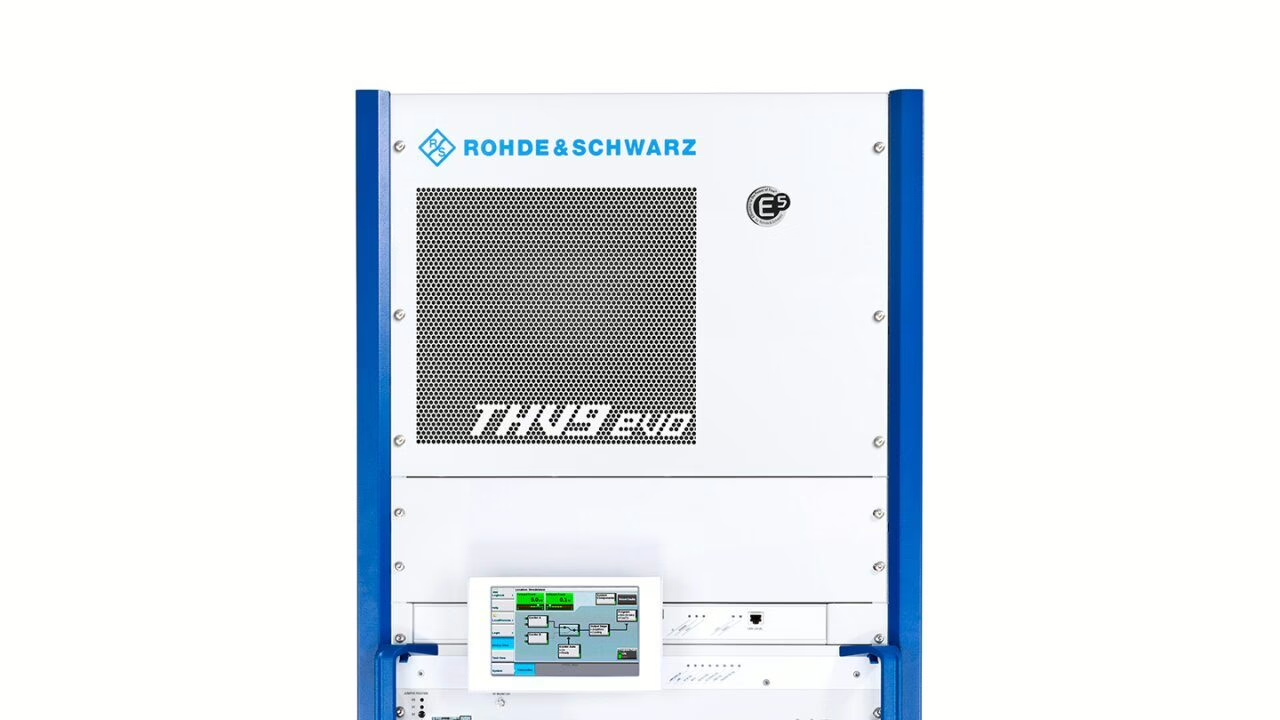
To carry that multiplex, DAB+ relies on COFDM (coded OFDM) modulation: the signal is spread across a large number of carriers, which makes it remarkably resistant to multipath — those signal echoes that, on FM, cause hiss and dropouts in a car. That is why DAB+ reception on the move is generally cleaner, as long as you stay inside the coverage area.
Another major consequence: DAB+ allows single-frequency networks (SFN). Several transmitters can broadcast the same multiplex on the same frequency without interfering, because the modulation tolerates echoes. Where FM forces you to retune as you drive from one region to another, a well-designed DAB+ network lets the listener tune once and forget it.
Bitrate, quality and the constant trade-off
Because the multiplex capacity is shared, each station gets a bitrate (in kbit/s) that governs its sound quality. A demanding music programme needs a higher bitrate than a speech station. The operator and broadcasters are forever arbitrating: the more bitrate you give one station, the better it sounds, but the less room remains for the others. That is the heart of the DAB+ fight, and the reason some stations sound more “squashed” than others.
This trade-off echoes a well-known issue in online delivery: we cover it from another angle in our guide to streaming an internet radio station, where codec and bitrate choices follow the same logic.
Data: much more than sound
A DAB+ multiplex carries more than audio. Each service can embed DLS (scrolling text: now-playing title, show name), a slideshow (images: artwork, logo, station visuals) and service information such as the station name and genre. On the listener side this feeds the receiver’s screen; on the production side it means driving that metadata from the studio, often through the automated playout system. It is a point that overlaps with radio automation, which orchestrates playout and imaging.
What DAB+ changes back at the studio
For a studio, moving to digital air does not revolutionise the audio chain, but it shifts a few reference points. First, on-air processing: the broadcast processor stays essential, but its settings differ from FM — no pre-emphasis, no stereo MPX pilot, dynamics to handle differently. We detail this stage in our article on broadcast audio processing. Some recent processors, like the one shown by Telos Alliance with the Omnia XII, handle FM, HD and DAB in one box.
Next, loudness: digital radio is a chance to rethink level consistency between stations and between programmes. The LUFS, EBU R128 and true-peak reference points we explain in our guide to broadcast loudness apply fully. Finally, getting streams to the multiplex encoder increasingly runs over standard networks: a detour through our explainer on audio over IP sheds light on that link.
DAB+ versus FM: the match in brief
| Criterion | FM | DAB+ |
|---|---|---|
| Channel use | One station per frequency | One multiplex, several stations |
| Audio codec | Analogue (frequency modulation) | HE-AAC v2, variable bitrate |
| Reception on the move | Hiss, dropouts, multipath | Robust while covered, then a clean cut-off |
| Retuning | Needed from region to region | Single-frequency network possible |
| Associated data | RDS (limited text) | Text, images, EPG |
Note: digital robustness has a flip side. On FM, as the signal weakens the sound degrades gradually; on DAB+ it stays clean up to a threshold, then cuts out sharply (the “cliff” effect). Coverage therefore has to be planned carefully.
What about hybrid radio?
The final stage of the rocket is hybrid radio, which marries over-the-air broadcast and IP. Thanks to technologies like RadioDNS, a receiver can complement the DAB+ stream with data from the internet — richer visuals, a switch to the online stream outside coverage, analytics. The line between terrestrial broadcast and streaming is blurring, and that is probably where the future of listening is being decided.
My take
DAB+ fixed radio’s real in-car flaw — those FM dropouts that ruin a drive — and finally brings a useful screen to the receiver. The shared-multiplex model, though, cuts both ways: it democratises access to air, but turns sound quality into a budget variable, and some stations pay for it audibly. For a studio, the move to digital is mostly a chance to tidy up on-air processing and loudness. The exciting part is not DAB+ alone, but its marriage with IP: hybrid radio is what sketches the next chapter.