For decades, moving audio channels from one point to another meant pulling copper: one pair per signal, a multicore for a stage, meters of cable and connectors by the dozen. Digital first densified that transport with links like MADI, and then the whole industry converged on the same idea IT had reached long ago: run all of it over a plain Ethernet network. That’s audio over IP. Behind the term sit several technologies whose names keep coming up — Dante, AES67, Ravenna, SMPTE ST 2110 — and which are easily confused. This guide puts each building block back in its place.
What exactly is audio over IP?
Audio over IP means carrying digital audio channels, typically uncompressed and studio-grade, inside packets that travel across a standard Ethernet network — exactly the way your computer traffic does. A single network cable can then carry dozens, even hundreds, of channels in both directions. The upsides are substantial: radically simpler cabling, distances measured in hundreds of meters over fiber, fully software-based routing (any input to any output, no re-patching), and the ability to build full redundancy by doubling up the network.
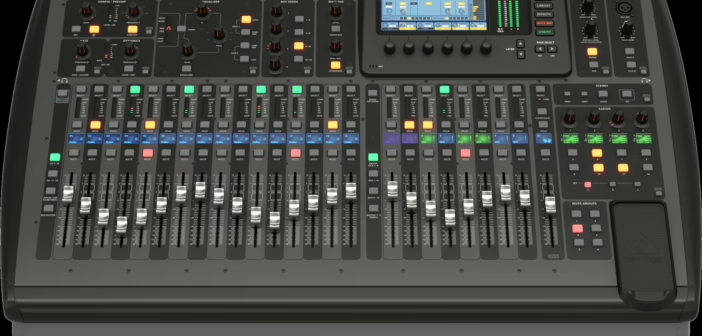
This logic is a natural extension of what digital consoles already do internally. If the idea of routing and buses is familiar to you, audio over IP is simply that same concept scaled up to an entire building: the patch stops being a physical panel and becomes a virtual matrix you reconfigure with a click.
Dante, AES67, ST 2110: who does what
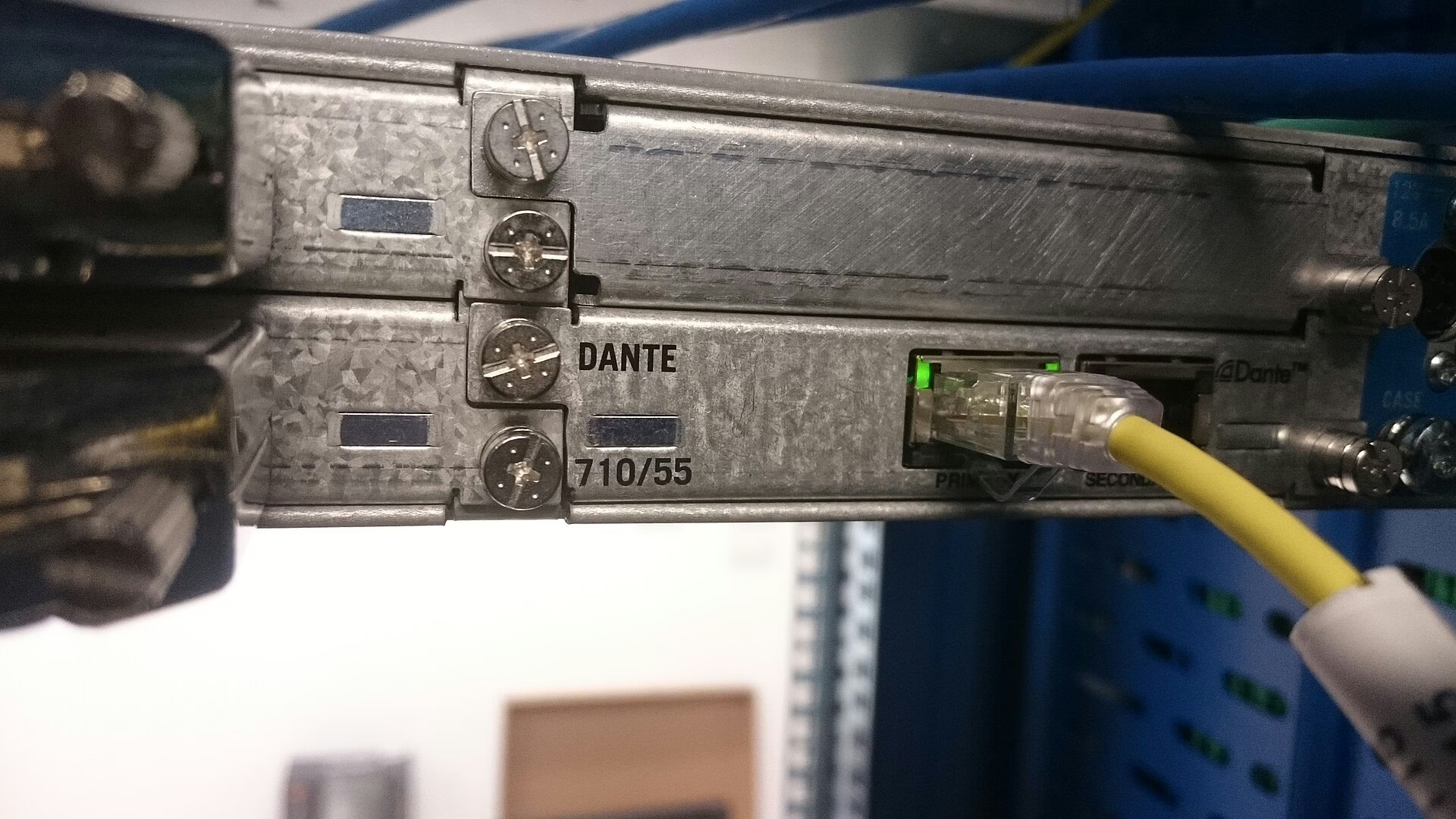
The first source of confusion is that these names don’t refer to the same category of thing. Dante, developed by Audinate, is a complete proprietary solution: transport protocol, automatic device discovery and routing software (Dante Controller). It’s the most widespread technology today, precisely because it works “plug-and-play”: connect, devices see each other, you route. Its dominance in live sound and installation is overwhelming.
AES67, by contrast, isn’t a product but an interoperability standard published by the Audio Engineering Society. Its job isn’t to replace Dante or Ravenna, but to give them common ground: a set of shared rules (synchronization, packet format, addressing) that let equipment from different brands and ecosystems exchange audio streams. Dante, Ravenna and Livewire+ can all speak AES67: it’s the industry’s lingua franca.
SMPTE ST 2110 comes from the world of professional video and TV broadcast. It’s a suite of standards that carries the “essences” of a program separately over the same IP network: video, audio and ancillary data, each in its own stream. The audio part of ST 2110 (the ST 2110-30 document) builds directly on AES67 — in other words, TV broadcast built its audio standard on the foundations laid by pro audio. Ravenna, finally, is an open technology widely used in radio and broadcast (you’ll find it at makers such as Lawo and DHD), and it too is AES67-compatible.
| Standard | Nature | Home turf | AES67-compatible |
|---|---|---|---|
| Dante | Complete proprietary solution | Live, install, studio | Yes (AES67 mode) |
| AES67 | Interoperability standard | Bridge between ecosystems | By definition |
| Ravenna | Open technology | Radio, broadcast | Yes |
| SMPTE ST 2110 | Broadcast standards suite | Television, video production | Yes (audio via ST 2110-30) |
The technical foundations that really matter
Beneath these commercial names, two technical concepts govern everything. The first is clock synchronization. For audio streams arriving from everywhere to stay perfectly aligned, every device must share a single time reference, distributed across the network by the PTP protocol (Precision Time Protocol, the IEEE 1588 standard). One device acts as the “grandmaster” clock and all the others slave to it. Get the clock wrong and the network starts spitting clicks and dropouts: it’s the first thing to check when an IP system misbehaves.
The second concept is multicast. Rather than sending a copy of the stream to each recipient, a source transmits once and the network delivers it to those who subscribe. It’s tremendously efficient, but it requires managed network switches able to police that traffic (through IGMP snooping) and to prioritize audio with a quality-of-service policy. This is the single most important point for an engineer getting started: an audio-over-IP network is not an office network. You don’t plug critical streams into whatever switch you find.
What you need to deploy
- Managed switches, properly configured (IGMP snooping, QoS), and crucially with energy-efficiency (EEE) disabled — the sworn enemy of PTP.
- A clear synchronization plan: one designated grandmaster clock, one backup.
- An addressing scheme and, often, a dedicated VLAN to isolate audio from the rest of the traffic.
- For critical use, redundancy across two physically separate networks (the ST 2022-7 principle, which sends two copies and switches over seamlessly).
Why broadcast switches over first
Radio and television are on the front line of this transition, and for good reason. A broadcast facility means dozens of studios, control rooms and capture points to interconnect, with an absolute reliability requirement and a constant need for redundancy. IP answers that better than any fixed cabling ever could. The example of the Concert de Paris and Radio France’s fully redundant all-IP backbone illustrates it perfectly: a doubled network, software routing, and the ability to reconfigure an entire system without touching a single cable. Add the loudness normalization demands specific to broadcast, and it’s clear why this sector drove adoption.
Audio-video convergence accelerates things further: once a console treats audio and video together, carrying both over the same IP infrastructure becomes the logical next step.
Should you make the move?
For stage and studio, the answer depends on scale. On a small setup, an IP network can be needless complexity, and a good old point-to-point digital link is more than enough. But the moment you’re routing lots of channels between several machines, rooms or control rooms, audio over IP quickly becomes unbeatable — one of the reasons it increasingly tips the balance in the analog-versus-digital debate.
My advice, after seeing control rooms of every size: never underestimate the network side. The sound quality of audio over IP is beyond reproach — you’re moving untouched samples, there’s no “cable color” to argue about here. The real subject is discipline: a clean PTP clock, switches that are up to the job, a tidy addressing scheme. A well-designed IP system is uncannily reliable; a sloppy one will drop out at the worst possible moment. Invest the time in the network, not just in the marquee gear that plugs into it.
Keep the essentials in mind: Dante for turnkey simplicity, AES67 as the common language that guarantees interoperability, ST 2110 when video enters the equation, Ravenna in the radio world. These worlds don’t exclude one another — they nest, and it’s precisely AES67 that acts as the glue. Understanding this architecture is what lets you pick the right building block for the right job, rather than being at the mercy of marketing vocabulary that muddies concepts which are, at heart, quite logical.