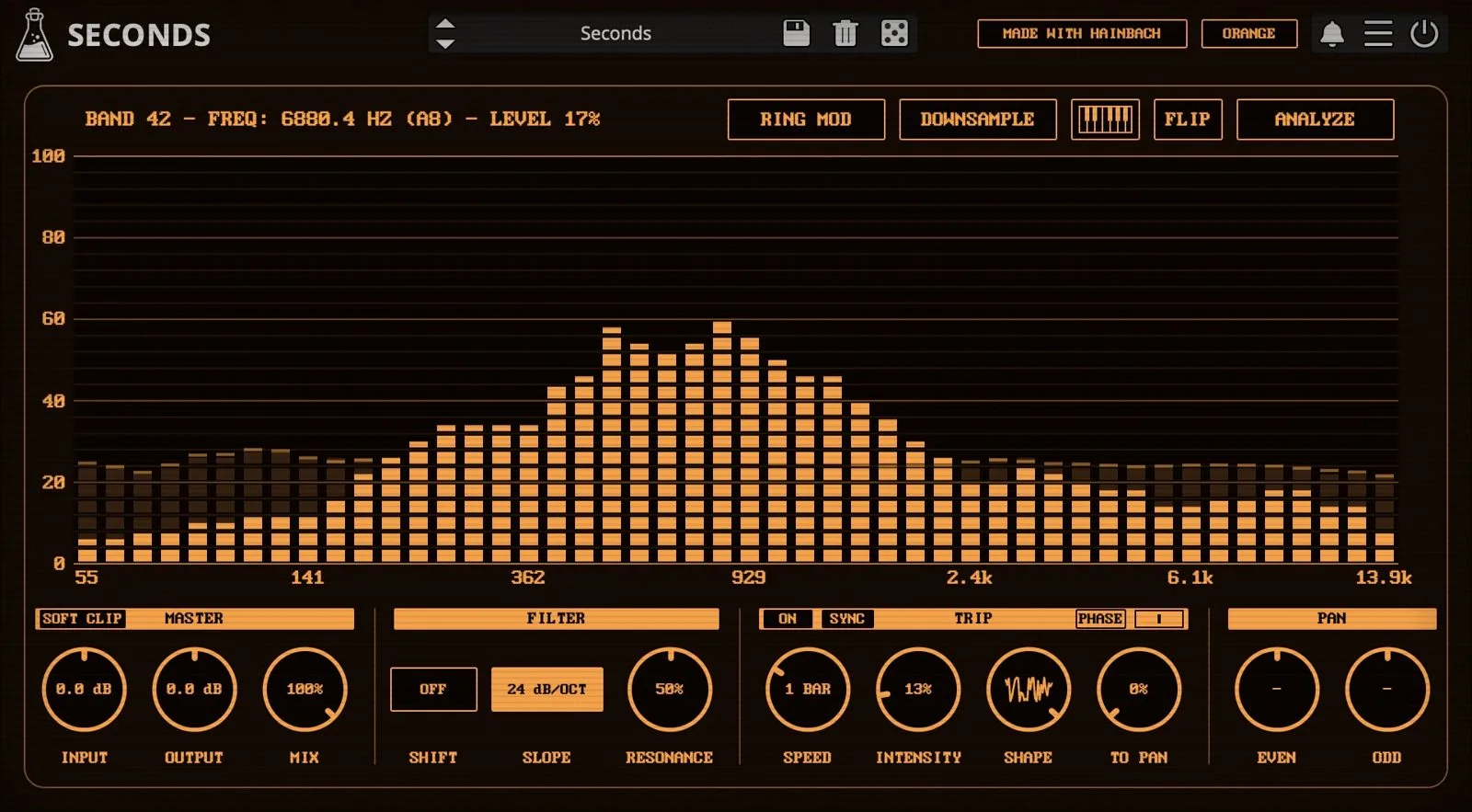
AudioThing continues its line of tools drawn from old measurement gear and releases Seconds, a spectral sound-design effect made with Berlin-based musician Hainbach. At its core, a bank of 48 modelled bandpass filters reshapes any signal, from subtle correction to the most abstract noise work.
A bank of 48 bandpass filters
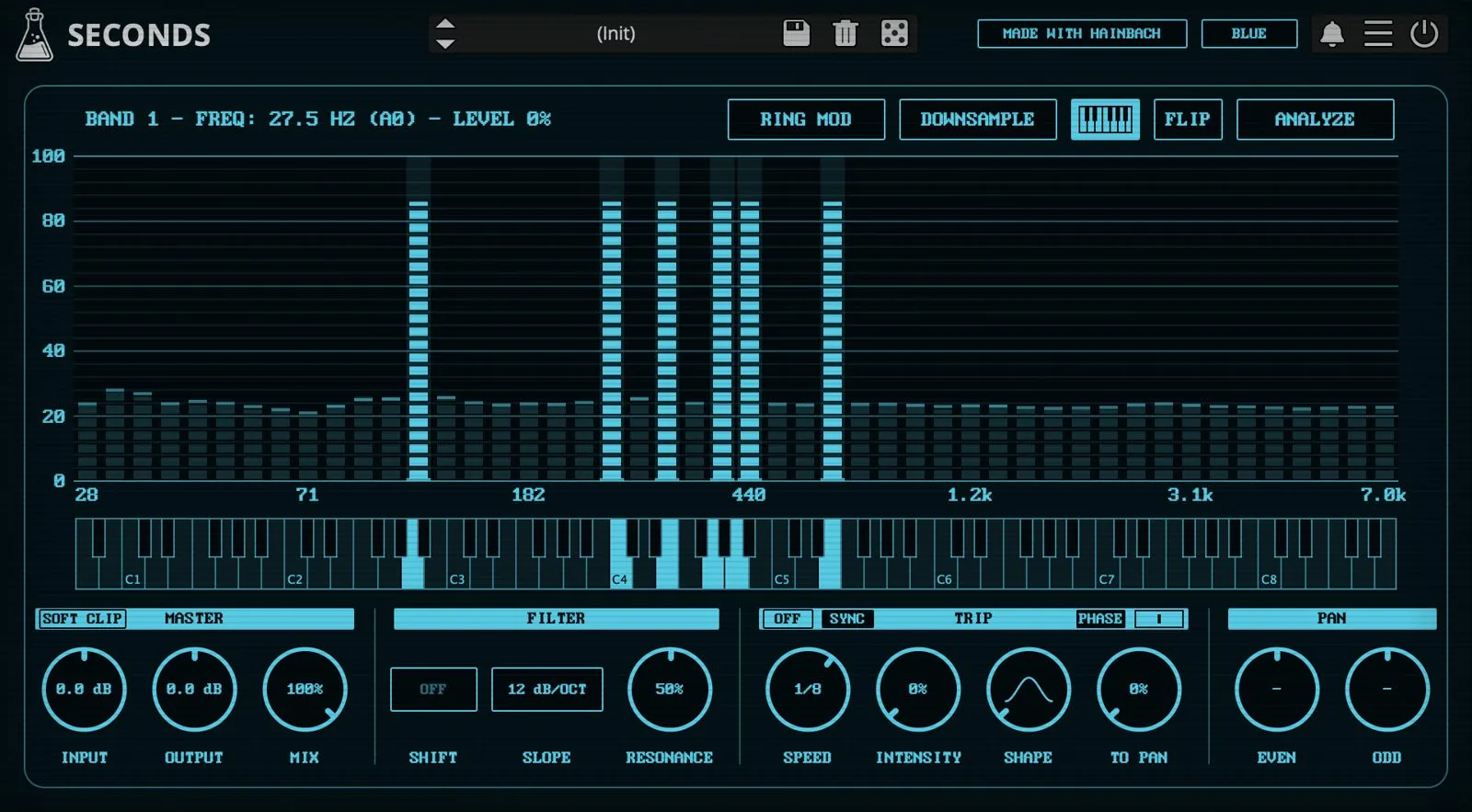
The 48 bands sit a whole tone apart, each with its own resonance control and a choice of 12 or 24 dB per octave slope. You open and close bands to carve the spectrum, a little like a fixed-filter vocoder, but at a far finer resolution. The kinship with the brand’s Dials and Materia plugins is clear: the AudioThing family has been exploring these lab-derived filter banks for years.
Play the spectrum, freeze it, transfer it
Seconds does more than filter. The 48 filters can be played over MIDI or sequenced, and the plugin can freeze a spectrum and transfer it from one sound to another. In other words, you capture the spectral fingerprint of a source and apply it to a different one, a form of resonant filtering that recalls the band-analysis processing of research studios. For anyone working on vocals or textures, that ability opens ground a standard EQ cannot reach.
Ring modulation, odd/even panning and saturation
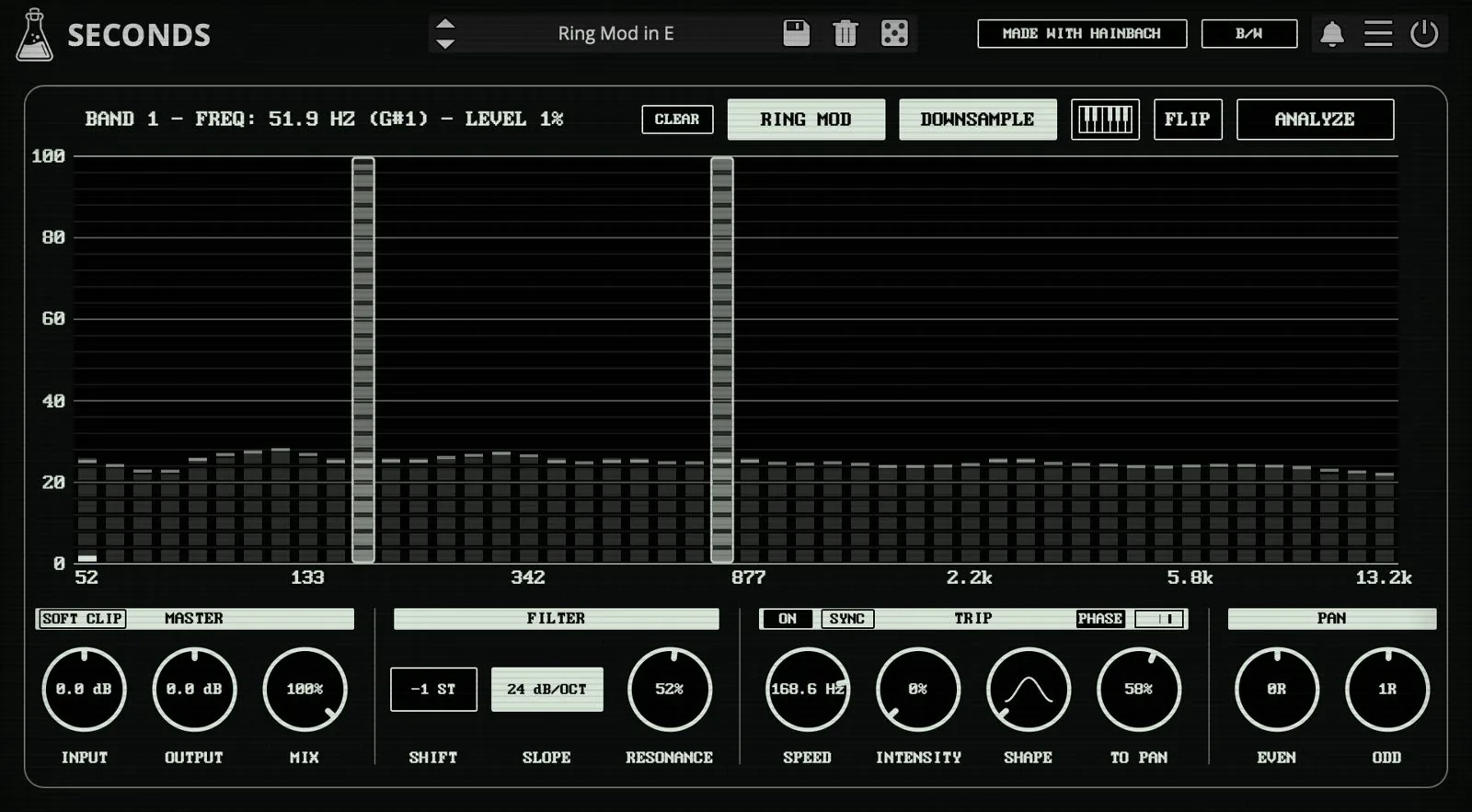
Each band can take ring modulation, enough to shift perceived pitch and pull the sound toward the metallic. Odd and even bands spread separately across the stereo image, with volume and pan modulation that sets the spectrum moving. At the input, a high-gain stage adds saturation, and a sample-rate reduction option dirties the signal when you want it. On that last point, aliasing comes into play, a phenomenon we covered in our article on oversampling and aliasing.
Roots in the Sekundenfilterbank
Seconds draws on a specific device: the Sekundenfilterbank, a digital 48-band filter bank developed with Sennheiser in the late 1980s and early 1990s at the SWR experimental studio in Freiburg. The plugin’s frequency display, in turn, borrows from the Brüel & Kjær 2131 analyzer. Hainbach fed the project two books from his library, a history of the SWR studio and a Brüel & Kjær catalogue, and it was his push for ring modulation that took the filter bank beyond gentle shaping.
Formats, activation and availability
Seconds runs on macOS, Windows and Linux, in VST2, VST3, AU, AAX and CLAP formats. Activation needs neither iLok nor an internet connection, and one license covers up to three computers. A free demo lets you try it before buying. Version 1.0 was released on 12 November 2026.
My take
A 48-band filter bank you can play over MIDI, with ring modulation and spectral transfer, is a fine way off the path of clean EQ. Seconds clearly aims at sound design and texture, not transparent mixing, and the lineage from a 1990s lab instrument gives it a colour few plugins offer. Fans of treated vocals, moving pads and electro-acoustic noise will find a tool with character. Others will pass, and that is a fair call.