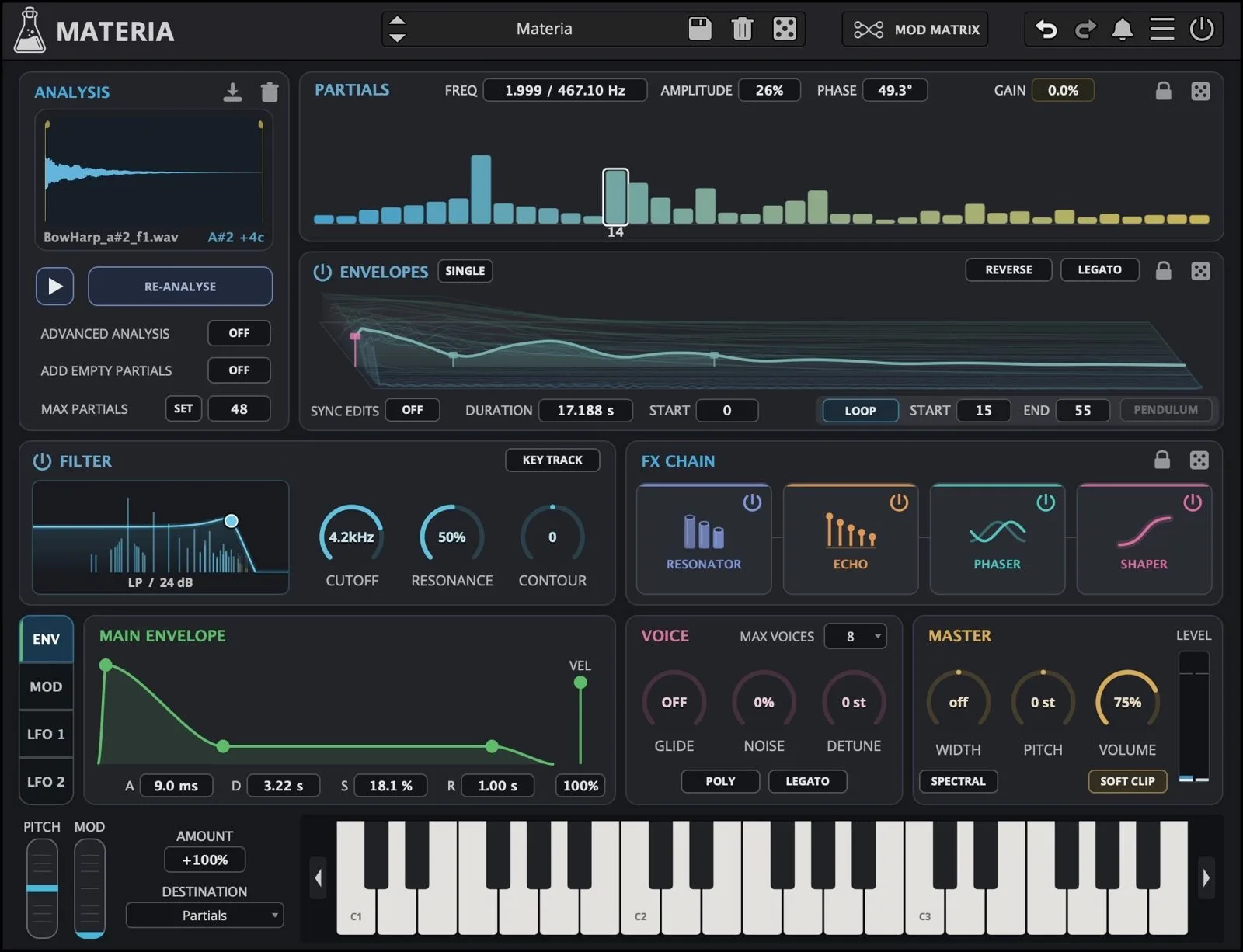
With Materia, Dublin-based AudioThing takes on a corner of sound design that few plugins tackle head-on: additive resynthesis. The idea is simple to state. Load a sample, let Materia analyse it into a stack of harmonic partials, then play that sound back as an instrument at any pitch, with every component open to rewriting. This is not a sample player: once the sound is pulled apart, it is the structure itself you reshape.
From sample to partials: how Materia works
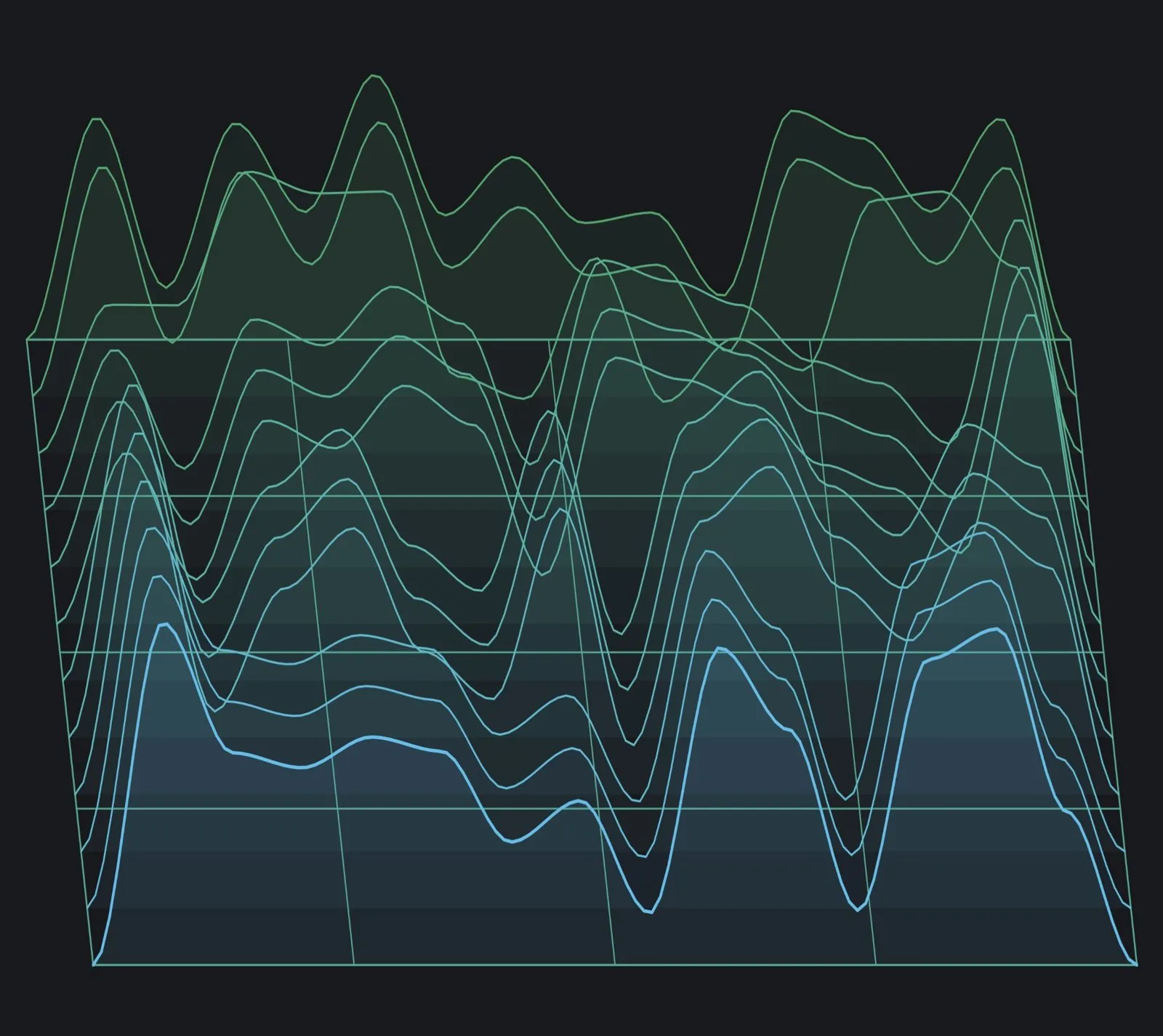
Drop a sound into Materia and the engine breaks it into partials, each with its own frequency, amplitude, phase and envelope. It is additive synthesis run in reverse: instead of stacking sine waves to build a timbre, you start from an existing sound and extract its building blocks. You do not even have to begin from a sample — start from an empty spectrum and draw partials by hand to build a timbre from scratch.
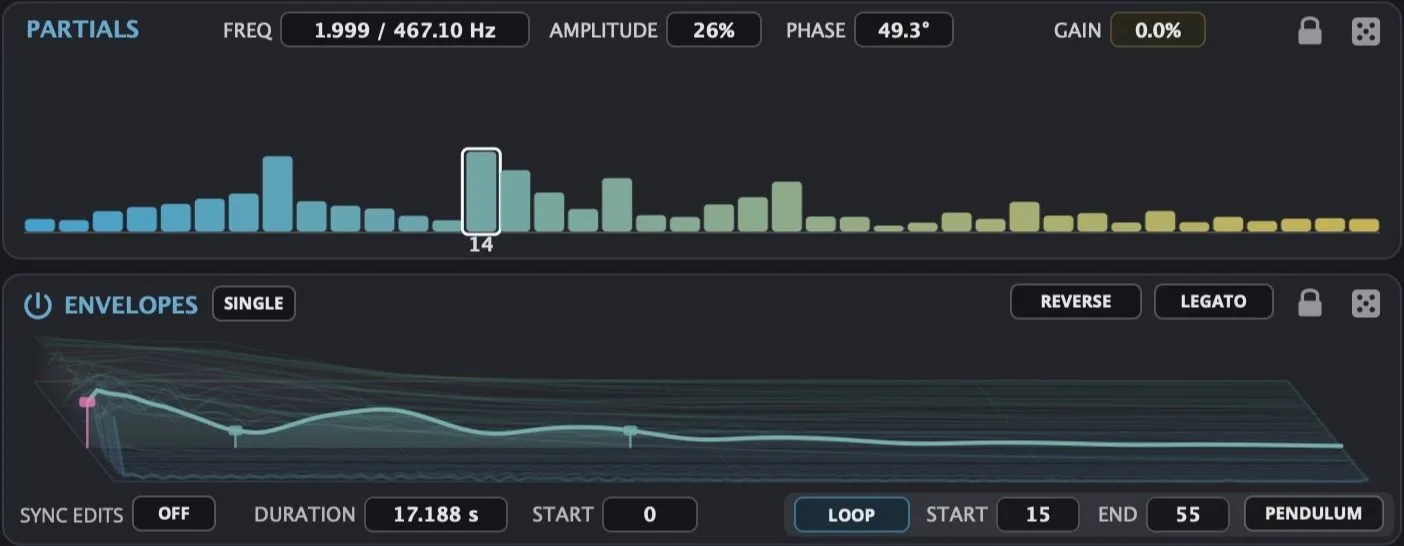
The detailed work happens on the envelopes. Each partial carries a 128-point envelope with adjustable duration and sustain loop points, so a single harmonic can evolve over time independently of the rest. Advanced Analysis gives every partial its own envelope and loop, while Sync Partial Edits applies the same timing across the board when you want one global gesture. A practical touch: the analysed model is saved with the plugin state, so projects and presets reopen without needing the original audio file.
What Materia actually gives you
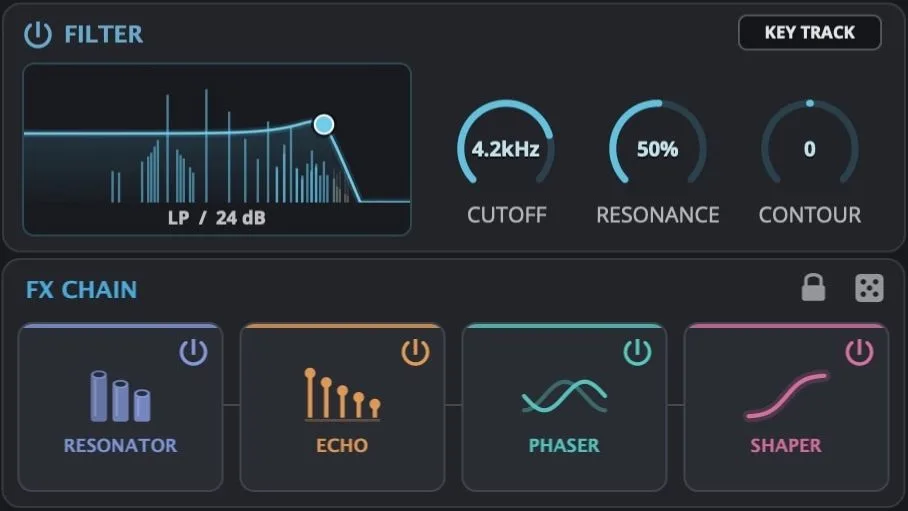
At the heart of the engine sit 96 partials, each with adjustable frequency ratio, amplitude and phase, plus overall balance controls to tilt the harmonic spread without redoing everything by hand. A multimode filter (low-pass, high-pass, band-pass, notch and formant) shapes the output, followed by four effects that give Materia its character:
- a resonator that models materials — pipes, plates, glass, wood, stone, gongs, membranes, springs;
- a tap echo for rhythmic repeats;
- a multi-stage phaser;
- a waveshaper to add grit and body.
Modulation comes from two envelopes and two LFOs with fully drawable waveforms. A preset browser with a randomizer, interface brightness and contrast controls, and a resizable window round things off. Nothing over-engineered on paper, but the whole thing is built to keep exploration fast: load a sound, hear what the analysis makes of it, and take it from there.
Price, formats and availability
| Item | Detail |
|---|---|
| Version | 1.0 (October 2026) |
| Price | $39 intro (regular $69) |
| Formats | VST2, VST3, AU, AAX, CLAP (64-bit) |
| Platforms | macOS (Universal 2), Windows, Linux |
| Licence | up to 3 machines, no iLok, offline activation |
A free demo is available (three seconds of silence every 45 seconds, saving disabled), which is plenty to decide whether the concept clicks for you. Minimum requirements stay light: a 2 GHz CPU and 4 GB of RAM.
Where Materia fits
Additive resynthesis is not new, but it stays rare in a format this direct and this affordable. Materia lands in a season when tools that “replay” sound are branching out in different directions: Imaginando Colapso comes at additive from a more conceptual angle, while Baby Audio HyperWarp starts from the granular grain. Materia bets on clarity instead: a spectrum, some envelopes, four well-chosen effects. For sound design, evolving pads or turning a field recording into a playable instrument, it is exactly the kind of tool that invites you to spend an afternoon loading anything and everything just to hear what comes out. The product page is on the AudioThing site.
My take
Materia nails the thing that matters: it makes additive resynthesis approachable without watering it down. Breaking a sound into 96 editable partials, then drawing independent envelopes for them, is the sort of power that turns a throwaway noise into a living timbre — and the materials resonator adds just enough character that the result never sounds like a lab demo. At $39, with a demo to check the idea lands for you, there is little reason not to try it. The real test is how much time you spend exploring rather than tweaking; on that score, Materia looks to have aimed right.