Listener call-ins are a pillar of live radio. To the ear, nothing could be more ordinary. In the control room, it’s a small technical challenge: mishandled, the call turns to echo, to feedback, or leaves a caller hearing themselves half a beat late. Two pieces sort all of this out: the telephone hybrid and the mix-minus. Understand their roles and you’ll avoid most on-air mishaps.
The problem: one line, two directions
On a standard phone line, the voice you send and the voice you receive travel on the same pair of wires, mixed together. To put the listener on air, though, you have to isolate their voice (what you broadcast) from what you send back to their ear (the return). Separating those two directions sharing a single line is exactly the hybrid’s job.
The hybrid: separating send and return
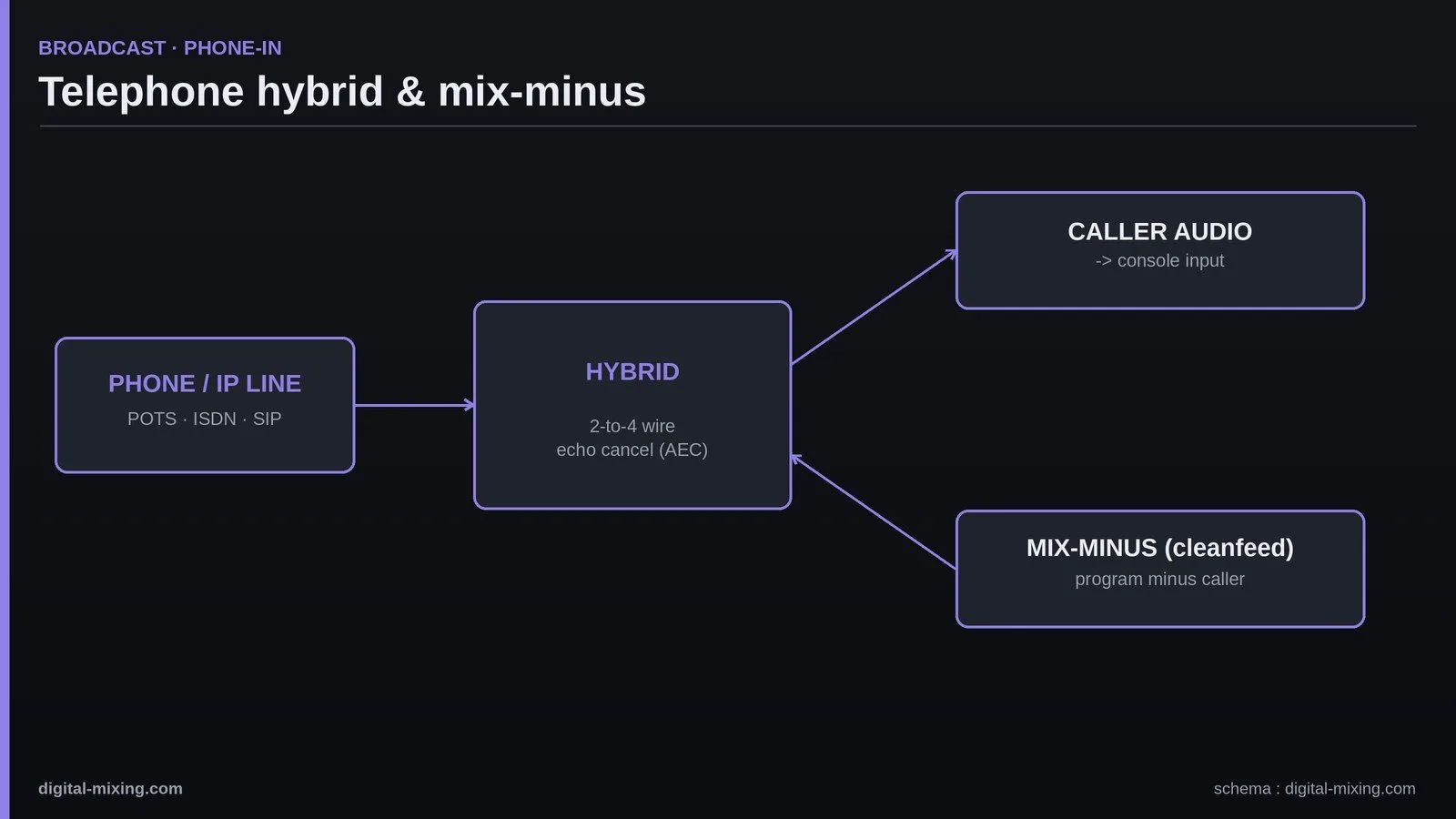
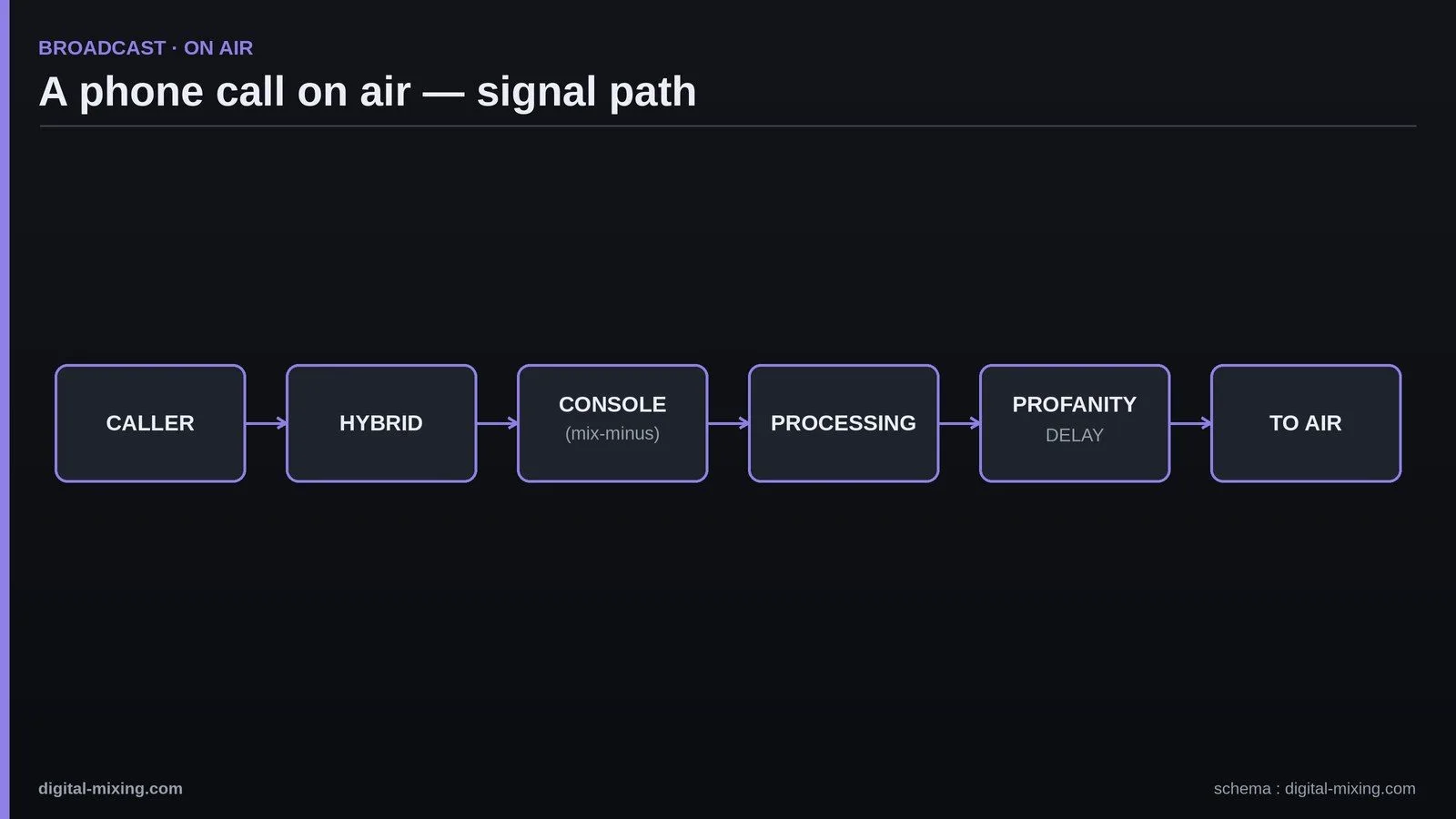
A telephone hybrid converts the bidirectional two-wire line into two separate four-wire paths: a clean output with the caller’s voice alone, and an input for what you send them. The technical catch is that the separation is never perfect: some of the sent signal leaks into the output. Modern hybrids correct this with adaptive echo cancellation (AEC), which measures that leak and subtracts it in real time.
Historically analogue over POTS lines, the hybrid moved on to ISDN and, today, to IP/SIP: the call arrives over the network, with far more bandwidth and quality than the old switched line.
Mix-minus, the other essential half
The hybrid alone isn’t enough: you still have to feed it the right return. What you send back to the caller must be the whole program except themselves. That’s the principle of mix-minus (or cleanfeed): if you sent the listener a mix containing their own voice, they’d hear themselves with the loop delay, and the whole thing would slide into echo and then feedback. We break the mechanism down in our dedicated article on mix-minus.
From switched line to IP: POTS, ISDN, SIP
The shift to IP has transformed the gear. A modern on-air phone system handles several SIP lines, limits and filters each call, and plugs into the station’s audio-over-IP networks — the same family of technologies we introduce in our guide to Dante and audio-over-IP. A VoIP caller on a good connection sounds nothing like the old telephone tone.
On air: processing and broadcast delay
Two safeguards complete the chain. First, processing: callers come in at wildly uneven levels, so an AGC and a limiter on the caller voice smooth out the jumps; in an open-mic studio, a slight pitch shift breaks the feedback loop between loudspeaker and caller. Then the broadcast delay: a few seconds of offset placed just before the transmitter give you time to cut an inappropriate remark before it hits the air. We explain how it works in our article on broadcast delay.
What about a podcast or a remote?
The logic is the same beyond over-the-air radio. For a remote guest on a podcast or a two-way, you have to give them a clean return — so, a mix-minus — and, whenever quality matters, record each end locally: that’s the principle of the double-ender. Podcast studios like the Mixcast or RØDECaster build these functions in, as we show in our Tascam Mixcast 4 guide.
The caller’s perceived quality
A clean call doesn’t depend on the control room alone. The listener’s voice arrives at the quality of their own handset: a call from a mobile on the street will never match a guest in the studio. That’s why many stations, for important contributors, favour a smartphone on-air app that carries wideband audio over the data network rather than the GSM voice path. For everyday callers, good processing — rolling off useless low end, a presence EQ, limiting — is enough to make each call intelligible without chasing hi-fi. And nothing stops you recording the call in parallel, to cut it into a feature or a podcast later.
Setting a mix-minus in three steps
In practice, building a clean cleanfeed comes down to three moves. First, create an aux bus that receives the whole program. Then, remove the caller’s own channel from that bus — that’s the “minus” in mix-minus. Finally, route that bus to the hybrid’s return input, and check by ear, on a test call, that the caller doesn’t hear themselves come back. That last-minute check, too often skipped, is what separates a calm live show from air that rings.
My take
The phone call is live radio at its most exposed: no margin, and a mistake is heard instantly. The pleasant surprise is that the move to IP has made call audio almost comfortable — a long way from the crackle of the switched line. The real issue today isn’t the hybrid but the mix-minus: nine feedback loops out of ten come from a badly built return. Lay out your cleanfeed cleanly, keep a finger on the delay, and an overflowing switchboard becomes an on-air comfort rather than a cold-sweat moment.