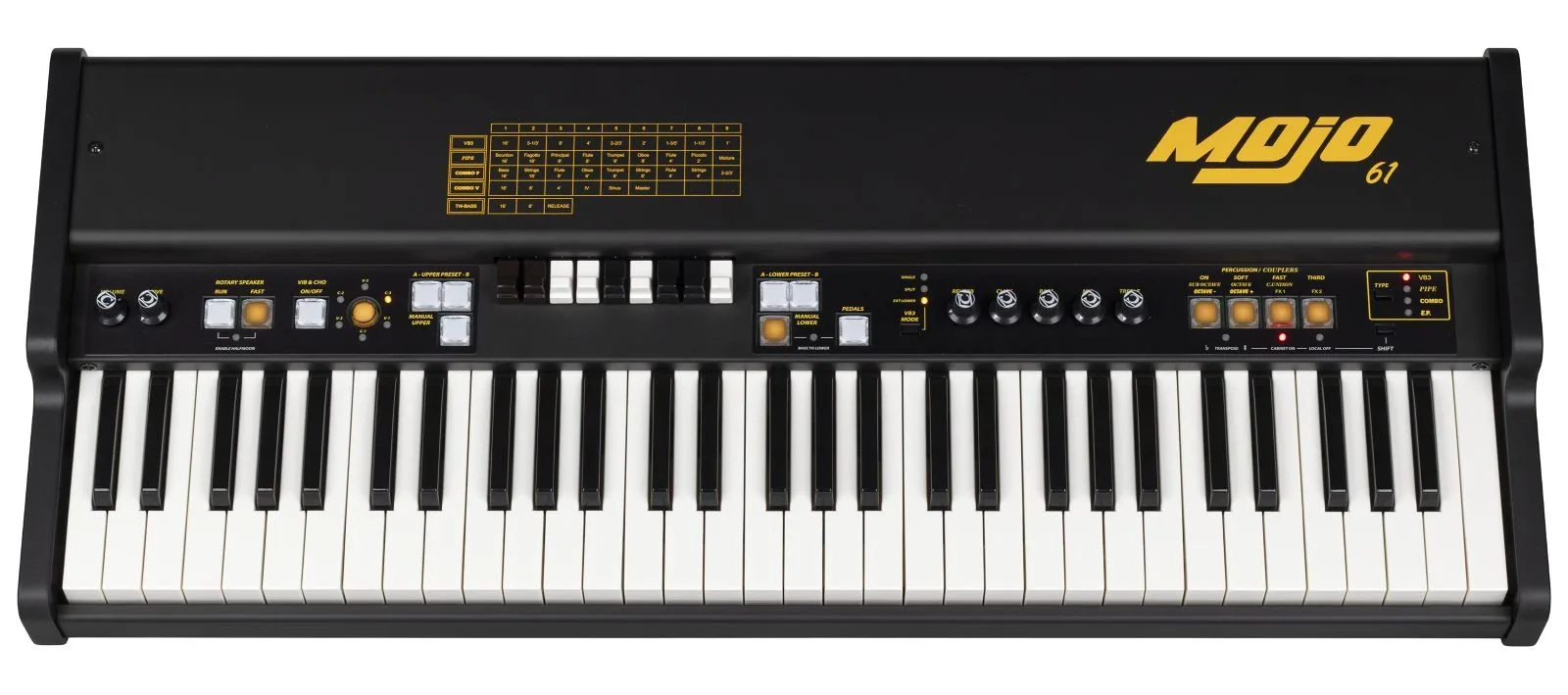
Crumar has refreshed its most popular clonewheel organ. The Mojo 61 MK2 keeps the VB3-II engine that built its reputation, but adds a new waterfall keybed, redesigned front-panel controls and wireless editing from any browser. It is a smart update that puts a classic electromechanical voice back at the heart of the compact stage-keyboard class.
A clonewheel that bets on feel and real time
The Mojo 61 MK2 is a single-manual digital drawbar organ and electric piano. It uses a 61-note, five-octave, semi-weighted, velocity-sensitive waterfall keybed, the PULSE 6105WF borrowed from the brand’s DK61 controller. That flat-fronted profile, without the lip of a piano key, is what an organist’s hands expect for glissandos and percussive attacks. It is one of the real upgrades in this second generation, alongside larger push buttons and a cleaner layout.
At its core sits the GSi VB3-II engine, the same electromechanical organ simulation found in the dual-manual Mojo Classic. The instrument carries 22 vintage tonewheel models: you pick the character, fine-tune it drawbar by drawbar, then store it for instant recall. Everything is generated in real time, with no samples and full polyphony, so there are no dropped notes even when you stack chords.
Eight engines, not just tonewheels
The MK2 goes well beyond tonewheel sounds. It offers a modeled Baroque-style pipe organ with eight stops plus a mixture, three couplers and a tremulant. Two transistor organs follow, an Italian Compact DeLuxe and a red-tolex Continental, for that 1960s combo register. On the piano side, the modeling covers a Tine, a Reed and a Clavinet, rounded out by a hybrid acoustic piano that mixes samples and modeling. Sympathetic resonance, mechanical noise and sustain-pedal behavior are all captured, which changes how the instrument plays.
An effects section built for the stage
A tonewheel organ without a rotary cabinet would make no sense, so the MK2 includes a modeled 122/147 tube rotary amp, tube overdrive, tremolo/auto-panner, wah, stereo chorus and phaser, static amps for the combos and a stereo reverb. Each effect is modeled after respected vintage pedals and amps, and everything is dialed in from the panel or the editor.
Wi-Fi editing and connectivity
The most practical new feature is Wi-Fi editing: the Mojo 61 MK2 serves its own web app, so you adjust every parameter from a phone, tablet or computer with no driver to install. Round the back you get two MIDI inputs, a USB-B port for MIDI, two USB-A ports for updates and the editor, two balanced 6.3 mm line outputs, a headphone output and inputs for expression, rotary and sustain pedals. It all fits in an 89.5 x 35.6 x 11 cm chassis weighing 9 kg, easy to carry.
For a true dual-manual rig, Crumar offers an optional matching Lower Manual: it slides under the Mojo 61, aligns on rubber feet, and a single dedicated MIDI cable handles both power and data. That lower keyboard also works as a standalone MIDI controller with USB and MIDI out.
On price, the Mojo 61 MK2 sits around $1,579 in the US (roughly €1,400 in Europe), with availability from early October 2026. It lines up against compact organ-focused stage keyboards and software rigs, arguing for a dedicated, instant, complete instrument. In the same keyboard space, compare it with the Arturia AstroLab 2.0 or the Roland FP-40, each with its own stage philosophy.
My take
The waterfall keybed matters more than the spec sheet suggests: it is exactly what separates a credible clonewheel from a synth doing an organ impression. Keeping the VB3-II while improving the feel and opening editing to a browser is a sharp call for organists who play standing, squeezed onto a two-tier stand. The 22 tonewheel sets and the modeled pipe organ give you plenty to dig into, and the modest weight genuinely counts when you load the van at 2 a.m. One open question remains: can the MK2 win over players who swear by the original dual-manual? The Lower Manual option is there for that.
Frequently asked questions
Is the Mojo 61 MK2 monophonic or polyphonic?
It is fully polyphonic. Every sound is generated through real-time modeling, with no sample playback for the organ engines, and Crumar guarantees no dropped notes even on dense chords and long sustains.
Can it be used as a dual-manual setup?
Yes, through the optional Lower Manual MK2. The second keyboard sits under the Mojo 61, aligns on rubber feet and connects with a single dedicated MIDI cable that carries both power and data. It can also take a half-moon rotary switch and doubles as a standalone MIDI controller.
How do you edit sounds in depth?
Beyond the drawbars and panel controls, the instrument hosts a web app over Wi-Fi. You open the editor in a browser on a phone, tablet or computer and reach every parameter with no driver to install.
Which outputs and pedals are supported?
The rear panel offers two balanced 6.3 mm line outputs, a headphone output, two MIDI inputs, a USB-B port for MIDI and two USB-A ports. For pedals, there are inputs for an expression pedal, a rotary controller and a sustain pedal.