There is one sound a radio station cannot afford to broadcast: none. Dead air, that unexpected silence on the air, drives listeners away within seconds and betrays a fault somewhere in the chain. Keeping the air safe means both detecting that silence and switching to a backup source before anyone notices. Here is how it is done, in practice.
Why silence is an incident, not a pause
A deliberate pause, a breath in a talk show, an artistic silence: all normal and short-lived. Dead air is a silence that should not be there — a dropped stream, a frozen player, an unplugged source. For a station the stakes are twofold: the instant loss of audience, which tunes out at the slightest gap, and continuity of service, often a legal requirement. Hence the drive to automate both the monitoring and the recovery, above all in the hours when no one is watching the studio.
Detecting silence without crying wolf
A silence detector rests on two inseparable settings. First the threshold: the level, in dBFS, below which you decide there is no useful signal (say -40 or -45 dBFS). Then the hold time: how long the level must stay below that threshold before it triggers — often ten to thirty seconds. That is what prevents false alarms: without it, a single breath or a very quiet passage would fire the switch. Setting these two values is about finding the point where you catch real faults without misreading legitimate silences.
Where to listen: after the processor, ideally off-air
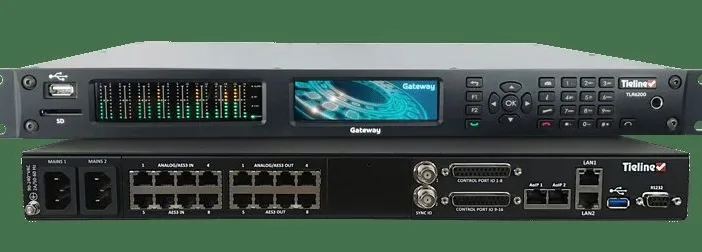
The monitoring point changes everything. Detecting silence at the console output does not prove the air is alive: the whole transmission chain still lies downstream. Better to listen at the output of the air chain processing, after the on-air processor, and better still to take an off-air feed (a tuner locked to your own frequency). This confidence monitoring is the only one that confirms the transmitter is actually modulating. Mind the difference, too, between digital silence — a lost audio-over-IP stream, a missing PTP clock on an AES67 or ST 2110 network — and analogue silence: the causes, and so the backups, are not the same.
Switching: a hierarchy of backup sources
Detection is useless without a clear recovery plan. You build a cascade, from the most “normal” source to the most rugged:
- the main playout takes back over if it merely froze;
- failing that, a backup playout or a second server steps in;
- then a file player running an evergreen “emergency music” playlist;
- as a last resort, a jingle loop or a local audio source installed right at the transmitter, which holds the air even if the studio-to-transmitter link drops.
The trigger can be fully automatic (through the system’s internal logic or a GPIO contact) or limited to an alert (supervision, SMS, a studio indicator) when an operator is present. At night, automation is a must; by day, an alert lets a human fix the root cause. It is the natural extension of radio automation.
Building a net that really holds
A few principles make the difference. Keep the detector independent of the playout: if it lives inside the server that fails, it fails with it — a separate box or module also covers a failure of the playout itself. Build redundant audio-over-IP paths end to end. Test the cascade for real, not just on paper, and log every switch so you can work out afterwards what let go. Finally, watch the level after the processor, remembering that loudness management and a reliable intercom serve the same goal: an air signal that never drops.
My take
Silence is the one “programme” a station can never put to air. A good detector does not chase perfection; it aims never to get it wrong in either direction: not triggering on a deliberate gap, not missing a real drop. The thing that changes everything is monitoring off-air rather than at the console output — it is the only feed that tells you what the listener actually hears. Build the backup cascade once, test it for real, and you will rest easy the night the main playout decides to give up the ghost.