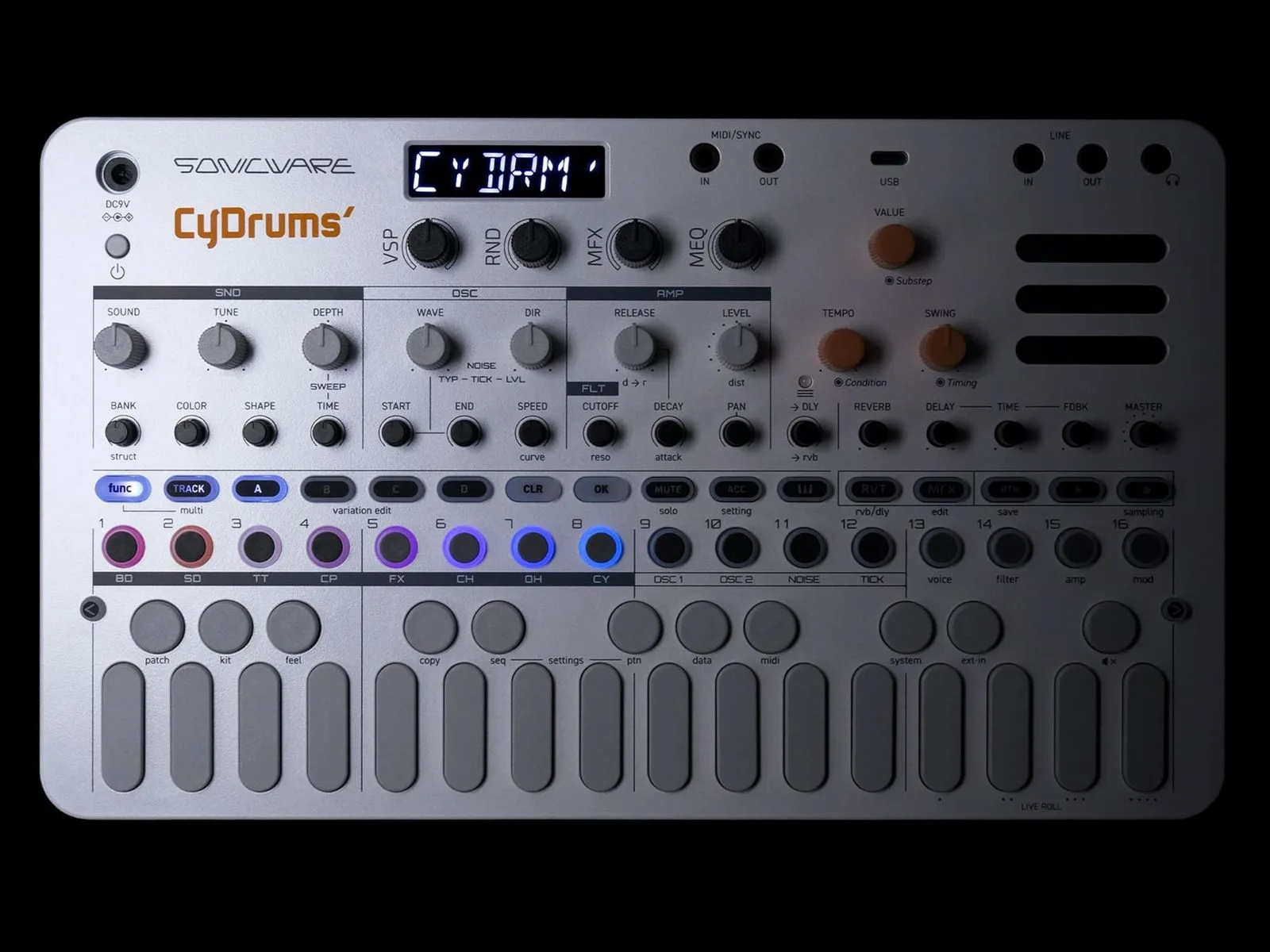
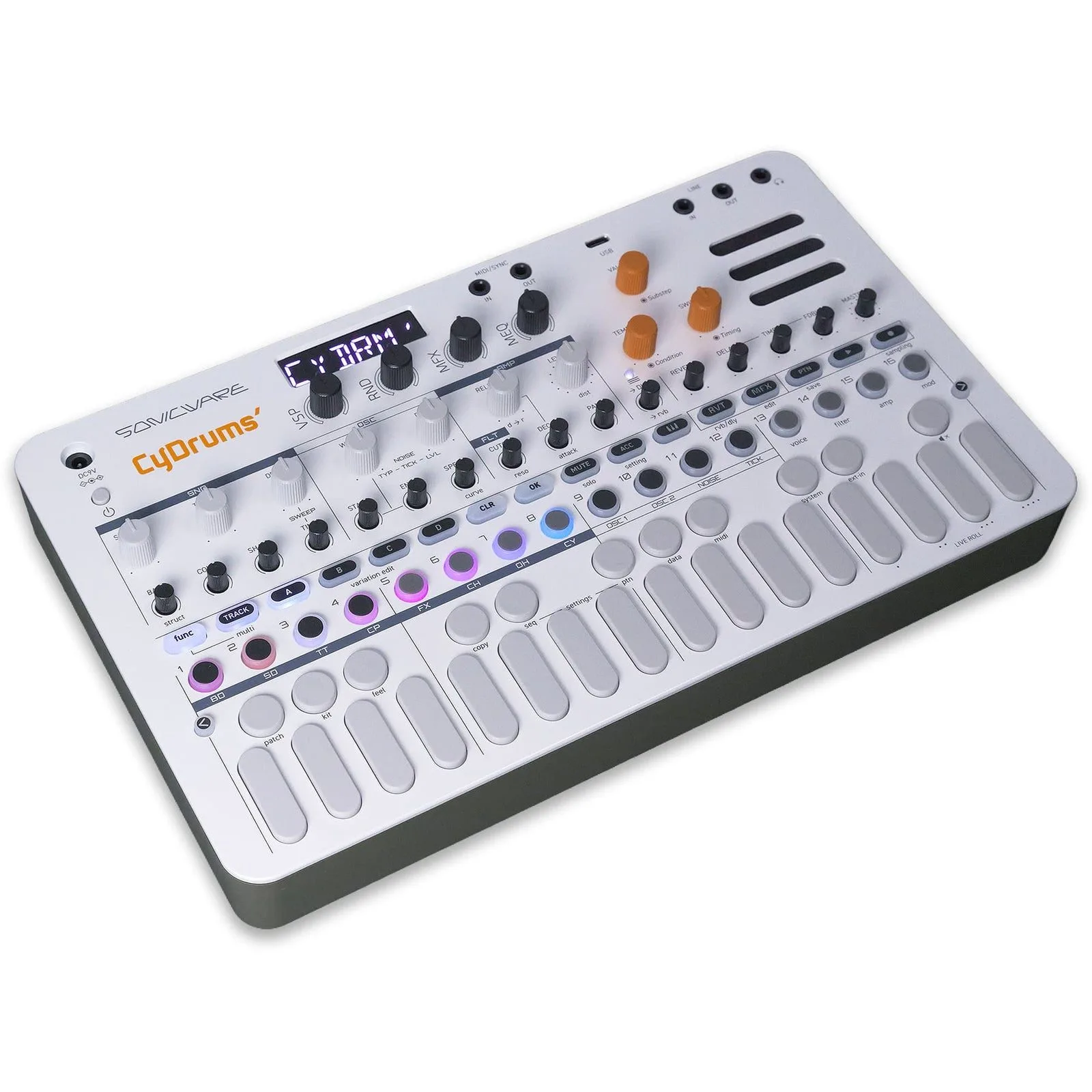
Sonicware spins its CyDrums drum synth into a compact version called CyDrums Dash, written CyDrums′. The box shrinks, it runs on batteries, and the sequencer is lifted from the deconstruct MINIMAL. The spirit is unchanged: build percussion that does not sound like one more 808, from a synthesis engine the brand calls neither analogue nor modelled.
A wavetable engine that owns its weirdness
Each voice pairs two wavetable oscillators with a noise source and a “tick” source for the attack. Sonicware lists 32 wavetables, 5 noise types and 10 ticks, spread across 23 sound structures each built for a specific instrument: kick, snare, toms, cymbals. Eight of those structures, reserved for tracks 6 to 8, handle cymbals and hats. An SP DUAL structure plays two samples at once. Behind that sit six filter types with an envelope, an ADSR amp envelope and built-in distortion. Modulation runs deep: three sources per track, from LFO, envelope and velocity, assignable to 53 parameters.
The “Not Analog, Not Analog Modeling” tagline is meant literally. This is closer to a small digital percussion synth than to a vintage drum-box clone. For the mechanics behind this kind of machine, our guide to drum synthesis shows how a kick or a clap is built without a single sample.
Four knobs to play, not to program
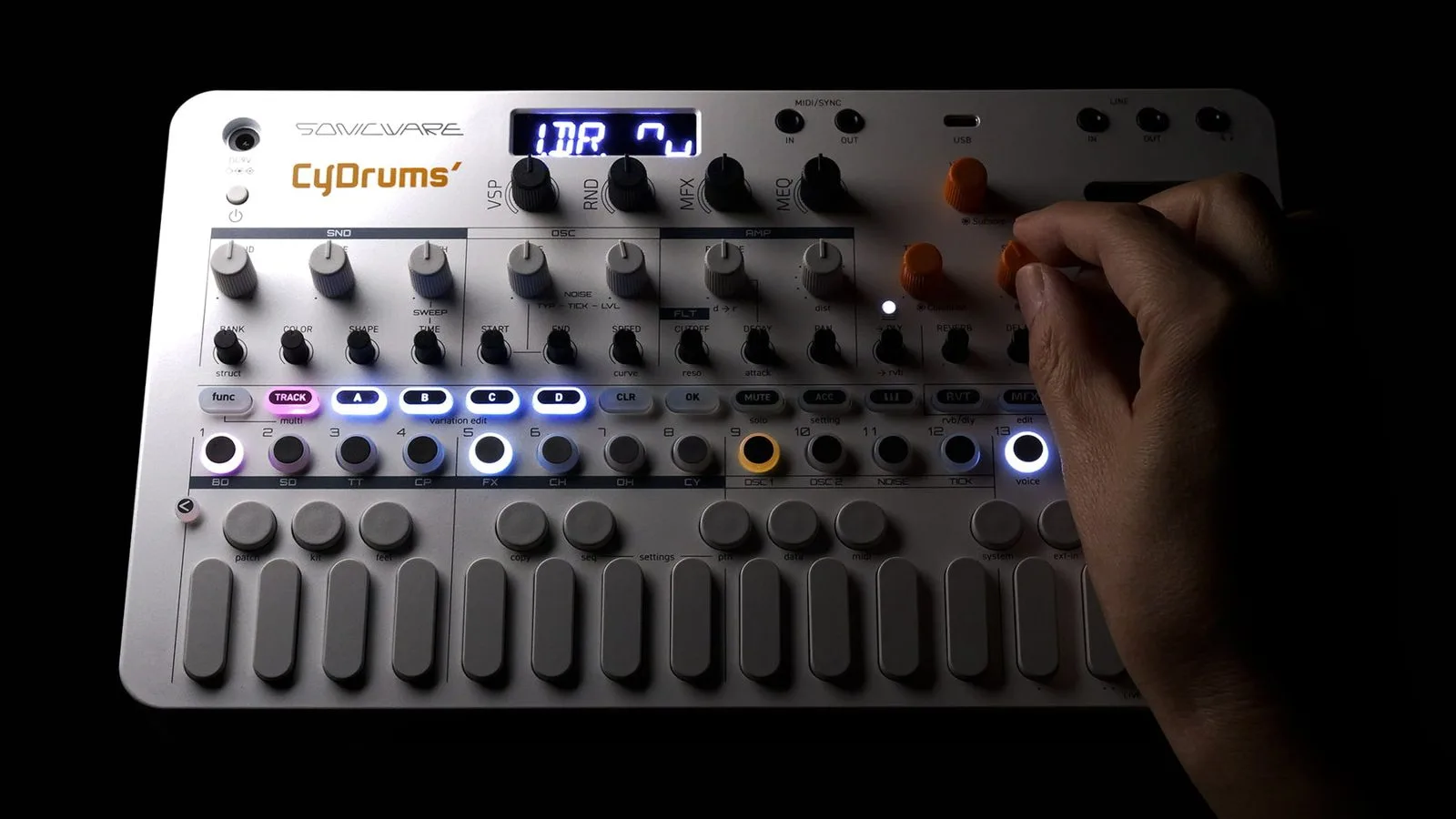
The panel puts four performance encoders up front: VSP for vari-speed, RND for step randomisation, MFX for master effects and MEQ for the master filter. Next to them, LIVE ROLL fires independently of the running pattern for rolls and glitches on demand. That is what sets the CyDrums Dash apart from a plain step sequencer: the machine is built to be worked live, not just edited at rest.
Sequencer, sampler and effects
The sequencer follows the deconstruct MINIMAL template: 128 patterns, 16 steps in four A-to-D variations, chainable up to 64 steps. You get substeps, trigger conditions, per-step parameter locks, and four recording methods, including unquantised real-time entry with micro-timing control. Groove is set per track with feel, accent and swing. Sampling runs through the line input or USB, into 32 slots, up to four seconds of mono at 32 kHz. For effects, the masters offer Slicer, Snip Loop, Bit Crusher, Phaser and a ducking compressor; the sends provide a Room, Hall or Plate reverb and a tape-style echo synced to tempo.
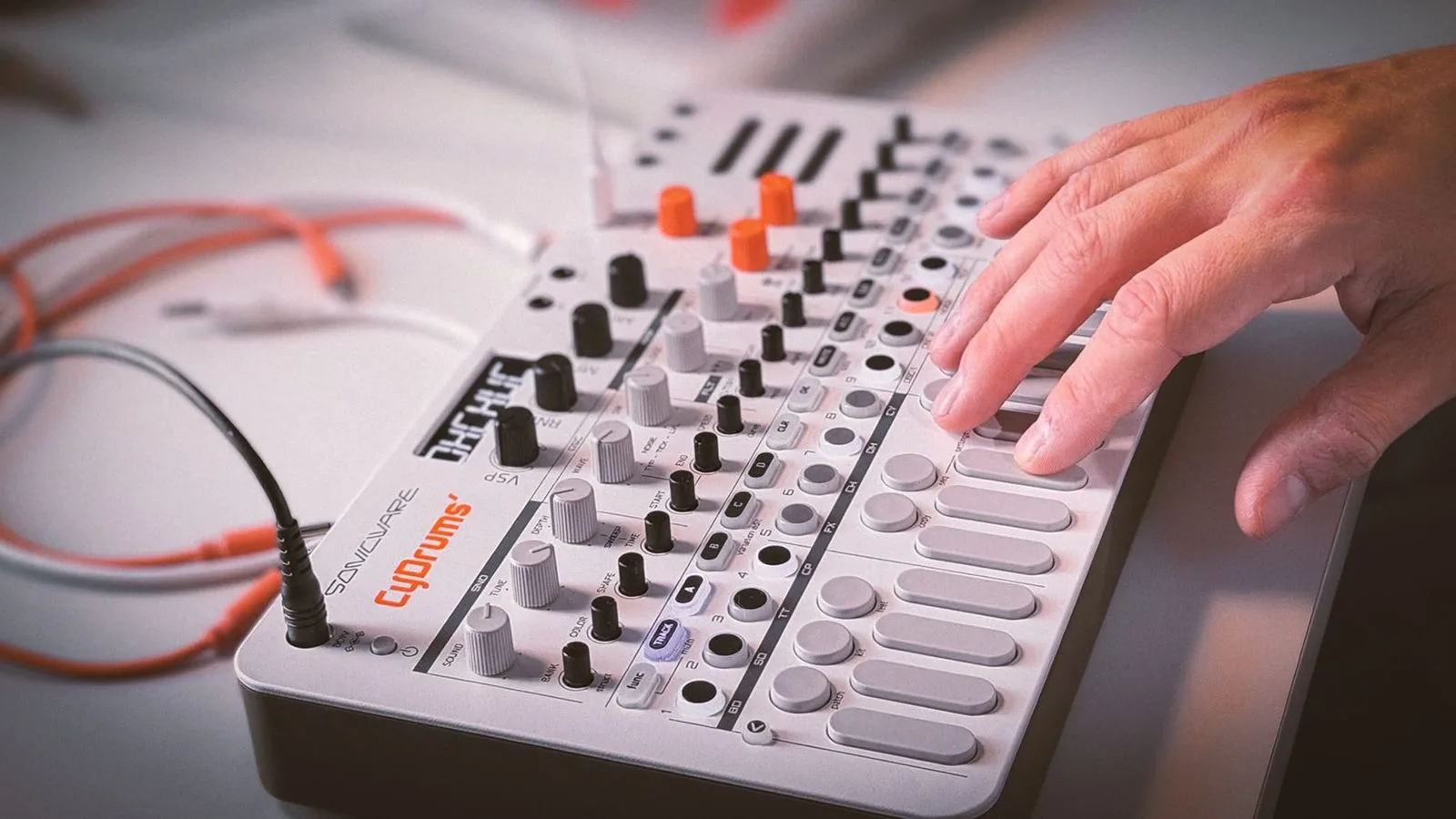
That focus on rhythmic placement ties into a bigger topic: groove, swing and quantization bring a sequence to life as much as the sounds do. Against an all-analogue box like the Gene Synths GENE 616, the CyDrums Dash plays a different card, digital synthesis and sampling in one box.
Format, connections and price
The unit measures 297 by 176 mm and weighs 840 g, with a built-in speaker, a six-digit LED display and power from a 9-volt adapter or six AA batteries, about eight hours on alkalines. Connections stay on mini-jack: line in and out, headphone, MIDI in and out on TRS, and a USB-C port that doubles as a USB 2.0 audio interface at 48 kHz, USB MIDI and mass storage. The preorder price is $299, valid until December 31, with shipping announced for early January.
My take
The bet is clear: a percussion machine that nudges you to hunt for timbres rather than replay the classics. The pocket format, the batteries and the onboard speaker make it a rhythmic sketchpad for the edge of a desk, and LIVE ROLL makes you want to play more than program. At $299, the entry ticket stays reasonable for what it offers in synthesis and sampling. The real question is how a six-digit display copes with 53 parameters per track, which is often where machines like this win or lose their users.