Mute a football match and all that is left is a lawn and some silhouettes. Turn it back on: the dry crack of the ball, the slide of a tackle, the murmur swelling as the attack builds, the commentator’s voice barely holding above the din. That carpet of sound does not fall from the sky. It is built, mic by mic, by a crew tucked inside an outside-broadcast truck parked behind the stand. Here is how a stadium is mic’d for television.
Twenty-two players, seventeen microphones
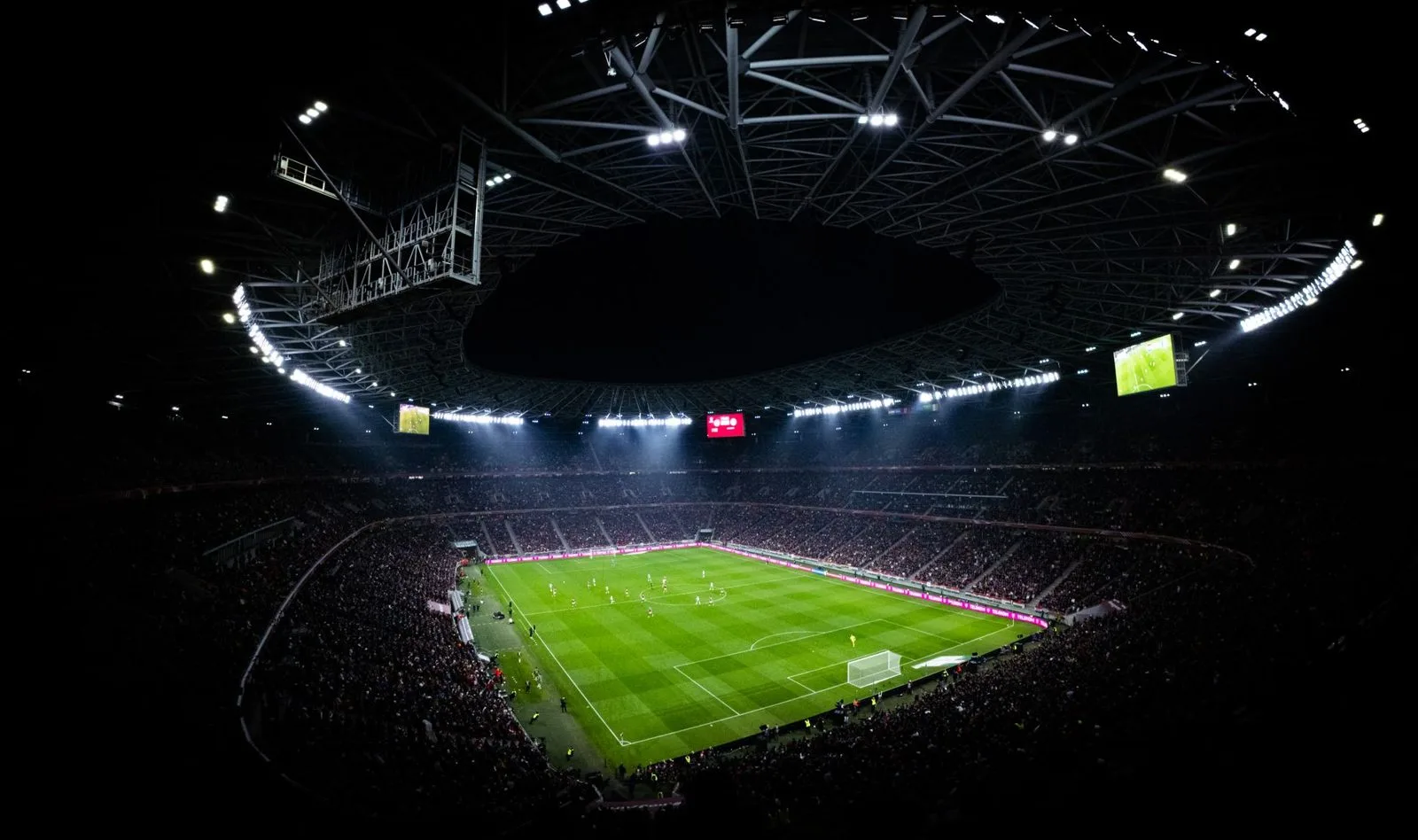
The heart of the pitch sound is the effects mics, set all around the grass to catch the noise of play. German production partner TopVision, which produces the Bundesliga, describes a layout down to the single mic. As its engineer Daniel Kersten explains in an interview relayed by Sennheiser, a match uses seventeen mics on the pitch: three behind each goal, one in the centre, two aimed toward the corners of the goal area, then four more between the 22- and 40-metre lines on the opposite side of the stadium. Each mic grabs the sound closest to it, and the mix rebuilds a coherent scene from goal to goal.
The choice of capsule has shifted. For years, highly directional shotguns, the Sennheiser MKH 8060 and 8070, isolated a precise spot on the pitch. The current setup prefers MKH 8040 cardioids, less pointed but more numerous: once the mics already cover the whole edge, extreme directivity adds little, and a bank of cardioids gives a more natural, less boxed-in sound. It all lives in brutal conditions, and a mic planted behind a goal sometimes ends its evening under the boot of a frustrated player.
Following the ball, automatically
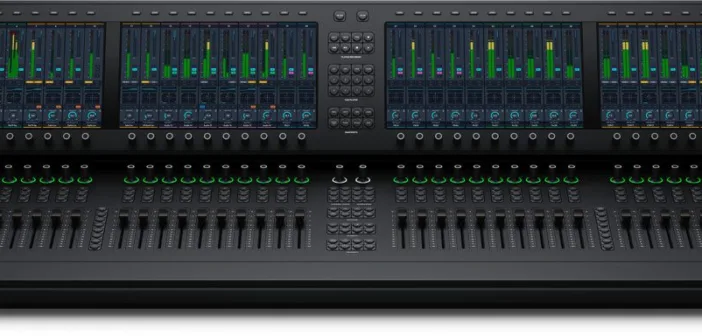
Mixing seventeen mics live, by hand, while tracking a ball that crosses the pitch in two seconds, is a craft. Systems automate it. Lawo’s KICK, for instance, distributes many directional or super-cardioid mics around the pitch and constantly weights their level by the position of the ball: the mics closest to the action rise, the others fade. The engineer keeps control, but the machine stops the noise of a tackle at the far end from polluting an action near goal. The result is that crisp, present struck-ball sound that makes all the difference between a flat broadcast and a living one.
The voice that holds in the noise
Above that bed of effects sits the speech: commentators, pundits, pitchside reporters. The problem is familiar to anyone who has run a live show in a noisy place: how do you keep a clean voice when the stadium roars at a hundred decibels? The answer is an object that has barely changed in decades, the Coles 4104 lip ribbon microphone. Originally built by STC for the BBC, it is a noise-cancelling mic: its bidirectional pattern and low-frequency roll-off reject the din, while two bars rest against the upper lip to hold a constant mouth distance, the key to a stable tone. Shielded against interference from screens, it isolates the commentator’s voice from the surrounding chaos as few mics can. On television you see it less than on radio, because the director likes to show the presenter’s face, but in the most exposed booths it stays the safe bet.
From the truck to the living room, in relief
All these signals converge on the OB truck, where a sound engineer, the A1, builds the mix live. They balance the pitch effects, the crowd ambience, the speech and the music beds, all calibrated to the European broadcast reference level so the match is neither louder nor quieter than the programme around it, a subject we cover in our guide to loudness and EBU R128. With loudness under control, the dozens of channels now travel the stadium over audio-over-IP networks, which have replaced the miles of multicore of old.
For a few years now, football has also been heard in relief. The big Champions League finals are broadcast in surround sound and Dolby Atmos: the immersive layer places the crowd all around the listener, even overhead, to recreate the feel of the stands. For the 2024 final, the host broadcaster offered surround on the HD feed and Atmos on the UHD feed; the experience, first tried in 2017 by BT Sport on two European cup matches (per SVG Europe), has since spread to the major events. In transport, this multichannel information often travels encapsulated, in the manner of Dolby E, and building the immersive mix meets the methods we describe in our guide to mixing in Dolby Atmos.
My take
Football sound is a textbook capture job: many mics, a hostile environment, no room for error, and a demand for naturalness that bans any crude trickery. The move from shotguns to cardioids and the arrival of ball-following mixers tell the same story, trusting numbers and a smart system over one magic spot. Then there is the Coles 4104, indestructible, a reminder that a sound acoustic principle does not age. Next time a ball cracks through your speakers, remember that a couple of dozen mics and an engineer in a truck just did all the work.