A television channel works in 5.1, but much of its infrastructure only knows stereo pairs. Routers, archive VTRs, links and above all channels embedded in SDI run two by two. Dolby E bridges that gap. It fits up to eight audio channels and their metadata into a single AES3 pair, while staying editable to the frame. Here is how it works and why it is still unavoidable in an OB truck or a master control room.
Why Dolby E exists
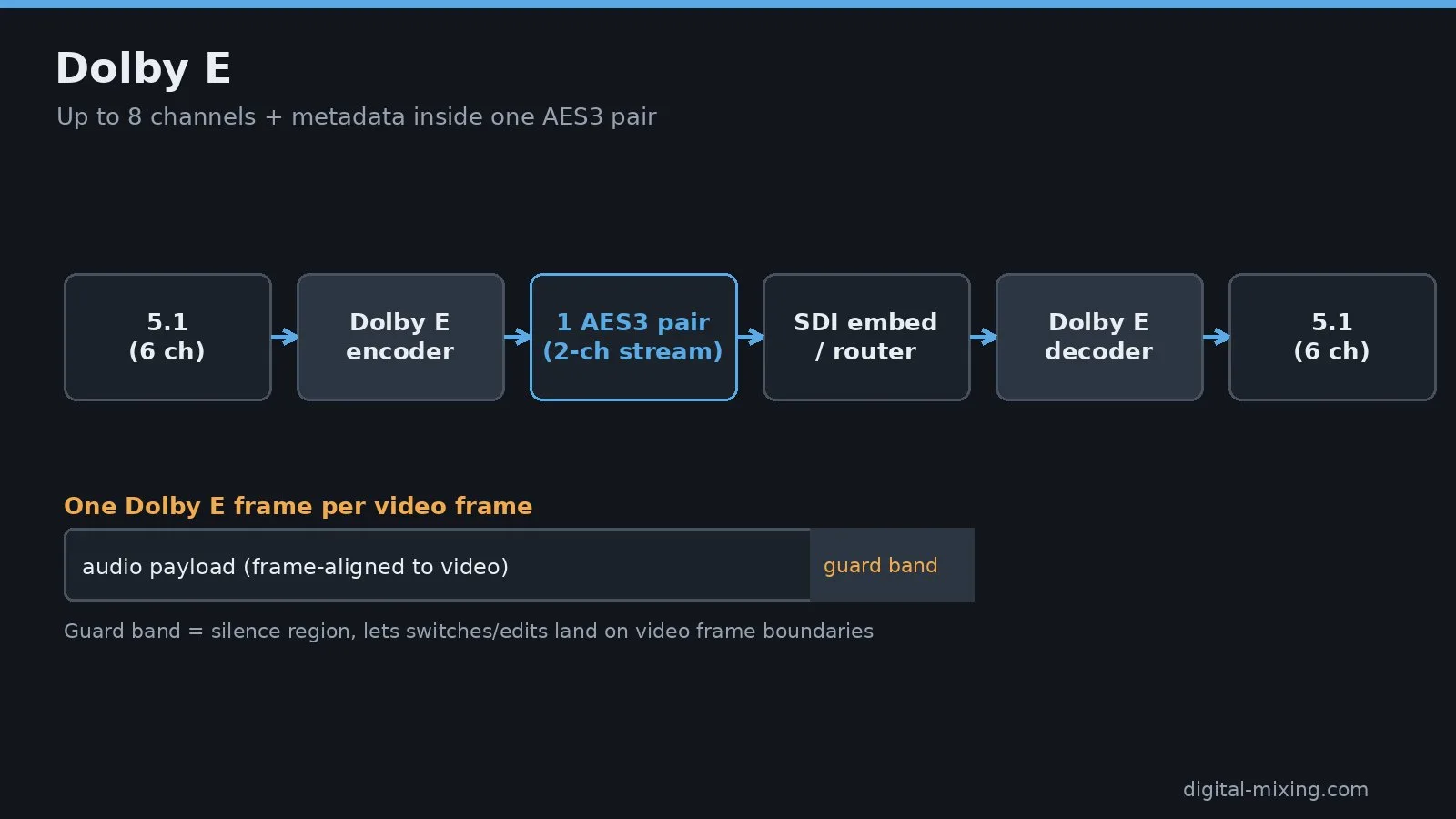
The core problem is simple. A 5.1 programme has six channels, sometimes with a stereo version too, so eight streams to carry together. Yet AES3, the reference digital audio link in broadcast, carries only two channels per pair, and that is also the granularity of SDI embedded audio. Duplicating pairs to pass six channels wastes infrastructure and complicates routing. Dolby E encodes the whole thing into a single digital stream that fits in the space of one AES3 pair, as if it were ordinary stereo audio.
| PCM | Dolby E | Dolby Digital (AC-3) | |
|---|---|---|---|
| Role | uncompressed audio | contribution and in-house distribution | emission to the viewer |
| Channels in one AES3 pair | 2 | up to 8 | 5.1 encoded as a stream |
| Metadata carried | no | yes (dialnorm, downmix, timecode) | yes |
| Frame-accurate editing | yes | yes, thanks to the guard band | not designed for it |
Eight channels and metadata in one pair
Technically, Dolby E packs its stream into AES3 data using the standardized SMPTE ST 337 method, described in the SMPTE RDD 33 document. Depending on the resolution used, a 48 kHz pair carries up to eight channels plus metadata at 20 bits, or six channels at 16 bits. Metadata is an essential part of the format. It carries, among other things, dialnorm and loudness information, downmix instructions and timecode, so that level and stereo compatibility travel with the sound all the way down the chain.
One frame per video frame
Dolby E’s clever trick is its synchronization. The format produces one audio frame per video frame and aligns to it. Between two frames, it leaves a guard band, a short region of silence in the stream. That guard band lets you switch and edit on frame boundaries without cutting in the middle of a Dolby E frame, which would corrupt decoding. An OB truck can then route, record and edit a 5.1 programme with the same moves as stereo, provided the guard band is aligned to the video switching point.
Encoding, decoding and latency
Dolby E decodes to PCM for mixing and monitoring, then re-encodes if needed for the next stage. Each encode or decode pass adds about one video frame of latency, so you have to count the generations and watch lip sync. At the end of the chain, the programme is often converted to Dolby Digital for emission to the viewer, or to next-gen audio such as AC-4 or MPEG-H on recent platforms. Dolby E itself stays a contribution and in-house distribution format, not an emission format.
Where you still meet it
Anywhere a 5.1 stream has to cross infrastructure built for stereo. In sport and live production, in archiving, in links between sites, Dolby E is a handy container. It talks naturally with the rest of the broadcast chain, from 5.1 sound for television to the loudness and true peak constraints its metadata helps to meet.
Programmes, configurations and pitfalls
A Dolby E stream does not always carry a single 5.1 programme. It can be configured, for example as a 5.1 programme plus a stereo programme, or as several independent programmes sharing the eight channels. That flexibility helps multilingual broadcasters, who move several sound versions through the same pair. The programme configuration is part of the metadata and must stay consistent from end to end of the chain, otherwise the channels end up misassigned at the output.
The best-known pitfall is a misaligned guard band. If the video switching point falls outside that region of silence, the cut lands in the middle of a frame and causes clicks, or even a loss of decoding over a few frames. Equipment therefore provides an offset setting, expressed in samples, to align the guard band precisely to the video switch. It is the first thing to check when a 5.1 edit snaps at the cuts or a live feed drops on every source change.
My take
Dolby E has the quiet longevity of good engineering ideas. Carrying 5.1 inside a stereo pair looked like a hack, and it became a de facto standard because it fit the existing infrastructure instead of fighting it. The guard band in particular is an elegant find that spared editors years of nightmares. IP and next-gen audio are slowly eating into its turf, but as long as AES3 pairs and SDI move through control rooms, Dolby E stays a required stop. A useful classic, not a museum piece.