We hear a lot about audio over IP, Dante and ST 2110, but a good share of radio studios, TV galleries and control rooms still runs on an older, perfectly reliable link: AES3, born from the collaboration between the Audio Engineering Society and the European Broadcasting Union, which is why it also goes by AES/EBU. It carries two digital audio channels on a single cable, with no network and no configuration, and remains a building block of any broadcast chain. Understanding it helps you cable cleanly and diagnose a click or a dropout.
Two channels, one balanced cable
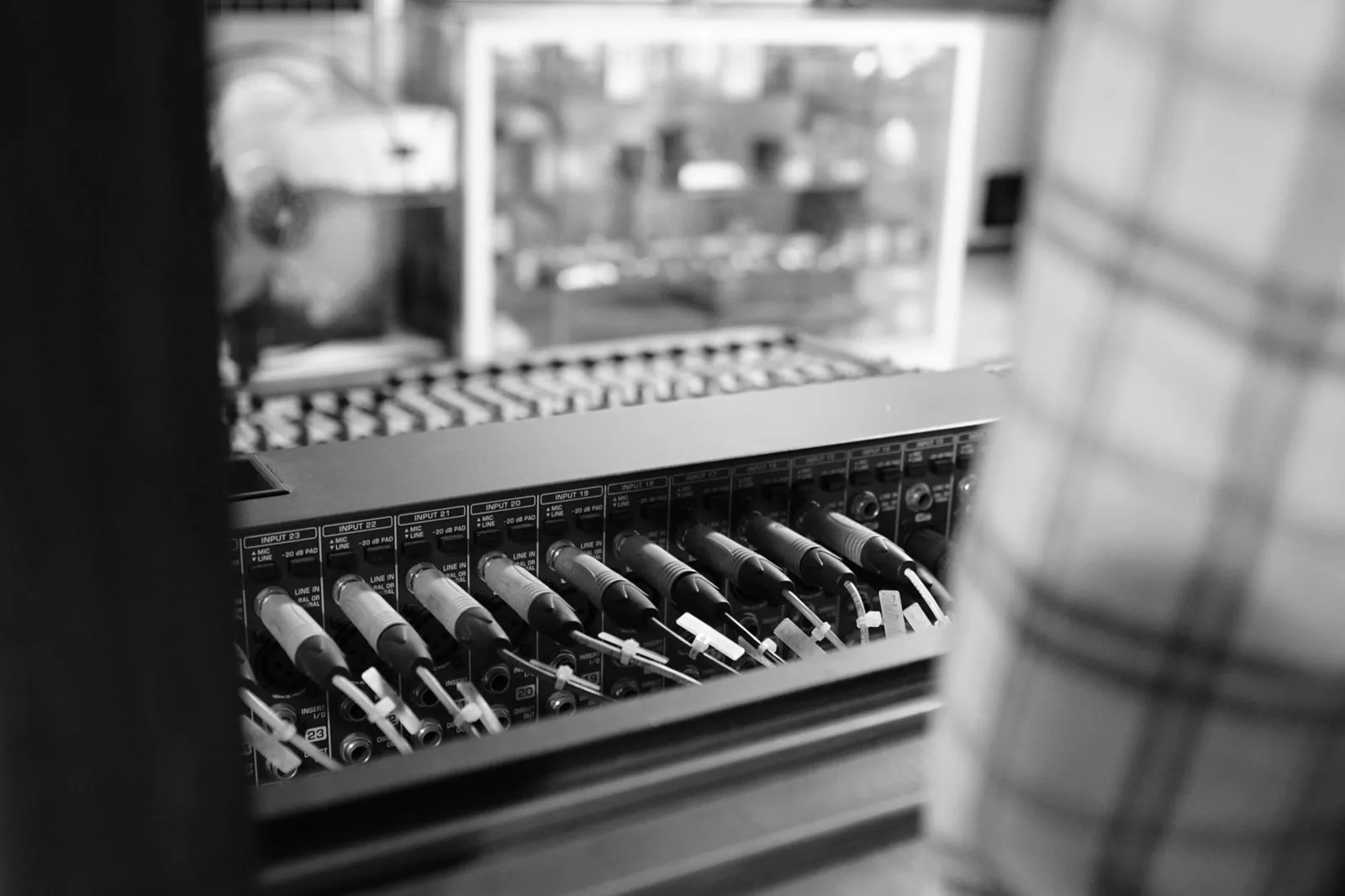
In its professional form, AES3 runs on a 110-ohm balanced cable terminated with XLRs, the same connector as a microphone, but not the same cable. The digital signal occupies a wide band and needs a cable rated for 110 ohms, not a makeshift analog lead that would cause reflections and errors. The link carries two channels, called A and B, interleaved in time. On a stereo link, A carries the left and B the right, but nothing stops you sending two independent mono signals.
Balancing is no detail: as in analog, it rejects interference picked up along the way through common-mode rejection. The principle is the same as the one described in our piece on balanced audio, applied here to a digital stream rather than an analog voltage.
A frame that carries its own clock
The stream is organised into 32-bit subframes, one per channel. Each subframe starts with a 4-bit preamble that acts as a sync marker, followed by an audio field of up to 24 bits, then four service bits: validity, user data, channel status and parity. The channel status is rebuilt over a block of 192 frames and carries information such as the sample rate or the signal type. The sample rate follows the source, from 32 to 192 kHz, with the higher rates sometimes needing a dual link.
The clever part is the coding. AES3 uses biphase-mark coding, which writes a transition at the start of every cell: the receiver rebuilds the clock straight from the signal, with no separate clock wire. The link is therefore self-clocking, and it does not care about the polarity of the two conductors, which simplifies wiring. A receiver locks to the incoming clock, or a whole facility refers to a common master clock, a DARS, so that everyone samples at the same rate.
AES3id, S/PDIF and the cousins
The AES3id variant carries the same data but on a 75-ohm coaxial cable terminated with BNC, at a lower level. It fits naturally into video galleries, where everything is already wired in 75 ohms, and pairs with SDI embedded audio. On the consumer side, S/PDIF carries the same kind of data on a 75-ohm RCA coax or a TOSLINK optical link. The audio data is almost identical, but the channel status differs, notably for copy management. Mixing the two worlds often works, but can surprise you on signal recognition.
| Variant | Medium | Use |
|---|---|---|
| Balanced AES3 | 110-ohm pair, XLR | Radio studios, galleries, pro gear |
| AES3id | 75-ohm coax, BNC | Video and broadcast installations |
| S/PDIF | 75-ohm RCA coax or optical | Consumer and semi-pro gear |
Where AES3 still earns its place, and its limits
Two channels on a cable is little in an age of networks that carry hundreds. To scale up, the industry moved to MADI and then to audio over IP. Yet AES3 does not go away: to link two devices, a console output to a processor, a player to a transmitter, a direct point-to-point link stays simple, instant and free of network latency. You also find it at the end of contribution codecs and on most converters. Its practical limits are distance, around 100 metres balanced, and channel count. Beyond that, the network takes over.
My take
AES3 has the charm of standards that just work without a second thought. A clock in the signal, two channels, one cable, and more than forty years of compatibility: hard to beat for linking two boxes. The only real trap stays the cable, an analog lead in place of a 110-ohm one sometimes passes over a metre and fails over ten. In an all-network world, keeping an AES3 link up your sleeve saves the day more often than you would think, the day a Dante stream refuses to negotiate five minutes before air.