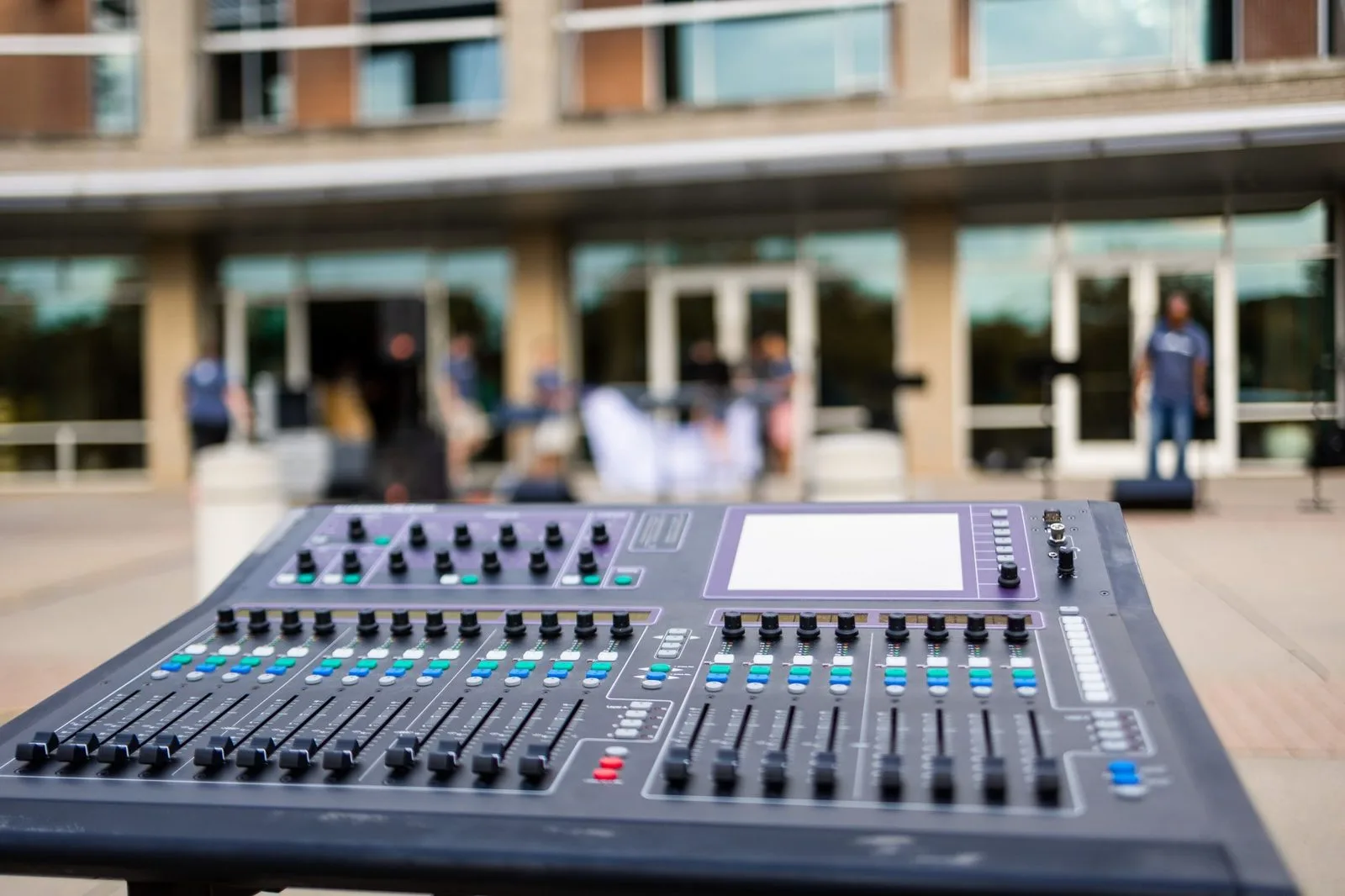
At a small gig, one console is enough. As the production grows, reality gets trickier: the FOH engineer and the monitor engineer each work on their own console, and a multitrack recording or a broadcast truck may join in. Yet there is only one vocal mic, one snare, one bass DI. The stage splitter distributes each source to all those destinations at the same time, without letting them interfere.
Why not just a Y-cable
The temptation is there: plug two connectors onto one mic output. In practice it is a bad idea. Two preamps in parallel share the load, levels drift, and above all one console’s phantom power can end up injected into the other, with unpredictable results. Electrically tying two consoles through their grounds also opens the door to ground loops and hum. The splitter solves both problems at once.
Passive or active
Two families coexist. The passive splitter relies on a splitting transformer: one input, several outputs, some of them galvanically isolated by the transformer. It needs no power, it is rugged and neutral, and its transformer brings natural isolation that breaks ground loops. Its limit is the number of outputs and the load: beyond two or three consoles, the transformer can weigh on the signal. The active splitter carries buffered amplification stages: each output is isolated and driven independently, which allows many destinations with no loss. It needs power, and its quality depends on the electronics, but it is the choice for large shows.
Ground, isolation and phantom power
The sensitive point of a split is handling grounds and +48V. Usually a single output connects directly to the source, the direct output: it is the one that supplies phantom power to the mic, and you logically reserve it for the console that holds the main take, often FOH. The other outputs pass through the transformer, with a ground lift available to break any loop. The result: the monitor console and the recording get the signal without sending their ground or their phantom back to the mic. That is the basic rule, and it prevents ninety percent of stage hum.
The splitter in the digital age
With digital stageboxes, sharing changes shape without going away. A Dante or MADI stagebox can distribute its inputs to several consoles on the network, but the preamp stays single: you then have to manage gain sharing, because setting the gain for FOH changes the level the monitors receive. Recent systems offer gain compensation that digitally corrects this gap, so each console keeps control. Even so, the analog split keeps its place whenever a recording or broadcast needs clean isolation, independent of the network. We cover these architectures in our piece on patch and stageboxes.
In practice on a show
The method is simple. Place the splitter as close to the stage as possible, send the direct output to the console that supplies phantom, then the isolated outputs to monitors and to recording or broadcast. Lift the grounds on the isolated outputs, never on the direct one. Label every line clearly, because a badly labelled split costs you dearly on patch day. All of this is prepared ahead, on the tech rider and stage plot: how many outputs per source, who supplies phantom, who gets what.
My take
The splitter is the kind of invisible gear that makes all the difference between a calm stage and a nightmare of a night. The reflex to keep is one line long: a single console supplies phantom through the direct output, everything else goes isolated, ground lifted. On big digital systems, gain compensation has settled the old FOH-versus-monitors conflict, and that is a good thing. But as soon as a broadcast truck joins in, the good old transformer split stays the safest way to sleep well the night before a live show.