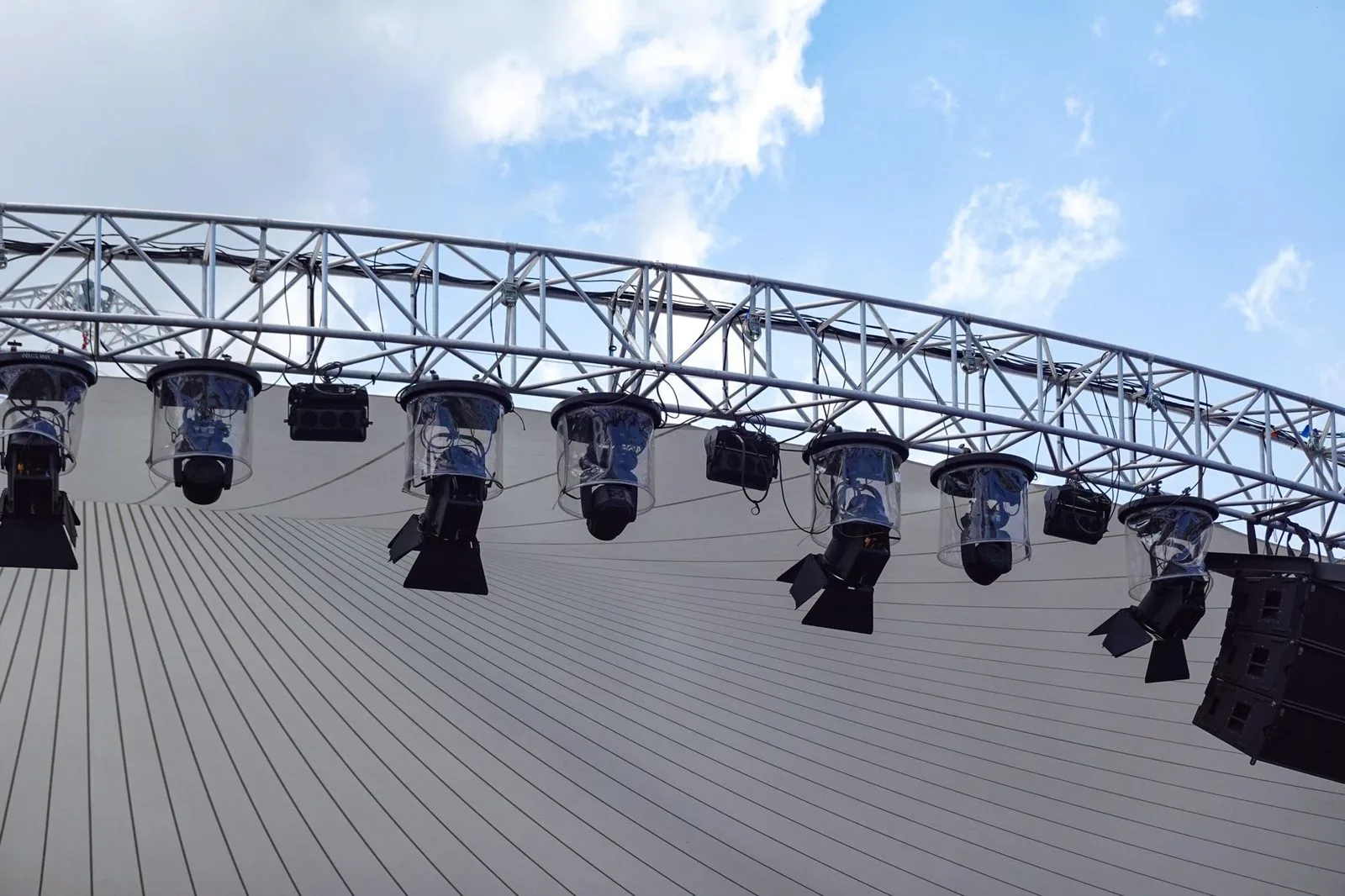
A line array is usually judged on its coverage and its tone. Before any of that, it hangs in the air, and this is the part of the job that forgives nothing. Flying an array means suspending several hundred kilos above human heads. The first question is not acoustic. It is mechanical and regulatory.
This guide follows the order a serious system tech works in. Splay angles and trim height come later, and they get their own guide on angling and coverage. Here we talk about what carries the load.
Weight first, and the anchor point that takes it
A mid-size modern array quickly reaches 300 to 600 kg with accessories, and a large main hang runs well over a tonne per side. That weight does not hang anywhere. The anchor point, whether a stage truss, a beam, a self-supporting tower or a lifting tower, has a known, documented rated load. We call it WLL (working load limit), always set below the breaking load by a mandated safety factor.
Two habits drive everything else. First, confirm the structure accepts the load at the exact point where it is applied, not just as a theoretical distributed load. Second, demand structural calculations or sign-off from a rigging lead when the setup is out of the ordinary. On tour, the production rigger decides; on a small show, the provider stays responsible for whatever they hang.
The flybar that spreads the load
The flybar, or bumper, is the part that links the array to the hoist. It takes the top cabinet, spreads the force across its pick-up points and offers several adjustment holes. The pick-up hole you choose changes the balance between the front and the back of the array, which sets the overall tilt.
Two methods exist. A single-point pick-up makes the lift simple but locks the overall angle. A two-point pick-up, one hoist on the flybar and a second on a pull-back bar, lets you set the top-of-array tilt once it is in the air. That pull-back bar sets the system’s overall site angle, while the inter-cabinet links handle the fine splay between each box.
The hoist and its redundancy
The chain hoist carries its own rated load. You never load a hoist beyond its WLL, and you keep a margin. Entertainment hoists are classified by use: a model rated to stay loaded above an audience (D8 Plus or C1 depending on the standard) does not share the requirements of a plain assembly hoist. The double brake and compliance with local regulations are not details.
Redundancy is handled with a safety sling where the setup or the rules require it: a strap or chain able to catch the load if the primary anchor fails. Finally, you rarely set the fine position under real tension. You lift, you secure, then you adjust.
Overall tilt versus inter-cabinet splay
A common vocabulary mix-up trips up beginners. The overall tilt of the array, its site angle, comes from the pick-up point and the pull-back bar. The angles between two neighbouring boxes are set cabinet by cabinet during assembly, on the ground, before the lift. Those splay angles shape how the sound travels from the back of the room down to the front rows. The manufacturer software computes both, and I cover the coverage side in the angling guide. To choose between an array and a compact system, the point source versus line array comparison sets the scene.
Prediction software is not only about acoustics
ArrayCalc at d&b, Soundvision at L-Acoustics, MAPP at Meyer Sound: these tools show coverage, but they also output the mechanics. Force on each pick-up point, load at the flybar, array deflection, compatibility of the configuration with the hardware in use: the software flags when a requested angle exceeds the mechanical limits of the links. A printed rigging report, carried to site and checked against the real truss, beats any eyeballed setting.
The pre-lift checklist
- Total load calculated and below the WLL of both the anchor and the hoist, margin included.
- All link pins and bars locked, nothing left pending.
- Pick-up points matching the software report.
- Safety sling fitted if the setup calls for it.
- Area under the load clear, nobody working or passing beneath during the move.
- Protective equipment worn, clear communication between the lift desk and the ground.
And when you stack on the ground
Not everything flies. A ground-stack sits the array on its subwoofers, with a tilted base frame to set the site angle. The safety concern changes: no load overhead, but a tip-over risk. You widen the footprint, strap it down, check the level. The same cabinets that carry the low end on tour often end up as fills, and the logic meets the one in the system choice guide. On the amplification side, splitting the bands follows the rules in the bi-amplification article.
My take
Rigging is the one job where a mistake cannot be fixed at the mix. The good news is that mechanical rigour is fully learnable: a clean rigging report, hoists kept at their WLL and a clear zone turn a tense moment into routine. Manufacturers have come a long way on flybars and software, to the point where mechanical prediction is now as trustworthy as acoustic prediction. What remains is the discipline of the gesture, and that cannot be bought. A good rigger on tour is worth their weight in peace of mind.