The line array took over live sound because it throws far while staying coherent. But a badly angled array does exactly the opposite of its job: too loud up front, weak at the back, and low end firing into the ceiling. It all comes down to the hang. Understanding why you angle a line array, and how, is the difference between a room covered evenly and a room that lurches from row to row.
Why it works: source coupling
Stacked vertically and close enough together, several boxes couple: their wavefronts merge and behave, in the lows and mids, like a single source radiating a near-cylindrical wavefront. As a result, energy falls off more slowly with distance than a single box, and the throw carries far. This coupling only exists if the boxes are tight and correctly angled; as soon as the angles open up, the array stops behaving as a coherent whole — which is precisely the tool we’re going to exploit.
Three settings, in order
A hang is thought through in three stages: height, overall tilt, then internal curvature.
- Height. The higher the array, the clearer the sightline to distant rows and the more even the coverage. Too low, and the audience’s heads shadow the back while the front row takes everything. The rigging-point height conditions all the rest.
- Overall tilt (site angle). You tilt the whole array so the top aims at the last listener. The top throws far; it must “point” toward the back of the room.
- Curvature (the splay angles). The heart of the matter, detailed below.
Splay angles: tight at the top, open at the bottom
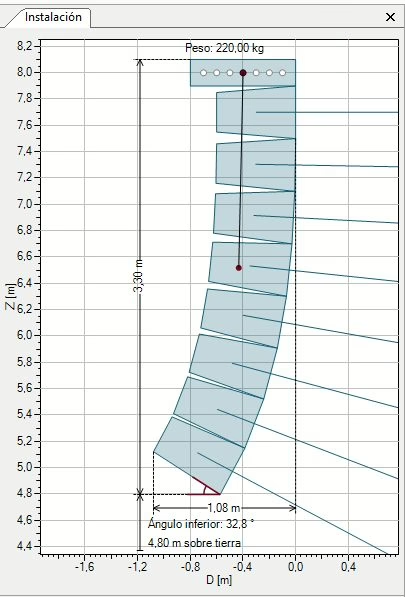
The golden rule: tight angles at the top, open angles at the bottom. The top boxes must throw far, toward distant rows: keep them almost parallel (small angles) to concentrate energy and maximise coupling over the long distance. The bottom boxes cover the near field — the front rows, right in front of the stage: open the angles to spread energy over a wide, short zone and avoid hammering the front row.
This progression of angles (from a few degrees at the top to sometimes 8-10° at the bottom, depending on the system) sculpts even coverage: every slice of the audience gets roughly the same level, whether they’re 10 or 40 metres away. It’s the principle of the “J” shape a well-angled array draws — almost straight at the top, curved at the bottom.
Compensating for distance: shading and amp zones
Angling isn’t everything. Near rows, covered by the bottom boxes, are far closer than distant rows covered by the top. To equalise the level, you apply shading: slightly lower the gain (and tweak the EQ) of the bottom boxes, or split the array into several amplification zones driven separately. Modern amps and processors allow this control by groups of boxes, essential to flatten the level curve across the whole depth.
Low end and subwoofers
An array of tops isn’t enough to carry the bottom of the spectrum in a controlled way. Subs are handled separately: arced on the ground, in a line, or flown themselves, with a configuration designed to steer energy toward the audience rather than the stage. Directional setups — including cardioid subwoofer arrays — keep the low end off the musicians’ backs and out of the mics.
Predict before you fly
You no longer angle an array “by eye”. Manufacturers’ prediction software — ArrayCalc, Soundvision, EASE Focus and the like — calculate, from the venue plan, the height, tilt and each splay angle to hit a target coverage. They also give the shading and check the mechanical constraints. It’s a reliable starting point, to be confirmed on site: d&b goes further by letting you hear the system before you fly it. Prediction sets the geometry; ears and measurement validate it.
Safety is not negotiable
Flying a system means suspending hundreds of kilos above the audience. A few non-negotiable principles: use only certified points and appropriate lifting gear, respect the working load limit (WLL) of each element, never exceed the mechanical angles the maker allows (beyond them, the frame and links are outside their limits), and provide secondary safeties. The prediction calculation includes these constraints: if it refuses a configuration, that’s a signal, not an obstacle to work around.
Then you tune
Once the array is flown and angled, the acoustic work begins: time-aligning zones and subs, setting the target curve, handling delay coverage. All of that is system tuning, and distant zones are often completed with delays, front fills and rears. The hang lays the foundations; tuning makes them level.
My take
Angling a line array is where physics rewards preparation. Manufacturers have poured enormous work into their prediction tools: ignoring them to hang “the way we always do” throws away half the system’s potential. The reflex that changes everything: aim for even coverage, not maximum level up front. An audience hearing the same thing in the first and last rows means a mix that holds the whole room and a FOH engineer who works calmly. Geometry can be calculated, but it’s always verified by ear once the room is full — the human body absorbs sound, and an empty room lies.