The Royal Albert Hall is a magnificent room and an acoustician’s nightmare. Opened by Queen Victoria in March 1871, the elliptical amphitheatre crowned by a vast glass-and-iron dome has everything it needs to send sound straight back at you. Its reputation survives as a running joke: it was, people said, the only place a British composer could be sure of hearing his work twice. The culprit was a sharp reflection off the dome, an echo of nearly half a second that blurred articulation.
An echo that became a legend
The geometry is the problem. A concave dome acts like a focusing mirror for voice and music: it refocuses energy down onto the stalls instead of scattering it. For almost a century, engineers rigged temporary curtains and reflectors without ever fixing the cause. The direct sound arrived cleanly, then a delayed copy dropped on top of it, and clarity collapsed the moment the orchestra opened up.
The mushrooms of 1969
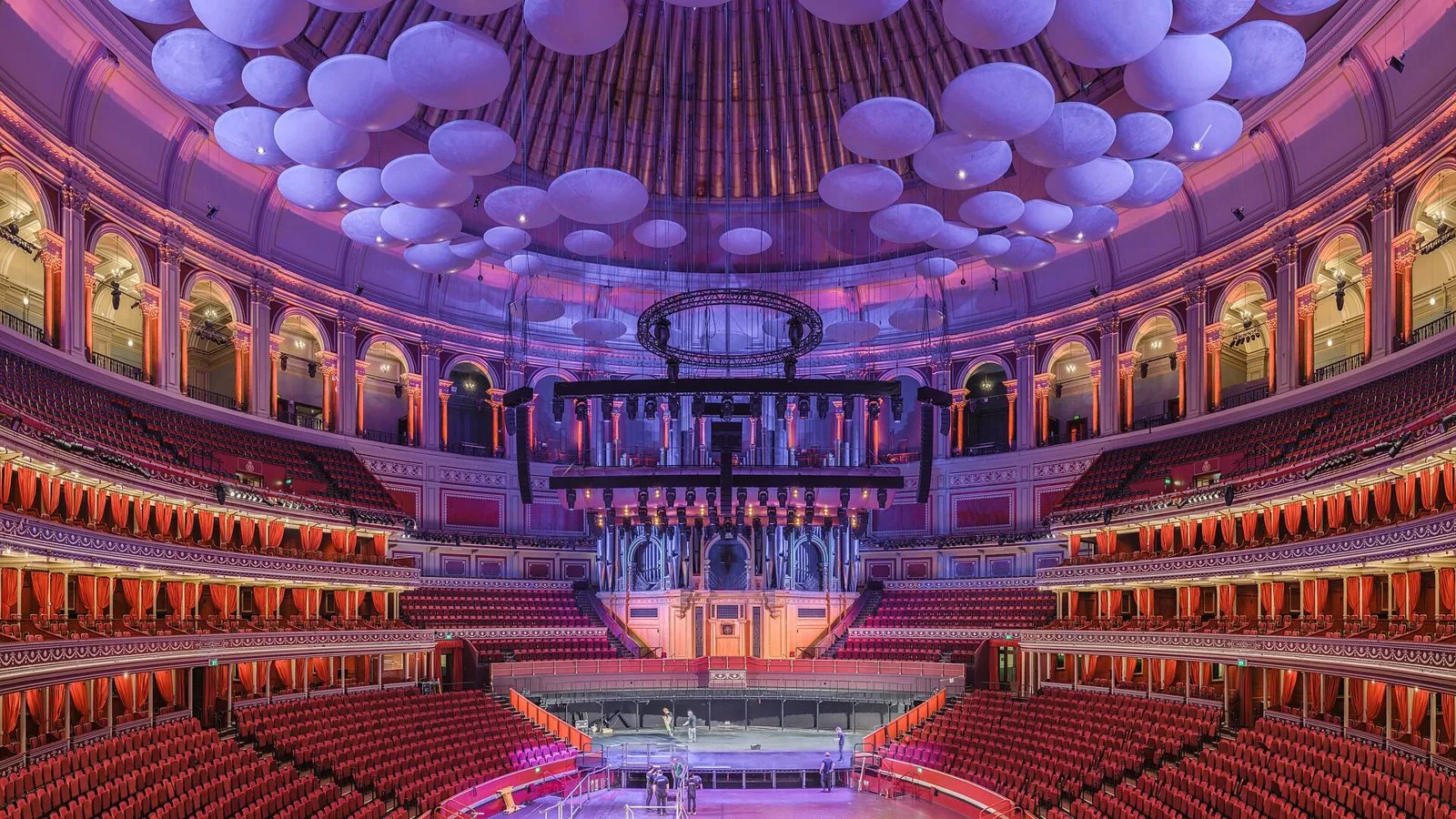
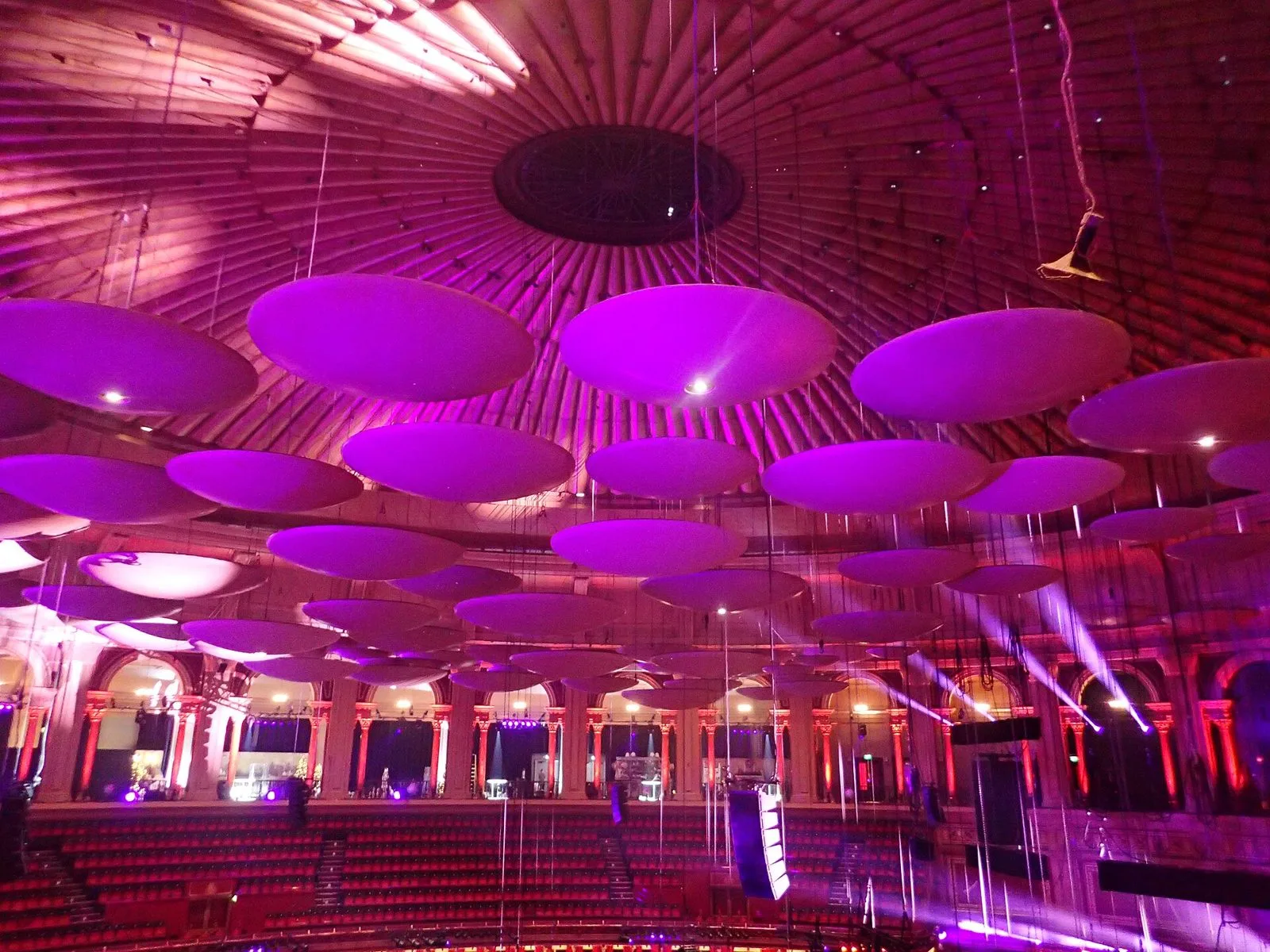
The real fix came in 1969. Under acoustician Ken Shearer, some 135 fibreglass discs were hung beneath the dome at varying heights. Their job was twofold: to intercept the energy rising toward the dome and to diffuse it in all directions rather than let it refocus. By breaking up the long path, they removed the late reflection behind the echo.
Their domed shape earned a nickname that stuck, the mushrooms, sometimes the saucers. They are now as much a part of the hall’s visual identity as of its acoustics. They are giant diffusers, distant cousins of the treatment you fit in a studio today, scaled up to the size of a monument.
The largest single-room system
The mushrooms fixed the natural acoustics. What remained was the reinforcement system, long entrusted to ageing gear. In 2019 the Royal Albert Hall installed a d&b audiotechnik system that the hall describes as the largest permanently installed single-room loudspeaker system in the world, with 465 loudspeakers. The project was costed at around two million pounds.
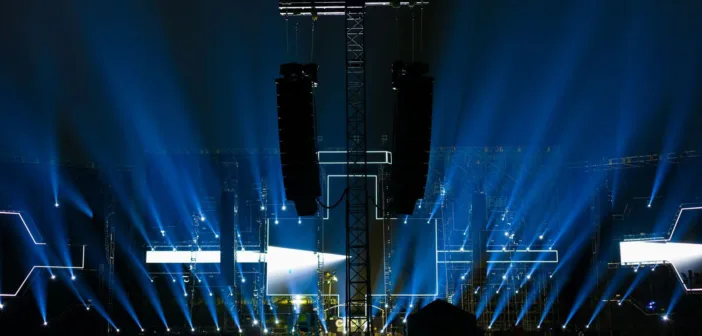
The backbone is left, centre and right hangs of d&b V8 and V12 line arrays, filled out with delay cabinets for the circles and 23 Ti10P units dedicated to the gallery, the notoriously awkward upper ring. Before a single cable went in, Sandy Brown’s acousticians built a full impulse-response model of the hall, which let the d&b teams predict the result before installation. The job alone accounts for 15,291 metres of cable.
The most telling constraint is the schedule. As a Grade I listed building, the Royal Albert Hall never really closes: the install stretched over 28 weeks of overnight work, and none of the 327 shows staged in that window were disrupted. Integrator SFL ran the operation by threading between concerts, packing up each morning to leave the hall ready.
What a difficult room teaches about reinforcement
The Royal Albert Hall is a textbook case of covering a hostile volume. The lesson reaches well beyond monuments: when a room gives too much back, you do not compensate by pushing the level, you control loudspeaker directivity to light up only the audience and spare the reflective surfaces. Flown line arrays exist for exactly this: a controlled curvature, directed energy, delays timed so every row gets the sound at the right moment. The gallery is the same coverage calculation as the choice between point source and line array. For sheer excess, though, it stays a long way from the Grateful Dead’s Wall of Sound, another landmark in the history of live sound. The figures and system detail are documented by the Royal Albert Hall.
My take
What strikes you is the consistency across 150 years. They first treated the physical cause with the mushrooms, then the reinforcement with a modern system, never trying to mask one with the other. The 465 loudspeakers make a fine press line, but the real feat is elsewhere: fitting all of it without closing a hall that runs every night, in a building where you cannot drill a wall without permission. It is the kind of project judged by silence, the silence of an audience that notices nothing and finally hears the music the first time around.