Behind every big tour is a provider that trucks, flies and tunes tons of sound. Clair is one of the firms that invented that trade. The story starts in a small Pennsylvania town, Lititz, and with a family that turned a teenage passion into a global company.
From the father’s PA to the first tours
It all begins in 1955. The father of Roy and Gene Clair buys a small PA that the two brothers start renting out, first to local bands, schools and churches in the area. The real turning point comes in 1966: they are asked to take their system on tour with Frankie Valli and the Four Seasons. Back then, putting sound on a tour is still improvised, and the available gear is not built to travel. In 1967, their system relies on Altec Lansing A7-500 cabinets, the famous Voice of the Theatre boxes designed for cinemas, repurposed to cover a concert crowd.
In 1970, the business is formalized as Clair Bros. Audio Enterprises. The company does more than rent speakers: it designs its own gear, because nothing on the market truly meets the demands of a tour.
The S4, the box that changed the game
Clair’s most cited contribution is the S4, introduced in 1974. At a time when large concert systems stack boxes of different sizes, the S4 offers an all-in-one cabinet, designed to be repeated identically and flown overhead. Early versions use JBL components. The idea of a single, repeatable, flown module already sketches the logic of the modern line array.
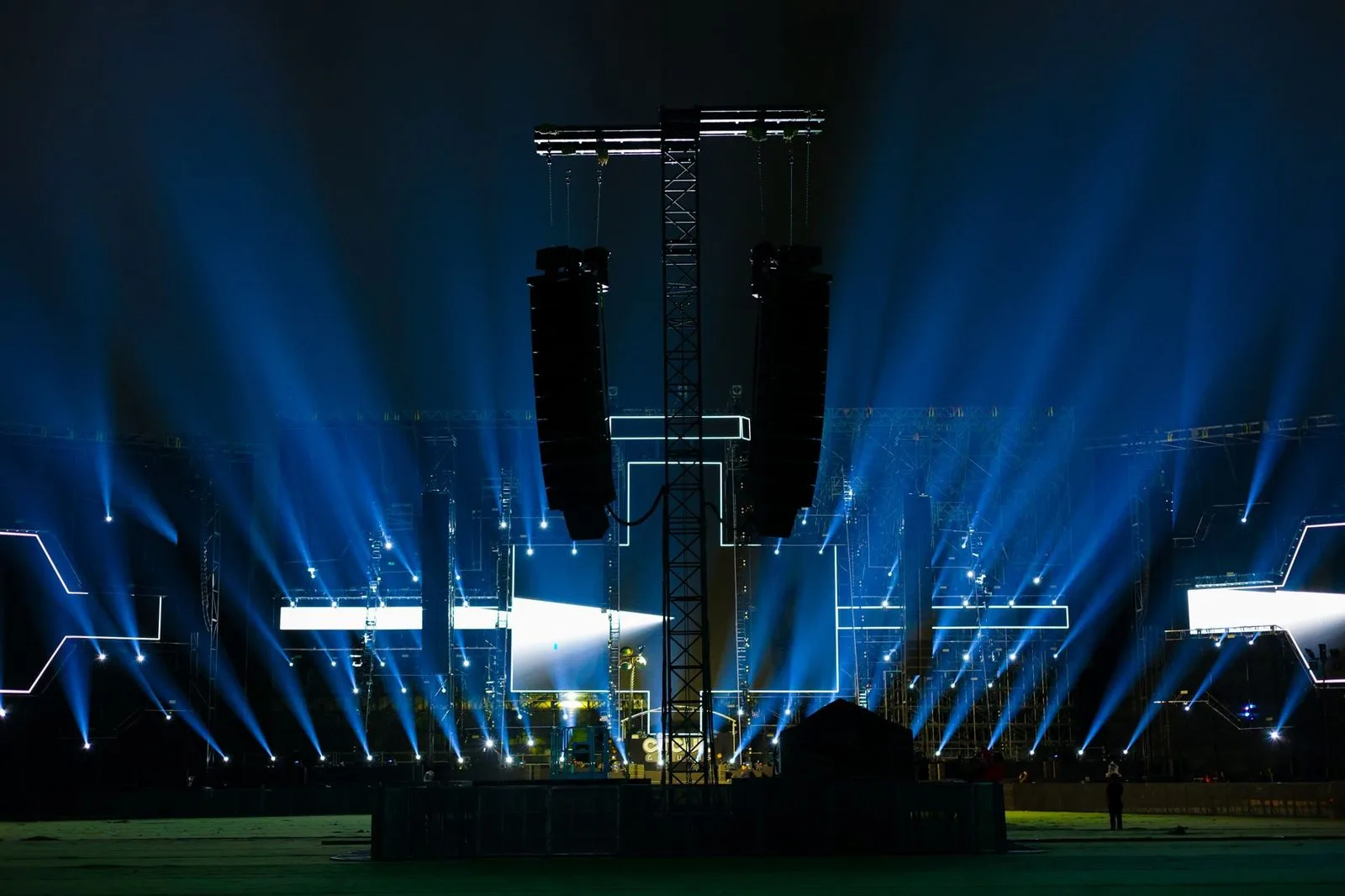
The other contribution is the rigging. Clair is among the first to hang its speakers above the audience rather than stack them on the ground, in the early 1970s, for indoor arenas. Accounts differ on the exact date of the first truly flown system, but the direction is clear: lift the sound off the floor, place it high, cover the crowd more evenly. It is the same quest as the Grateful Dead Wall of Sound, by other means.
How a touring system is designed
A touring sound system is a chain you unroll from the mix to the loudspeaker. The front-of-house console sends the mix to a system processor that handles alignment, filters and limiters, then to the power amplifiers, and finally to the main line array, with a dedicated branch for the subwoofers.
Clair did not just build boxes, it industrialized this chain: coherent systems, easy to transport, quick to rig and repeatable from one venue to the next. That is the whole point of a tour, where the sound has to be the same in Paris and in Tokyo. The core questions are still with us, from flying a line array safely to choosing between point source and line array for the room.
From Clair Bros to Clair Global
In 2008, the company takes the name Clair Global, a sign of a business that has gone worldwide. The headquarters stays in Lititz, the firm remains family-owned, now led by Troy Clair. Gene Clair, one of the two founding brothers, died in December 2013. The brand still designs its own systems, from the i-5 series to the Cohesion range, and Clair Global has grown into a production provider present on a large share of the big tours, well beyond sound alone.
That legacy still shapes a stage. Today’s reflexes, from system alignment to monitoring choices, from wedges to in-ear monitors, come straight from those years when everything was still to be invented.
My take
What stands out in Clair’s path is the consistency: design your own gear because the market does not follow, then turn it into a touring standard. The S4 was not the prettiest speaker in the world, but it solved a real problem, flying a coherent system fast. The lesson still holds for anyone preparing a rig: a system built for the field beats a spec sheet. And there is the quiet pride of a family firm that stayed in Lititz and ended up equipping the planet.
Source: historical account from ProSoundWeb (History Files).