Facing a room, the first real decision isn’t the brand but the architecture: point source or line array? You still see line arrays flown in 200-cap clubs where a good point source would do better, and ground-stacked point sources struggling to cover a 40-metre nave. The two approaches answer to different physics. Knowing them means choosing right — and often spending less.
Point source: simple, direct, predictable
A point source is a cabinet whose drivers sit close enough to behave as a single source: a coaxial head, a two- or three-way trapezoidal box. Sound radiates with a directivity set by the horn, and level drops about 6 dB every time distance doubles. That’s the inverse-square law, and it has a concrete consequence: it hits hard in the front row and runs thin at the back.
That behaviour isn’t a flaw, it’s a tool. In a shallow room, a club, a conference, a secondary festival stage, a point source offers fast deployment, a coherent sound image and a contained cost. It also excels as fill: front-fills, out-fills and delays are almost always point sources, because they’re asked to cover a close, well-defined zone.
Line array: throw far, cover deep
A line array stacks several identical elements, coupled tightly enough to form a near-cylindrical wavefront in the near field. In that zone, level drops only about 3 dB per doubling of distance instead of 6. That’s the system’s whole reason to exist: throw far and keep a reasonable level difference between the first and last row.
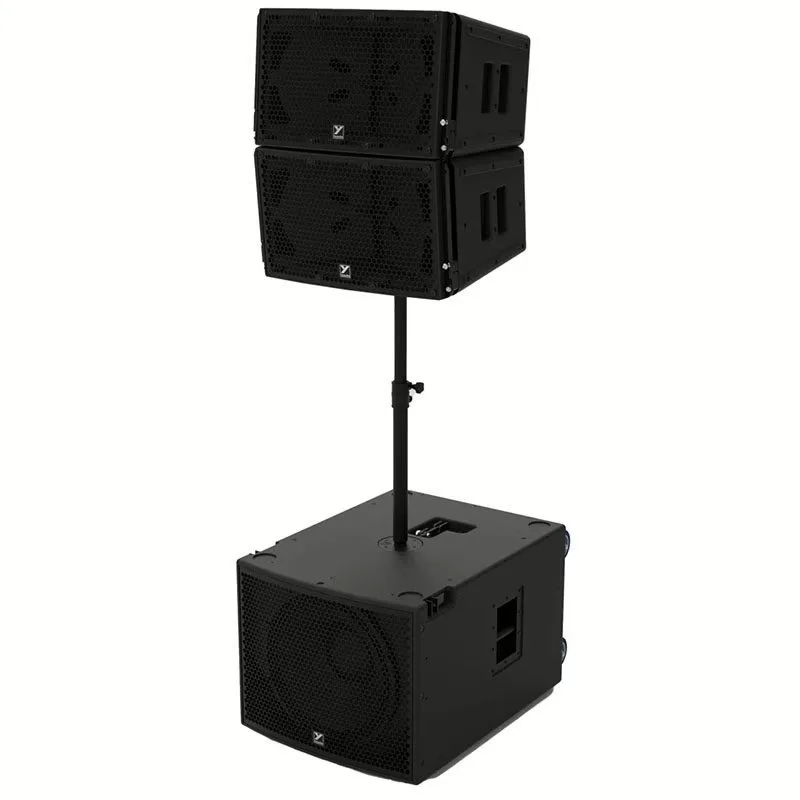
But that reach comes at the cost of complexity. A line array must be flown high and, above all, correctly curved: each inter-cabinet angle steers energy to a specific slice of the audience. That’s the whole point of hanging and angling a line array. Set wrong, it fires into the ceiling or leaves coverage holes; set right, it distributes level with an evenness no single point source matches over real depth. Compact models, such as active compact line array boxes, have brought that logic within reach of medium rooms.
The decision grid
To settle it, ask the right questions in order:
- Audience depth. Up to 15-20 metres, one or two point sources per side often suffice. Beyond that, the 6 dB drop becomes punishing and the line array (or a point source backed by delays) wins out.
- Available height. A line array needs to fly high for its curvature to work. No rigging points, low ceiling, flat floor? The point source becomes the realistic choice again.
- Target level and headroom. A demanding amplified show needs SPL and stamina; a conference or theatre prizes intelligibility and discretion.
- Logistics and budget. Rigging, motors, load calculations, build time: a line array costs in gear and labour. In a small room, that’s money and time wasted.
In practice, you combine
The reality on the ground is rarely binary. A main line array is nearly always backed by point sources: front-fills for the first rows that pass under the lines’ projection, delays for distant or masked zones. Subwoofers follow their own logic of coupling and directivity — see our feature on cardioid subwoofer arrays. Whatever system you choose, nothing works without rigorous system tuning: time alignment and a target curve are what turn a good architecture choice into even coverage.
My take
The line-array reflex is often an over-speccing mistake dressed up as an upgrade. In a shallow room, a well-placed point source sounds more natural, tunes in ten minutes and leaves budget for monitors. The line array earns its keep when audience depth exceeds what a single box can hold — there, its evenness is unbeatable. The real question is never “what’s the best system?” but “what do this room, this audience and this budget call for?”. A provider who can place two point sources and three delays in the right spots often serves the show better than a big array hung badly.