Dubreq, the inventor of the Stylophone, has grown up. With the Stylophone On-The-Fly, the brand delivers a sequencer built to be played rather than programmed. No screen, no sub-menus: every control responds instantly while the sequence runs. Priced at £149 (around €169 / $199), this newcomer to the Pro Range, branded Music Lab, targets electronic musicians, Eurorack patchers and anyone who likes to perform in real time.
A sequencer you play, not program
The idea is everything, right now. You program eight steps, and the On-The-Fly instantly builds patterns of 16, 32 or 64 steps. You switch between patterns or reverse the direction without breaking the groove. Mid-sequence, you add per-step slide, ratchets, rests, ties or a dose of controlled randomness. Three playback directions are on hand: forward, reverse and bounce. Twenty-four sequence memories recall on the fly, each holding the pitch and duty cycle of every step.
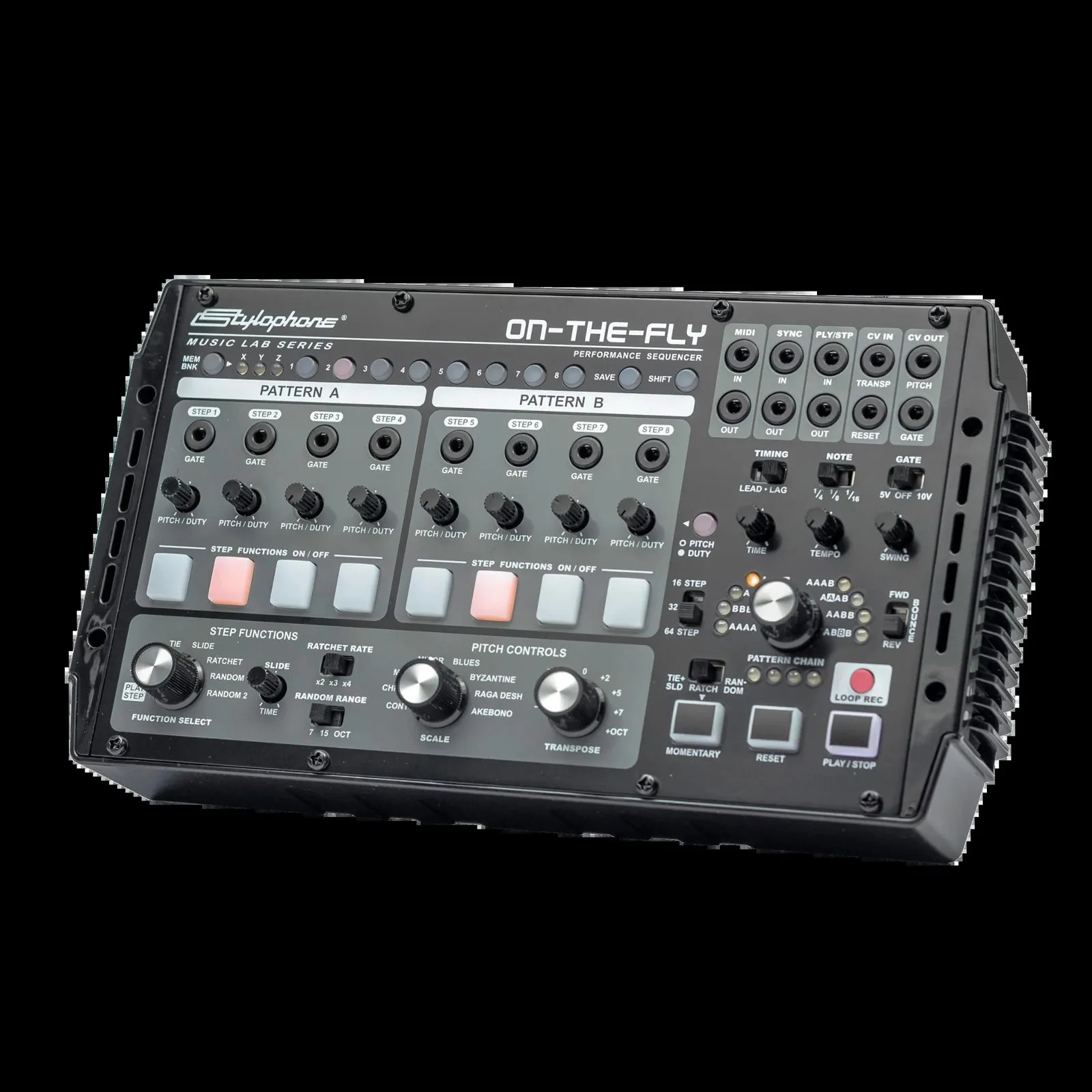
The rest of the panel follows suit. Scale and transpose control is handled by knob, CV or MIDI, with a range of scales that goes well beyond major and minor: blues, byzantine, raga desh, akebono. Groove controls, tempo, swing, lead/lag timing, note length and gate length, fine-tune the feel. A manual performance button fires fills and breaks by hand. Finally, loop recording captures a performance up to 128 steps, across 24 slots.
Built for modular
Where the On-The-Fly separates itself from a toy is the connectivity. It carries Eurorack-format CV and gate I/O, MIDI and sync. Better still, it offers eight separate gate outputs, one per step, plus a summed gate out. That is enough to drive a whole rack, trigger several envelopes or percussion voices independently, and slot into a modular, MIDI or hybrid system. Multiple units can even be linked and synced to build a multi-sequencer. A long way from the pocket gadget of old.
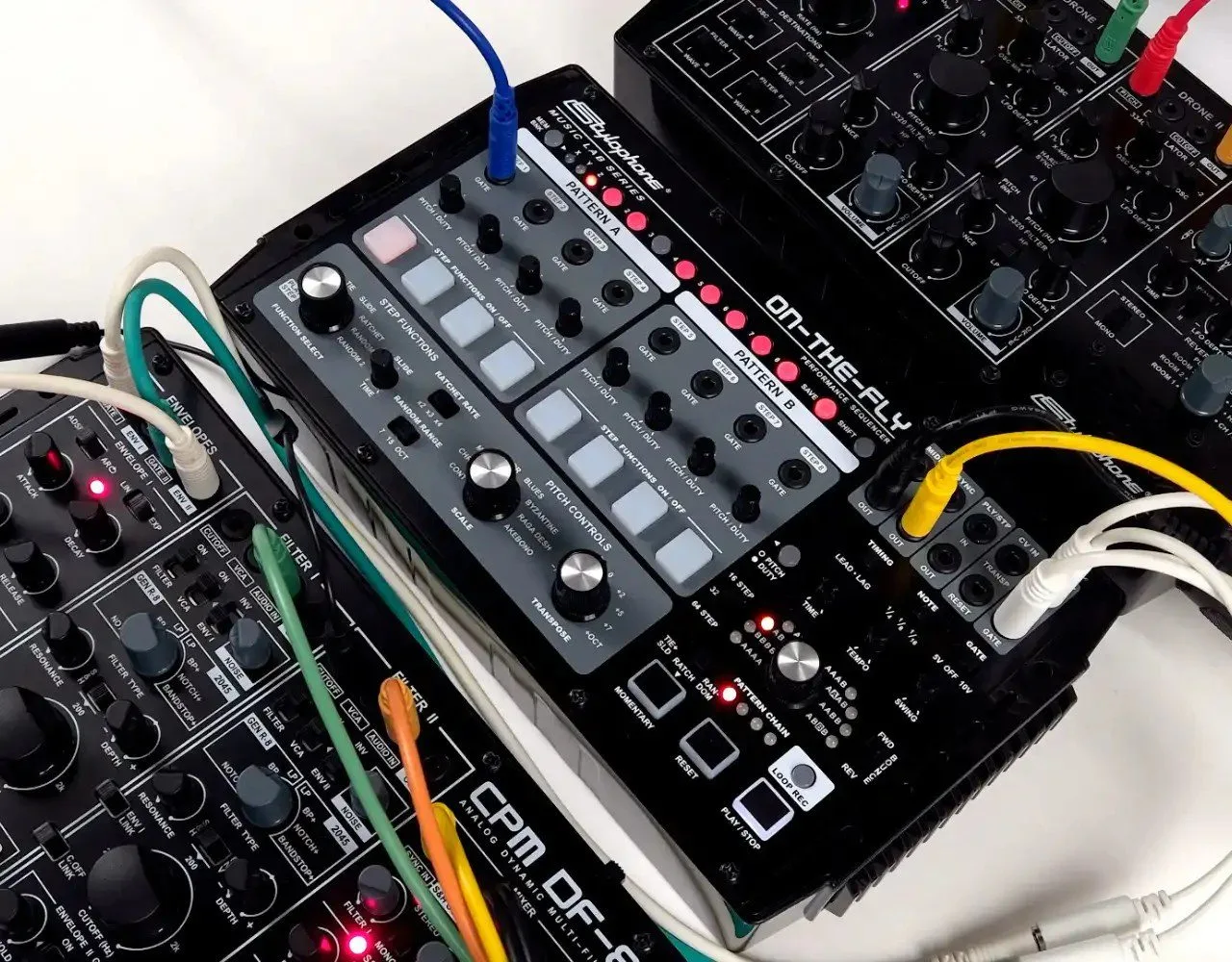
The On-The-Fly joins Dubreq’s CPM family, built around the DS-2 and DF-2 modules, and confirms the brand’s shift toward a genuine, affordable sound-creation ecosystem. Announced at NAMM in January, it has been reaching shops since early November.
My take
A screenless sequencer that answers to your fingers while it runs is exactly what many menu-locked setups are missing. The performance approach, eight steps expanded to 64, pattern and direction changes on the fly, puts playing back at the centre, and the eight independent gate outputs give away real modular ambition rather than a nostalgic wink. At £149, the features-to-price ratio stands out. The real question is ergonomic: does a panel this dense come quickly under the fingers in the heat of a performance? That is where the fun will be won or lost.
Frequently asked questions
Does the On-The-Fly make sound on its own?
No. It is a sequencer: it drives other instruments via CV/gate, MIDI or sync. You need to connect it to a synth, a Eurorack module or a drum machine to hear anything.
Is it Eurorack-compatible?
Yes. It has Eurorack-standard CV and gate inputs and outputs, plus MIDI and sync. It offers eight separate gate outputs, one per step, and a summed output, to trigger several parts of a rack independently.
How many steps and memories does it hold?
You program eight steps to build sequences of 16, 32 or 64 steps, with eight live-switchable pattern chains. The unit stores 24 sequence memories, and loop recording goes up to 128 steps across 24 slots.
Can you chain several units?
Yes. Multiple On-The-Fly units link and sync into a larger multi-sequencer system, handy for driving several voices or parts in parallel.
To stay in the modular and sequencing world, revisit our piece on the Befaco ARK and our look at the Behringer Ignite open-source sequencer.