Past a certain distance, no main PA is enough. The sound loses level, the highs dull, and people at the back hear a late, muddy version of the show. The classic answer has a name: the delay tower. Set well, it brings presence back to the rear without ever betraying that the music comes from the stage. Set badly, it doubles the sound and wrecks clarity. It all comes down to two numbers, a time and a level.
Why sound runs out at the back
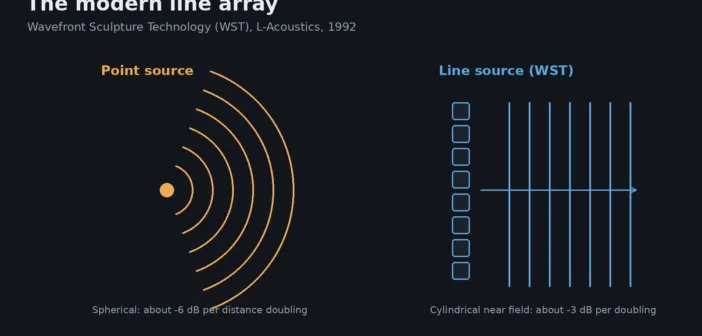
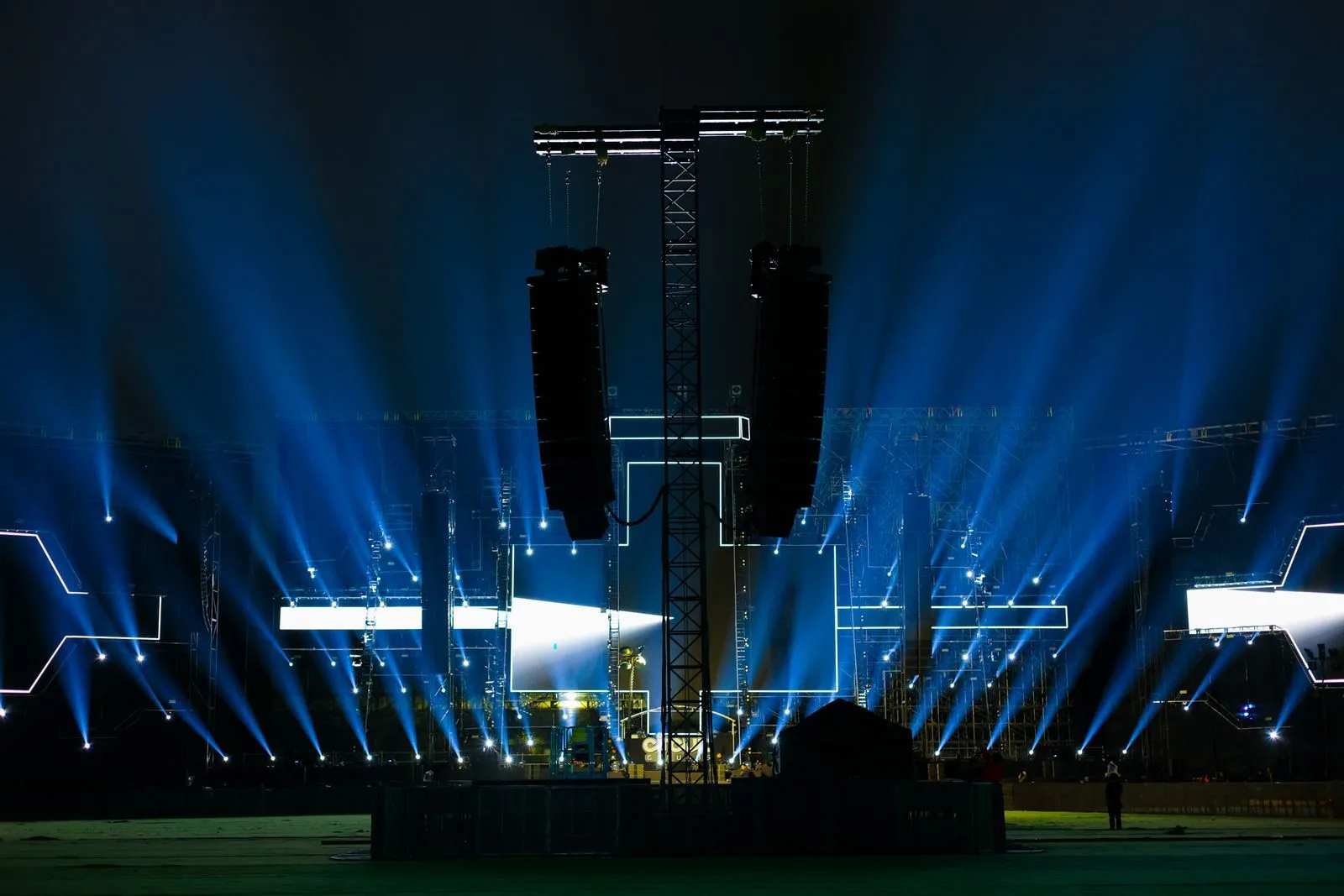
A source loses level with distance. In a free field, you lose about 6 decibels every time you double the distance. The air also absorbs high frequencies, more so when it is dry and the distance is long. The result is that a hundred metres from a line array, there is still low end and some midrange, but the clarity is gone. One main PA can cover a fine room, not an open field. To hold intelligibility far out, you need to bring a source closer to the audience without breaking where the sound seems to come from. The line array pushes that limit back, but it does not remove it.
How a delay tower works
A delay tower is a set of speakers placed deeper in the audience that carries the main PA signal. Its job is not to “add sound” but to lift the local level so speech and transients stay readable. The trap is obvious: if that closer source arrives before the one on stage, the ear locates the tower, not the band. So you electronically delay the tower so its wavefront leaves just after the main PA. The ear keeps pointing at the stage, thanks to a phenomenon we cover in our article on the Haas effect and precedence.
Working out the delay time
Sound travels at about 343 metres per second in air at 20 degrees Celsius. The basic figure is one division: the delay time in milliseconds equals the distance between the main PA and the tower, in metres, divided by 0.343. A tower sixty metres from the main PA therefore needs about 175 milliseconds. You then add a small margin, around 5 to 15 milliseconds, so the image stays firmly anchored on stage. That margin is the real secret of a tower you forget once you are in the crowd: it is there, but you do not hear it as a source.
Temperature changes the maths
The speed of sound depends on temperature: it rises about 0.6 metre per second for every degree gained. On a distant tower, a festival that goes from 28 degrees in the afternoon to 16 at night sees its alignment drift by several milliseconds. That is not trivial over long distances. The good habit is to re-measure in real conditions, at show time, not only at the afternoon tuning. Wind, for its part, shifts and distorts the wavefront outdoors, and you cannot compensate it to the millimetre.
Setting the level
A delay tower is set a few decibels below the level you would think is “right”. It should lift intelligibility, not take over. Too loud, it draws the ear despite the delay, and the audience locates the tower. The right cue: in the overlap zone, you should feel the clarity improve without being able to tell where it comes from. Indoors, the same logic applies to under-balcony fills and near-field reinforcement, over shorter distances.
Measure and align
The maths give a starting point, the measurement gives the final setting. A transfer function measurement system lets you align the delay to the millisecond and check coherence across the transition zone. The delays, filters and limiters that drive each tower live in the loudspeaker management processor, which you should document cleanly to recall settings from one night to the next. Remember to size the amplification of the tower for the area it covers.
Latency and signal transport
One last point often slips by: the chain that carries the signal to the tower adds its own latency. An audio network transport, a conversion, a processor, each costs a fraction of a millisecond. The delay you dial in is therefore not necessarily the real acoustic delay. Hence the value of measuring the arrival at a microphone, out in the crowd, rather than trusting the theoretical figure alone. Outdoors as indoors, it is that field check that separates a transparent tower from one you can hear.
My take
The delay tower is one of the rare settings where a wrong number is heard at once, and a right one turns invisible. That is what makes the task rewarding: you know straight away if it works. The theoretical figure is only a starting point; temperature and the chain’s latency do the rest. My advice fits in one line: drop a measurement mic in the zone, listen to a spoken voice, and pull the tower down until it disappears while the words stay sharp. The day nobody notices your towers, you have nailed them.