Two engineers can listen to the same PA and still disagree. Measurement doesn’t argue: it shows what the system is actually doing before the room fills up. At the heart of modern system tuning sits one precise method, the transfer function measurement using dual FFT. Here is how it works, and above all how to read what it tells you.
Why measure when you have ears
Your ears are a great judge of the result and a poor diagnostic instrument. They adapt in seconds, they can’t separate a room dip from a phase problem between two boxes, and they’ll never tell you your subs are arriving 4 ms early. Measurement answers questions listening can’t settle: are my sources time-aligned? is my response even across the whole audience? is that dip at 160 Hz coming from the speaker or from a cancellation between sources? We measure to be objective, to document, and to save time — not to replace the final judgment, which stays with the ears.
It’s also a safety net. A clean alignment means a show that starts with gain-before-feedback margin, intelligibility that holds at the back, and settings you can recall from date to date. It’s the direct extension of the method in our guide to live sound system alignment.
The transfer function principle
A transfer function measurement compares two signals: the reference (the electrical signal sent to the system, tapped at the console or processor output) and the measurement (what a measurement mic picks up in the room). The analyzer computes, frequency by frequency, the difference between the two. In plain terms: “what did the system and the room do to the signal between point A and point B?”
It’s called dual FFT because the device runs a Fourier transform on each of the two signals, then divides one by the other. The result doesn’t depend on the musical content: you can measure with pink noise, a soundcheck track or the walk-in music, as long as the signal is rich enough across the band. That’s what makes the method usable in the real world, not just with a lab test tone.
Three traces, three readings
A dual-FFT analyzer gives you three pieces of information at once: magnitude (the frequency response, in dB), phase (the relative time offset per frequency) and coherence (how trustworthy the measurement is). You read them together: a magnitude trace only means something where coherence is good.
Reading magnitude without over-correcting
The magnitude trace is the most intuitive one: it looks like an EQ frozen in time. The temptation is to make it perfectly flat. That’s a mistake. Aim for a gentle target curve, usually sloping slightly down toward the top end, and fix the broad, stable bumps, not the micro-peaks. A narrow, deep dip is almost always an acoustic cancellation tied to a path or a reflection: EQ won’t fill it, it will just waste headroom. Move the source instead, or treat the cause.
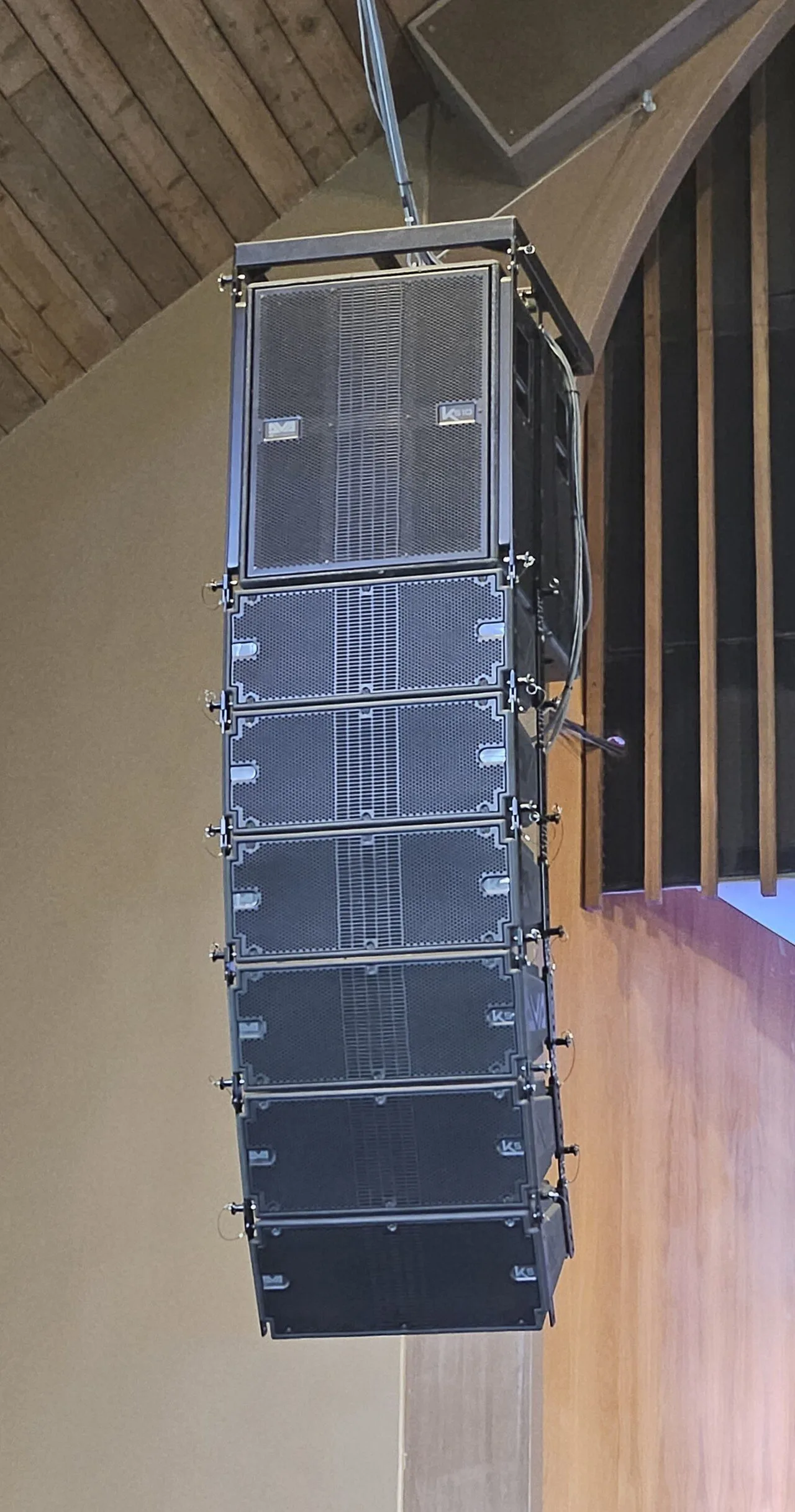
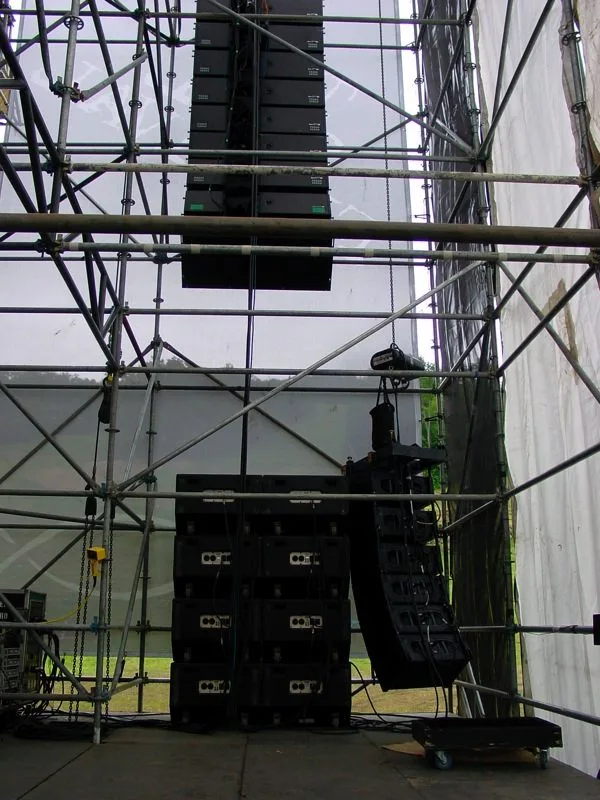
Remember that a measurement taken at a single point only describes that point. Real coverage is judged at several positions, from the front row to the back, and out to the sides. That’s where the evenness of a properly flown and angled line array is won or lost.
Phase, where the war is won
Magnitude says “how much,” phase says “when.” Phase decides whether two sources add up or fight each other in the overlap zone — typically between tops and subs, or between a main and a delay. Two systems whose phase responses track each other through the crossover region add cleanly; if they’re opposed, you lose low end and energy exactly where the audience is densest.
Reading phase takes some practice: a steady slope mostly indicates a constant delay (compensated with a delay line), while sharp jumps signal a real crossover or polarity problem. When you’re unsure whether it’s an inversion or an offset, our piece on phase vs polarity clears things up.
Coherence, your confidence meter
Coherence is the trace beginners ignore and good engineers check first. It scores, from 0 to 1, how much of the measured signal actually corresponds to the reference. High coherence means “this measurement is reliable, you can act on it.” Coherence collapsing in the low end or in certain zones betrays noise, too much reverberation, too low a level or bad windowing. Golden rule: never correct a zone where coherence is poor. First find out why it is.
Windowing, averaging and the mic: the field method
A few habits make the difference between a lying measurement and a helpful one:
- Find the delay first. The delay finder locks the measurement clock to when sound reaches the mic. Without it, your phase trace is useless.
- Average. Several averaged captures smooth out ambient noise and small air movements. A single isolated capture is fragile.
- Mind the mic. A calibrated omnidirectional measurement mic, on a stand, at audience ear height, away from immediate reflective surfaces. Move it to confirm a trend rather than trusting one spot.
- Enough level. Measure loud enough to clear the noise floor, without clipping the measurement chain.
From diagnosis to adjustment
Measurement isn’t an end in itself: it feeds three decisions. Delay, to time-align sources covering the same zone (subs, delays, front-fills). Gain, to balance relative levels between sub-systems. EQ, last, to bring the response closer to the target curve once time and level are set. That order isn’t negotiable: EQ-ing before aligning phase means treating a symptom while hiding the cause. You’ll find the same logic in our method for aligning delay, phase and gain, and in the architecture choice between point source and line array.
Recent software suites such as Waves TRACT automate part of this work — but they rest on exactly the same principles. Understanding what happens under the hood is knowing when to trust the automation and when to take back control. The same caution applies to subwoofer placement, where phase decides everything.
My take
The transfer function has stopped being a system-engineer gadget and become a front-of-house reflex, and that’s a good thing. The real leap isn’t in the software, which has become affordable, but in the reading: knowing to ignore a magnitude trace when coherence is poor, recognising a room dip no EQ will fill, resisting the urge to flatten everything. Measuring doesn’t replace the ears, it frees them: once the system is clean and aligned, you can finally listen to the mix instead of fighting the venue. For anyone starting out, the time-gain-EQ order is the one thing to memorise. The rest comes with the rooms.