Building a clean frequency plan is only half the job in RF. The other half, too often neglected, happens in the physical radio domain: the antennas and how you distribute them. A perfect plan on paper won’t hold if the signal already arrives damaged at the receiver. Here’s how to think about antenna distribution for your wireless mics and in-ears — no needless jargon, but no shortcuts either.
Why distribute instead of multiplying antennas
Every diversity receiver needs, in theory, two antennas. For eight channels that would mean sixteen whips bolted to the back of the rack — unmanageable, and counterproductive. Antenna distribution solves it: a single pair of antennas captures the signal, then an active splitter feeds it to every receiver. You gain clarity, you can move the antennas out toward the stage, and you stop neighbouring antennas from interfering with each other.
Omnidirectional or directional
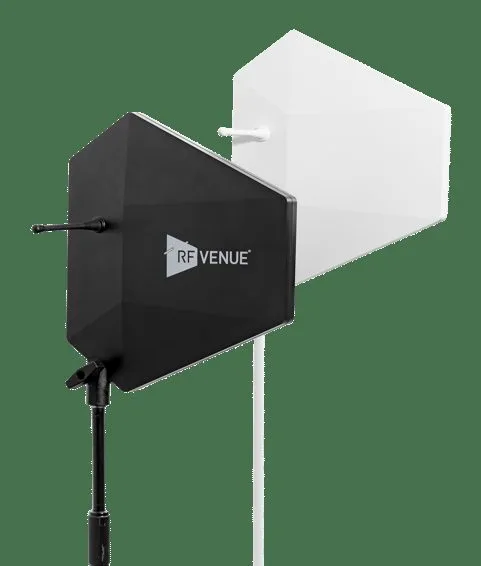
Two main families. The omnidirectional antenna, often a simple half-wave whip, picks up in every direction: simple, but it also gathers all the ambient RF noise. The directional antenna — log-periodic (the famous “paddle”) or circularly polarized — concentrates its sensitivity into an angle, with a gain that improves on-axis range and rejects what comes from behind. On a stage polluted by LED walls or a rack of dimmers, a directional antenna aimed properly at the transmitters changes everything.
Mind the word “gain”: a passive antenna creates no energy, it concentrates what it receives. An active antenna, by contrast, includes a preamplifier. And the earlier you amplify, the more you also amplify noise: the goal is never “the most signal,” but the best signal-to-noise ratio at the receiver.
Move the antenna, don’t lengthen the cable
Here’s the most common mistake. You think you’re helping by bringing the antenna closer to the transmitters with a long coax run — and you lose in cable what you gained in proximity. Coaxial cable attenuates, and all the more as frequency rises: a thin RG58 can cost you several dB over a few dozen metres in UHF, where a larger RG8 or LMR keeps the damage down.
The correct logic: moving the antenna toward the performance area reduces the transmitter-to-antenna distance (what really matters), and to compensate for the resulting cable length you use an active antenna or an inline amplifier whose gain is matched to the cable loss. Not too much (saturation), not too little (noise). It’s a balance, not a crank-it-up setting.
The active splitter, the heart of the system
The antenna splitter takes the signal from the two antennas and replicates it to four, eight receivers or more, often cascaded. It usually powers the active antennas with DC over the coax (bias), avoiding a separate supply at the stage. Two watch points: cascade gain (each stage adds noise) and saturation — a transmitter stuck to the antenna can overload the input stage and degrade the whole system at once. Hence the golden rule: never park a transmitter against a receive antenna. Keep a few metres.
The combiner, on the transmit side
For in-ears and transmit systems the problem reverses: several transmitters close together create intermodulation products that pollute the band. The combiner cleanly sums several transmitters onto a single antenna, with channel-to-channel isolation that limits those intermods. It’s the transmit-side equivalent of what the splitter does on receive — and just as decisive on a busy stage.
Placement: line of sight above all
An antenna lives by its line of sight to the transmitters. Place it high, clear, facing the performance area, away from large metal masses, LED walls and screens that radiate digital noise. Two diversity receive antennas cross slightly to cover the whole stage and fill propagation dropouts when the artist turns away. And if you go circular polarization, you become less sensitive to transmitter orientation — real comfort when handheld mics wave around in every direction.
Antenna distribution isn’t a big-festival luxury: past four channels, it makes everything else reliable. It’s planned upstream, alongside the frequency plan and RF frequency coordination. The choice of system itself — from entry level to broadcast — matters too, as our survey of the best wireless microphone systems shows. Recent wideband platforms, like the Sennheiser Spectera base station or the Spectera SKM handheld, even rethink distribution around bidirectional antennas.
My take
Antenna distribution is the department nobody sees as long as it works — and that sinks a whole stage when it’s botched. The right instinct isn’t to stack up gain, but to care for line of sight, pick a cable worthy of the distance and let the transmitters breathe. A clean directional, a properly sized splitter and two metres of clearance are usually enough to turn a temperamental RF setup into a system that holds all night. It’s RF plumbing: unglamorous, utterly decisive.