5.1 remains the reference format for TV broadcast, from sport to drama. You still need to master its channels, its standard placement, and above all the stereo downmix most of the audience will actually hear. Here is how to produce a clean, compatible surround mix.
Five channels and one subwoofer
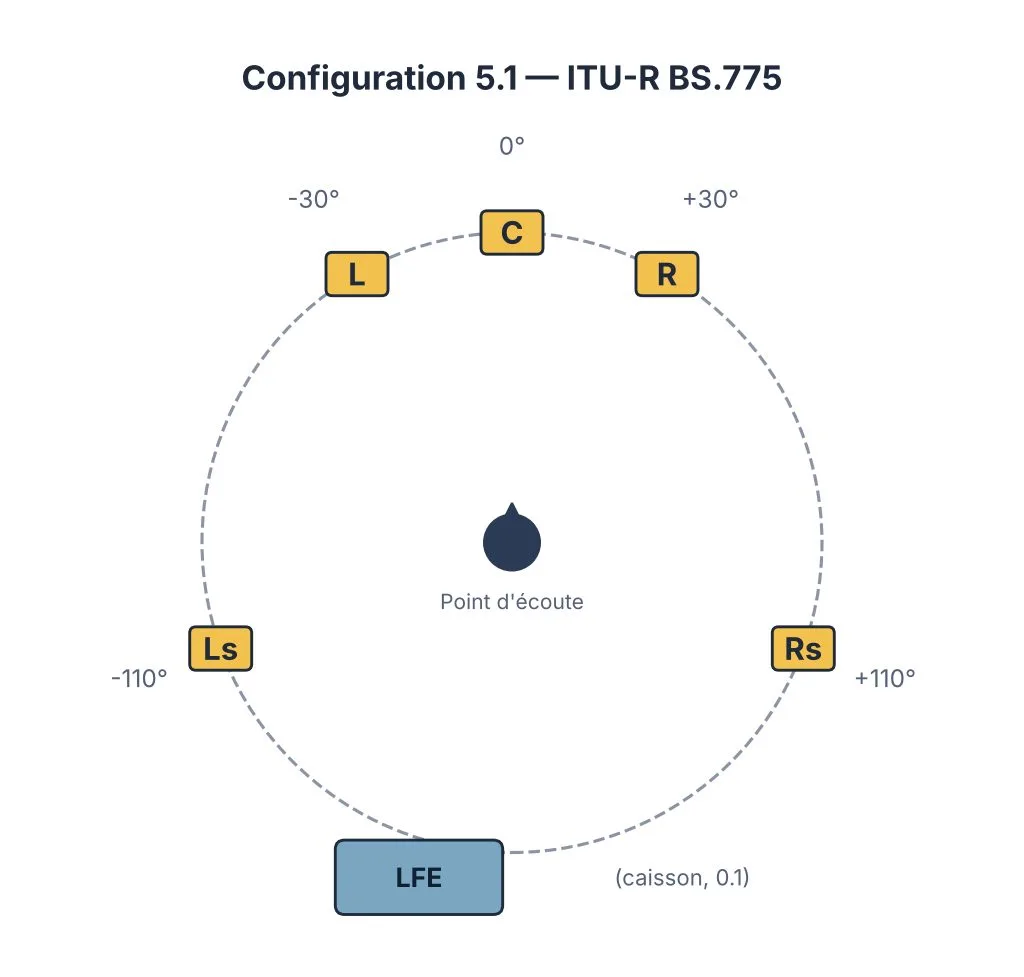
5.1 has five full-range main channels — left (L), centre (C), right (R), left surround (Ls) and right surround (Rs) — plus a low-frequency effects channel, the LFE, which forms the “.1”. Each has a role. The centre carries most of the dialogue and anchors it to the screen, wherever you sit. Left and right fronts hold music and wide effects. The surrounds build ambience and immersion. The LFE carries only a limited band (up to about 120 Hz) and is reserved for low-frequency effects; it is a complement, not an extra bass channel.
Standard placement (ITU-R BS.775)
The ITU-R BS.775 recommendation sets the reference layout around the listening point: centre at 0°, fronts at ±30°, surrounds at ±110°, all speakers equidistant. This placement is no detail: it is what guarantees a mix travels correctly from one control room to another. You still have to calibrate the monitoring — matched level per channel, a reference sound-pressure set with pink noise — otherwise two studios will not speak the same language.
The stereo downmix, the real arbiter
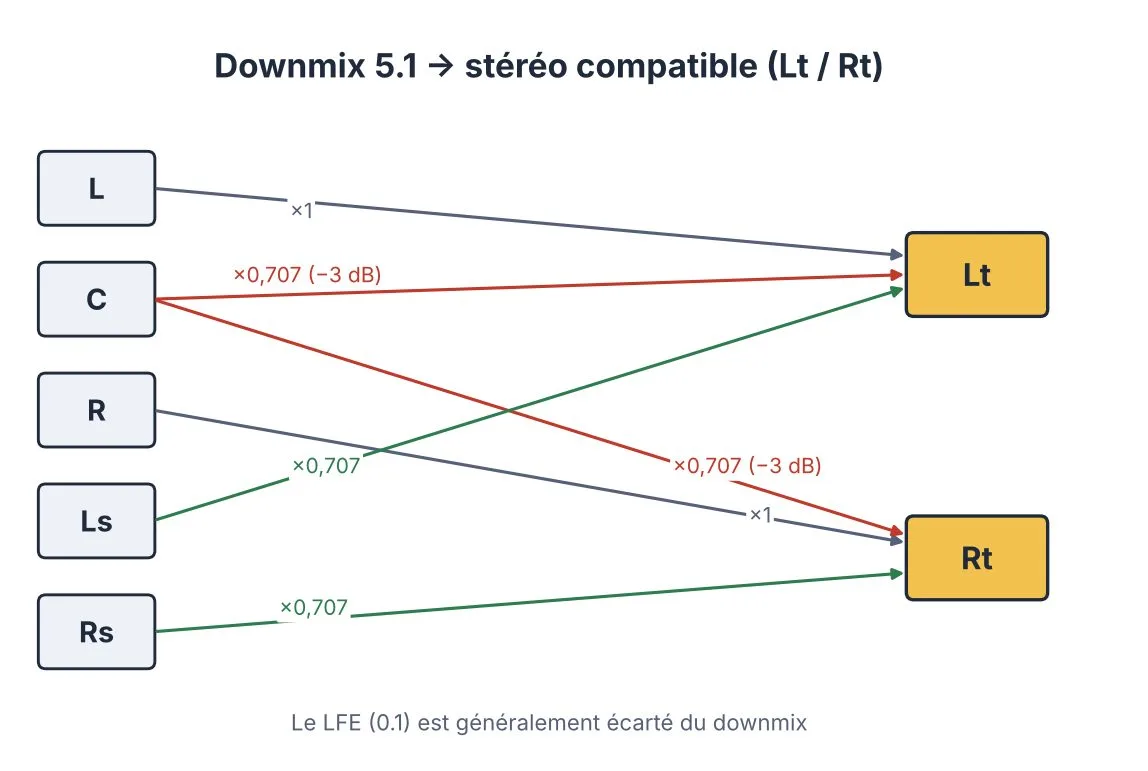
Here is the point most often neglected, though it concerns the majority of viewers: many watch TV in stereo, often on a set’s two small speakers. The 5.1 programme is therefore folded to two channels through a well-established matrix: the fronts pass unchanged, while centre and surrounds are summed into left and right with a 3 dB attenuation (a factor of 0.707). The LFE is usually discarded. We distinguish the purely additive Lo/Ro fold-down from the matrixed Lt/Rt downmix, compatible with Dolby Surround-type decoders. Either way, a mix that sounds superb in 5.1 but collapses once folded down is a failed mix.
Dialogue, dialnorm and loudness
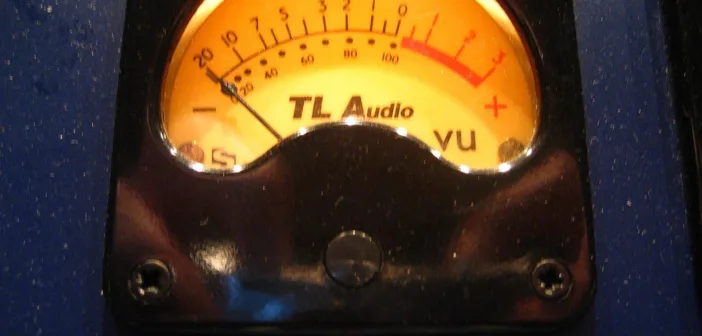
Level consistency between programmes is a delivery requirement. You target an even loudness — around -23 LUFS under EBU R128, -24 LKFS under ATSC A/85 — and you document the dialogue level with a metadata value, dialnorm, which tells the decoder how to adjust playback at the viewer’s end. Watching these values on the right meter avoids harsh jumps between a show and the ad that follows.
From capture to broadcast
The chain starts with multichannel capture and a mix on calibrated monitoring, then the audio is encoded for delivery — typically Dolby Digital (AC-3) on air, or Dolby E for contribution and internal links, since it fits inside a two-channel digital stream. Then it has to travel: embedded in the SDI video signal, or carried over an audio-over-IP network, where each channel must stay in its place all the way to the point of broadcast.
Classic traps in a broadcast 5.1:
- too quiet a centre: dialogue drops out as soon as you downmix to stereo;
- surrounds too present, spectacular in 5.1 but overbearing once folded down;
- neglected phase correlation, which cancels elements in the downmix;
- an LFE used as a bass extension rather than an effects channel.
Where does immersive fit in?
Object-based formats, immersive audio and “next-gen audio” are gaining ground, in TV as in streaming. But they coexist with 5.1 rather than replace it: across the vast majority of broadcast chains, 5.1 — and its stereo downmix — remains the foundation everything else is built on.
My take
5.1 may be twenty-five years old, but it is still the format that pays the bills in TV — and its stereo downmix is its most neglected weak spot. Looking after the centre channel and checking the two-channel fold-down keeps dialogue intelligible for the viewers who never plugged in rear speakers. Immersive is rising, sure, but a well-mixed, properly loudness-aligned 5.1 still does more good than a sloppy Atmos. The basics, always the basics.