Fitting six stereo effects into twelve HP of Eurorack, with direct control over each: that’s the bet behind FUM, the new module from Spanish maker NANO Modules. Shipping since autumn 2026, it targets compact modular systems where you want colour and movement without giving up half your case to a large multi-effects processor.
Six effects, six knobs, one clear principle
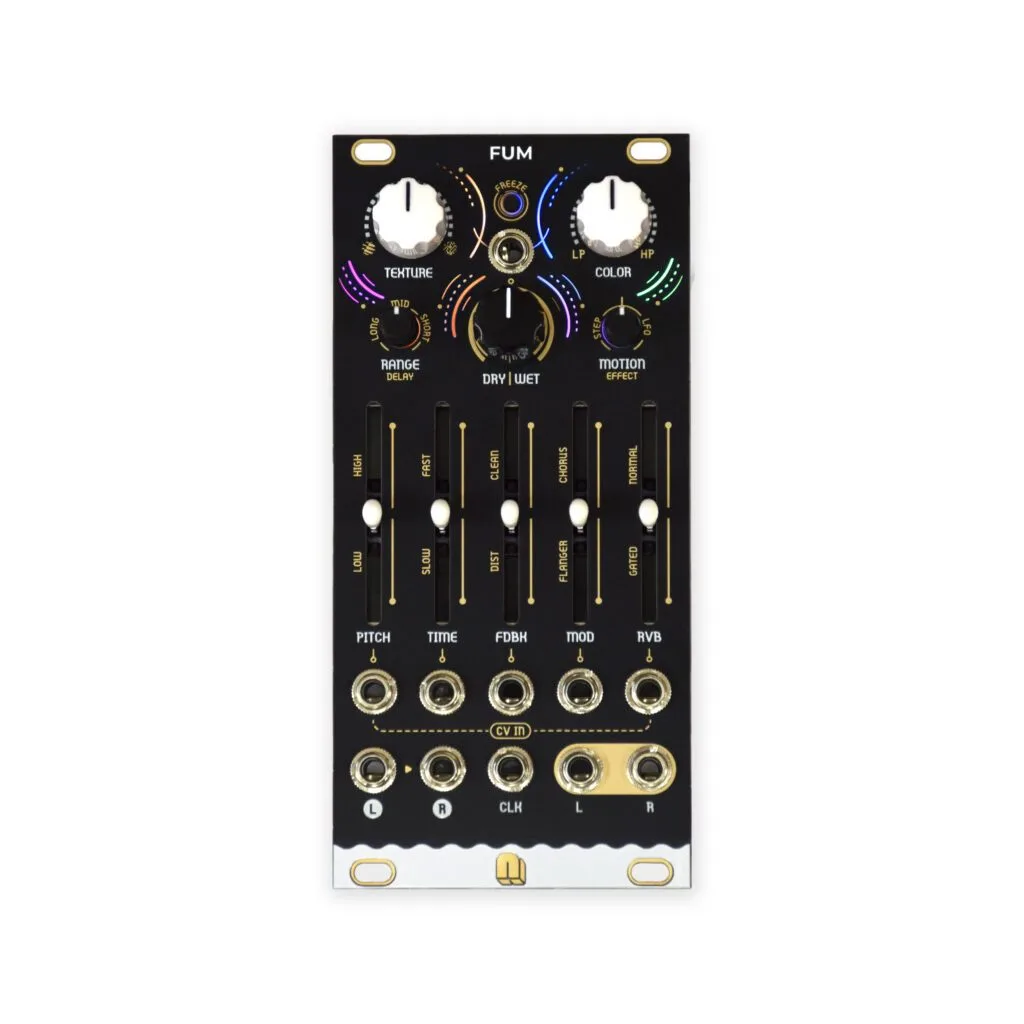
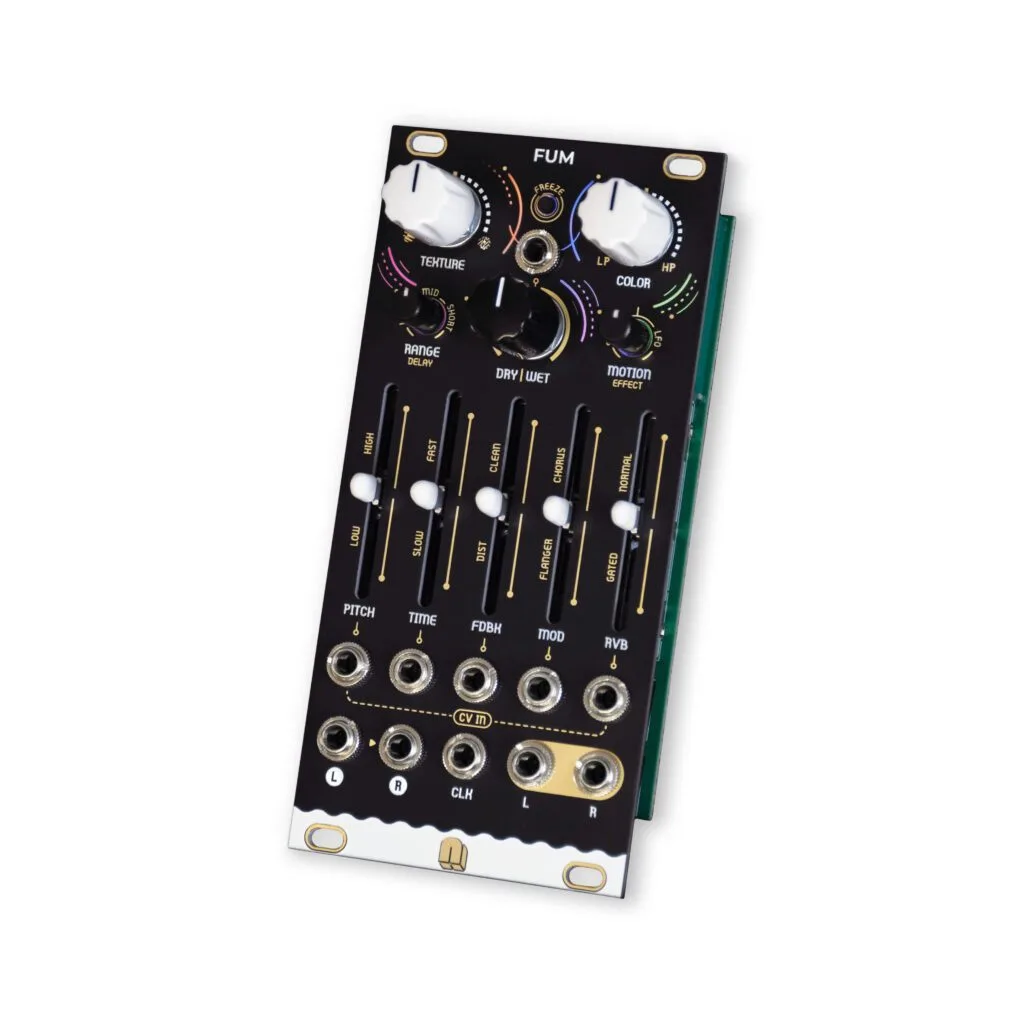
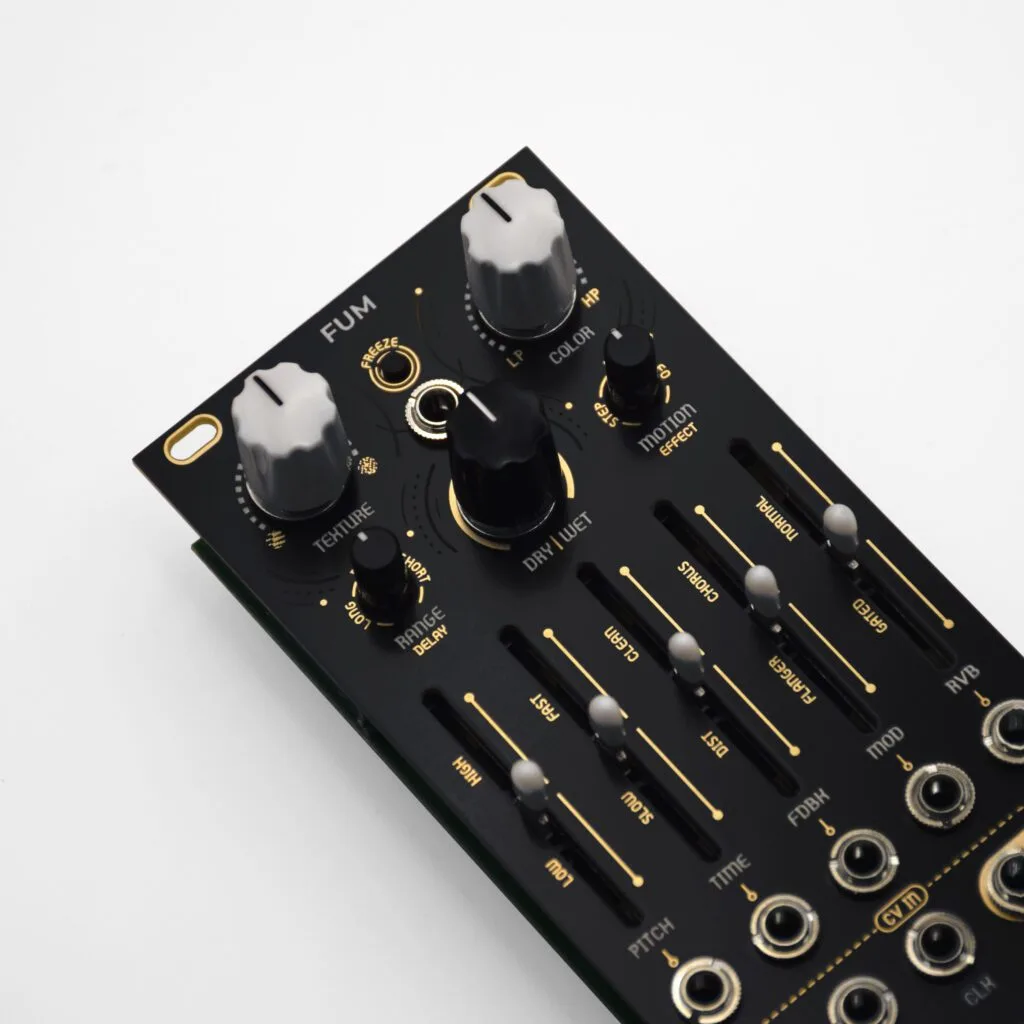
FUM lines up six stereo effects: a delay, a reverb, a pitch shifter, a chorus/flanger, a texture and a colour filter. Each is driven by a single bipolar knob, with the centre position meaning the effect is off. You turn one way or the other to set the amount and vary the character, which makes the module instant to grasp: no menus, no hidden pages, you turn and listen. In 12 HP, that’s a rare effect density.
A delay that syncs, a module that moves
The ping-pong delay can lock to an external clock or run on the module’s internal tempo, and its longest range reaches around ten seconds — enough for evolving pads and loops. An internal modulator animates the active effects, avoiding the frozen sound of static multi-effects. The Freeze function holds the delay buffer while the rest of the module keeps running: you freeze a texture and play over it. That’s where FUM moves past a simple stack of effects to become a playground.
Fitting into the patch
For connections, FUM offers six CV inputs to modulate the effects, a clock input and stereo I/O, with the left input normalled to the right for easy mono use. The six CVs open the door to creative patching: modulate texture from an envelope, pitch from an LFO, filter colour from a sequencer, and the module blends into a modular system’s logic rather than sitting as an end-of-chain effect.
| Spec | FUM |
|---|---|
| Format | Eurorack 12 HP |
| Effects | delay, reverb, pitch, chorus/flanger, texture, colour filter |
| Control | one bipolar knob per effect (centre = off) |
| Delay | ping-pong, syncable (external clock or internal tempo), up to ~10 s |
| Patch | 6 CV inputs, clock input, Freeze, stereo I/O (left normalled to right) |
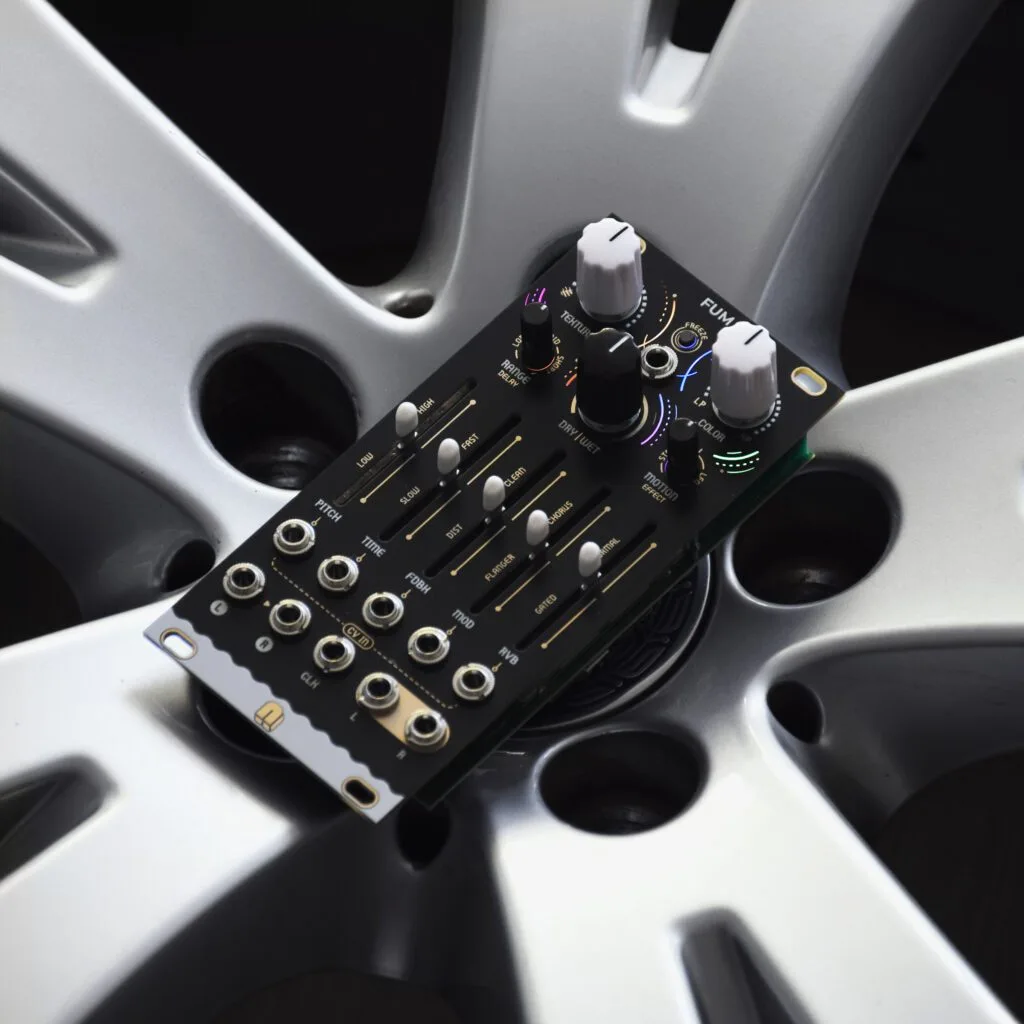
Priced around €235, FUM positions itself as an effects Swiss Army knife for small systems. It won’t replace a dedicated high-end reverb, but in minimal space it gives you the means to colour, spatialise and animate an entire patch. For a travel modular or a packed skiff, it’s a very smart proposition.
Frequently asked questions
Can you use several effects at once?
Yes. All six effects are available simultaneously, each set by its bipolar knob. The centre position disables the effect, so you can switch on only the ones you need and set their amounts independently.
Does the delay sync to the rest of the system?
Yes. The ping-pong delay accepts an external clock to lock to the patch tempo, or runs on its internal clock. Its longest range reaches around ten seconds, useful for loops and pads.
How do you modulate the effects with CV?
FUM has six CV inputs dedicated to modulating the effects, plus a clock input. You can drive texture, pitch or filter colour from the system’s envelopes, LFOs or sequencers.
Does the module work in mono?
Yes. The inputs and outputs are stereo, but the left input is normalled to the right: just patch the left input to process a mono signal, and the module handles the rest.
My take
FUM’s real win is the ergonomics: one knob per effect, centre at rest, and you set it by ear without ever opening a menu. Getting six genuinely playable stereo effects into 12 HP is something of a feat, and Freeze plus the synced delay make it as much a texture instrument as a processor. It isn’t after the precision of a dedicated reverb, and that’s not the point. To animate a small system or travel light, it’s hard to find anything denser per centimetre.