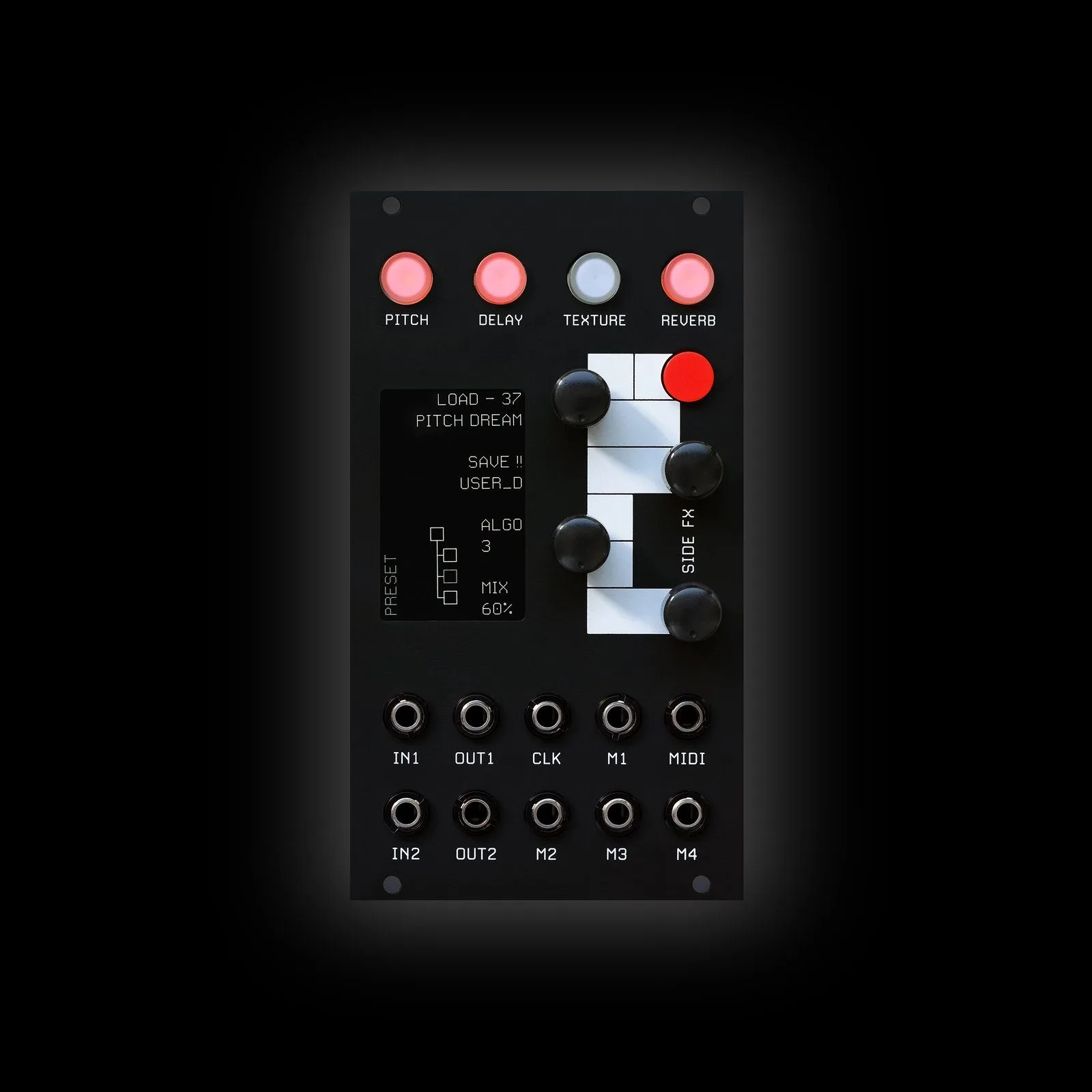
RYK Modular, the maker behind the M185 sequencer and the Vector Wave oscillator, packs four effects engines into a single 14HP module. The Side FX brings delays, pitch, a granulator, resonators and three reverbs, all CV-modulated and MIDI-controllable, and it is shipping now.
RYK Modular is best known for characterful modules such as its sequencing brains, so an effects box is slightly off its usual path. The Side FX is an algorithmic multi-effects processor that fits four effect blocks into a compact 14HP frame, just 25 mm deep so it drops into shallow cases.
Four blocks, seven chains, sixteen algorithms
The idea is simple: instead of stacking separate effect modules, the Side FX runs up to four treatments at once and arranges them through seven preset chains — serial, parallel or mixed. Those layouts include dual-mono chains, letting you process two independent mono signals inside one module, which is handy for routing two different synth voices without doubling up on hardware.
The algorithm list is broad. There are delays and pitch effects (Dual Pitch Shift-Delay, Granulator, Dual Delay, Band Delay, Tap Delays, Tape Delay), modulation and filtering (Phase Shifter, Mod Combs, Quad Resonator, APF Chains), texture and distortion (Glitch, Tape Sim, Wave Shapers) and, for space, three distinct reverbs: Plate, FDN and Modal. Enough to go from a subtle slapback to an unrecognisable granular wash within a single patch.
Internal modulation and control
What sets the Side FX apart from a shrunk-down studio effect is its modular integration. Four assignable CV inputs can drive any parameter, a clock input syncs the time-based effects, and a MIDI input offers the same control from a sequencer or keyboard. The module also carries its own modulation sources — LFOs, a random source and an envelope follower — so you don’t have to give up a rack LFO just to animate a reverb or delay. Each block has an effect send you can open by hand or via CV, useful for riding the effect live.
Settings are stored on a removable SD card, which makes backups and sharing banks between machines straightforward. The module ships with a bank of ready-made chains, from gentle to extreme.
The specs that matter
| Specification | Side FX |
|---|---|
| Format | Eurorack 14HP, 25 mm deep |
| Simultaneous processing | 4 blocks, 7 serial/parallel chains (including dual-mono) |
| Algorithms | 16 (delays, pitch, granulator, resonator, phaser, tape sim, wave shapers, 3 reverbs) |
| Modulation | 4 assignable CV inputs, clock input, MIDI, internal LFO/random/envelope follower |
| Memory | Removable SD card |
| Power draw | 300 mA (+12V), 10 mA (-12V), 0 mA (+5V) |
| Price / availability | £330 ex VAT (approx. $449 / €459), available now |
A DSP effect built for the modular
The Eurorack DSP multi-effects market has filled out, but most modules force a choice: one deep effect, or several simple ones. The Side FX aims for the middle ground, with four full treatments routed freely and modulated by voltage. For anyone building patches around one or two synths — a modular groove box and a lead voice, say — it is a way to add space and texture without rearranging the whole rack. Control over CV and MIDI means it slots into a fully modular setup or a hybrid rig with an external sequencer.
My take
Four routable effects in 14HP, with internal modulation and SD presets, is a dense and well-judged offer: the Side FX solves Eurorack’s real problem, which is space and the number of free LFOs. The three reverbs and the granulator make it more than a delay box, and the chain logic means you hear something before spending ten minutes patching. At this price the competition from deep stereo multi-effects is real, and the reverbs will need a listen to settle it. But for a flexible effects hub at the heart of a small system, the approach is spot on.