You nailed the recording, edited cleanly, and yet one episode comes out louder than the last, or quieter than another podcast in the same app. The cause is almost always the same: a loudness target you did not control. Platforms normalise level on playback — so you may as well deliver at the right LUFS from the start. Here are the targets that matter and how to hit them.
Why aim for a LUFS instead of setting it “by ear”
LUFS (Loudness Units Full Scale) measures perceived loudness over time far more faithfully than a peak meter. Spotify, Apple Podcasts, YouTube and Amazon all apply normalisation: if your episode is louder than their target, they turn it down; if it is quieter, they turn it up (or leave it). Delivering at the right level guarantees consistency from episode to episode and a smooth transition with neighbouring content. The LUFS, true peak and LRA vocabulary is detailed in our feature on broadcast loudness.
Targets by platform
| Platform | Loudness target | True peak guide |
|---|---|---|
| Apple Podcasts | around −16 LUFS integrated | −1 dBTP |
| Spotify | around −14 LUFS integrated | −1 dBTP |
| YouTube | around −14 LUFS integrated | −1 dBTP |
| Amazon Music / Audible | −14 to −19 LUFS depending on content | −1 dBTP |
These values shift over time and vary between sources, but the order of magnitude is stable: speech sits around −16 LUFS, music a little louder. There is no need for four different masters: a single target of −16 LUFS integrated with a true peak of −1 dBTP travels well everywhere, since a platform aiming for −14 will nudge your episode up with no harm.
Speech, true peak and dynamic range
For a spoken podcast, three numbers are enough: the integrated target (−16 LUFS), the maximum true peak (−1 dBTP to keep headroom against clipping after encoding), and a deliberately moderate dynamic range (LRA) — a voice has to stay intelligible in a car or on public transport, so you tighten the gap between a whisper and a burst of laughter. A highly musical or narrative podcast can allow a wider LRA.
The chain that gets you there
The loudness target is built throughout the processing, not at the final limiter:
- A high-pass and a noise gate (or gentle expansion) to clean up background noise and breaths.
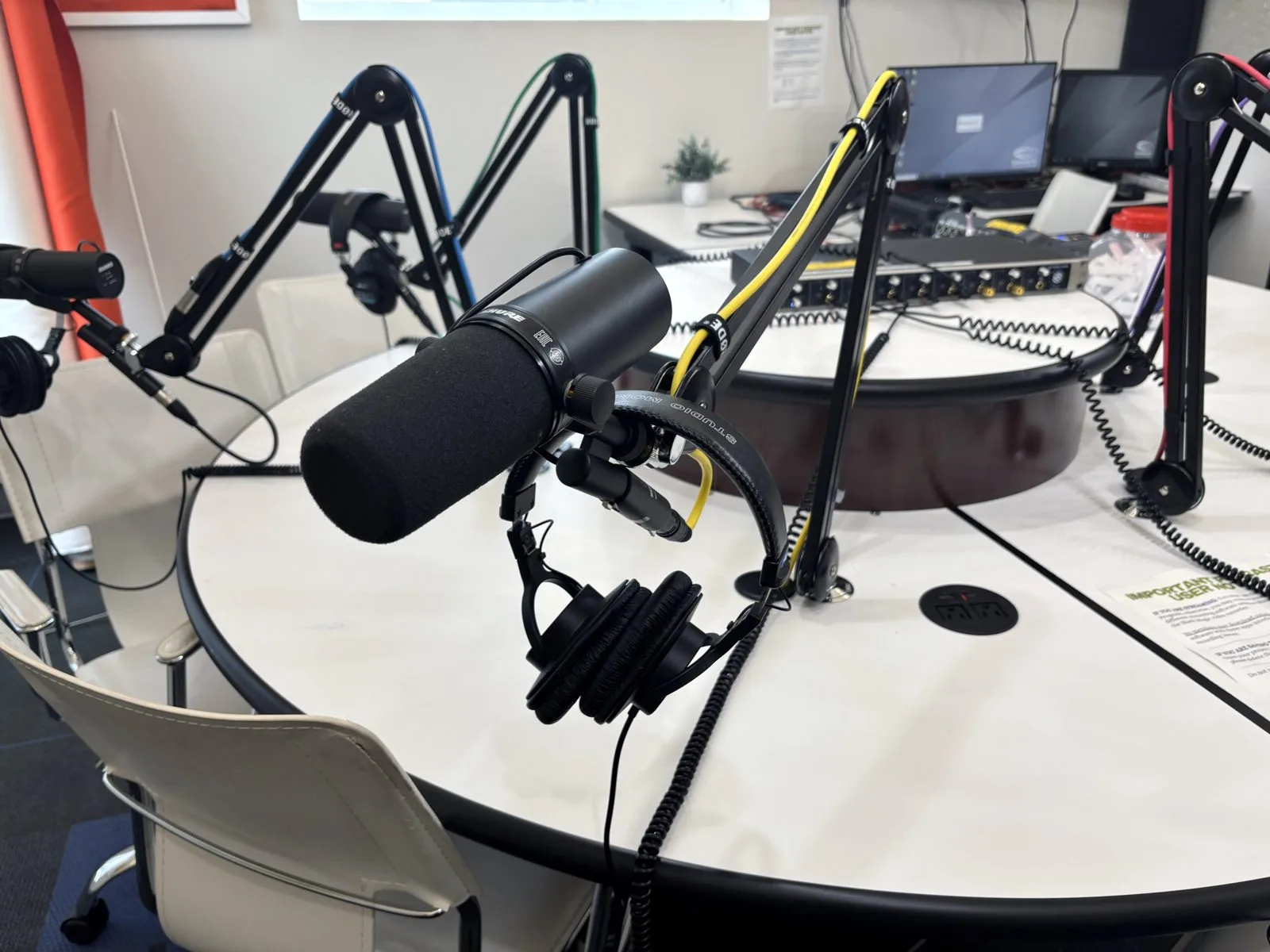
- An EQ for clarity, then a de-esser for sibilance — see our guide to the voice microphone and its processing chain.
- Measured compression to tighten dynamics without crushing, then a limiter set to hold true peak at −1 dBTP.
- Finally, loudness normalisation: measure the integrated LUFS of the whole episode and adjust the overall gain to land on target.
Most DAWs and dedicated podcast editors show an EBU R128-compliant loudness meter; some normalise to a target value in one click.
Managing relative levels
The loudness target applies to the whole episode, but inside it, not everything should sit at the same level. A musical intro or a sound sting can briefly exceed speech level without a problem, as long as the integrated measurement of the whole stays on target. The classic trap is bed music under a voice: set it well below — often 15 to 20 dB under speech — so intelligibility always wins. Likewise, match the levels of your different speakers in the edit before the final normalisation: a guest recorded too quietly is not fixed by pushing the limiter, but by correcting their gain upstream.
Mono or stereo?
For a spoken-only show, mono is often the safest choice: a lighter file, no panning surprises in earbuds, and more predictable normalisation. Reserve stereo for podcasts that genuinely use space (music, audio fiction, crafted sound design). If you record several guests, also consider mix-minus for remote contributors and the multitrack workflow of a RØDECaster Pro II.
The most common traps
Aiming for 0 dBFS “so it is loud”: platforms will turn the episode down and all you gained is distortion after encoding. Over-compressing a voice into fatigue. And above all measuring loudness on a snippet rather than the full episode: only the integrated measurement reflects what the platform will adjust.
My take
A single target of −16 LUFS and −1 dBTP settles the vast majority of cases, without getting lost in a per-platform master. The real win comes not from the limiter but from a cleanly captured voice and sober compression: in the end, it is the consistency between your episodes that listeners notice, not the absolute level. Measure the whole thing, deliver to target, and let the platforms do the rest — they will anyway.