For decades, levels were set by ear and by peak meter, then against digital 0 dBFS. The result was huge swings in perceived volume from one programme to the next — a song exploding after a spoken segment, a commercial twice as loud as the film it interrupts. Loudness was invented to end that chaos. Today, whether you are prepping a radio show, a TV package, a podcast or a streaming master, understanding LUFS, EBU R128 and true peak is no longer optional.
Why a peak meter isn’t enough
The issue is simple: our ears judge volume from a signal’s average energy over time, not its instantaneous peaks. A peak meter, or a plain dBFS readout, only shows the maximum value reached. Two programmes can top out at exactly the same peak level yet sound wildly different in loudness, because their density, compression and content differ. That is the limit of peak metering: it protects against digital clipping, but says nothing about perceived volume.
Hence the infamous “loudness war”: to seem louder than a rival, engineers compressed and limited ever harder, crushing dynamics in the process. Loudness normalization breaks that logic by setting a shared perceived-volume target. Since everyone aims for the same level, pushing artificially no longer helps — it just damages the sound without adding presence.
dBFS, peak and true peak
Before loudness, we need to clarify peak levels. dBFS (decibels relative to full scale) measures amplitude against the digital maximum: 0 dBFS is the ceiling, above which you clip. But a conventional sample-by-sample peak reading can underestimate real overshoots. During digital-to-analogue conversion, peaks appear between samples: these are inter-sample peaks.
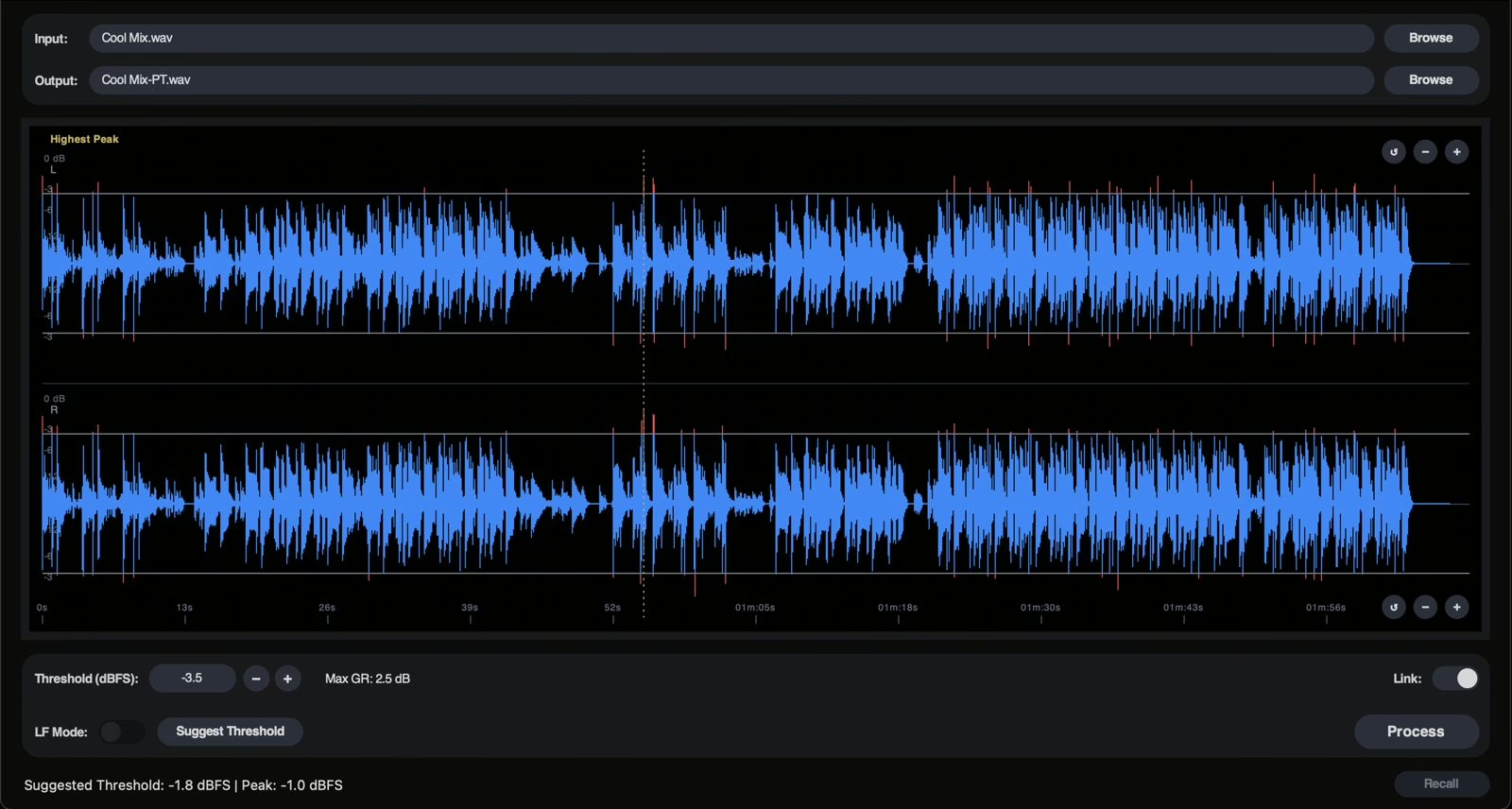
True peak, expressed in dBTP, accounts for those inter-sample peaks by oversampling the signal before measuring. That is why broadcast standards impose a true-peak ceiling, typically −1 dBTP: you keep headroom below 0 so the converter, a broadcast codec or a re-encode won’t generate audible distortion. Relying on a plain peak meter risks delivering a programme that looks compliant on paper but clips at the end of the chain.
LUFS, the reference unit
LUFS (Loudness Units relative to Full Scale, called LKFS in the US) is the unit that quantifies perceived volume. Its measurement uses so-called “K” weighting, which filters the signal to approximate the ear’s sensitivity, then integrates energy over time. There are three complementary readings:
- Momentary: loudness over a very short window (400 ms), useful for tracking the moment.
- Short-term: over 3 seconds, to judge the balance of a section.
- Integrated: the average across the whole programme — the value the standards target.
To this add the LRA (Loudness Range), which describes the programme’s dynamic spread: a low LRA signals heavily compressed content, a high LRA a livelier one. Good levelling isn’t only about hitting a number, but about keeping an LRA consistent with the genre — a drama doesn’t breathe like a news bulletin.
EBU R128, ATSC A/85 and streaming targets
In Europe, the reference is the EBU R128 recommendation: it sets an integrated loudness target of −23 LUFS, with a tolerance of around ±1 LU, and a maximum true peak of −1 dBTP. A “gating” system excludes silences and very quiet passages from the calculation, so the measurement reflects the real programme rather than the gaps. In the US, ATSC A/85 aims for the equivalent −24 LKFS, with a dialogue-anchored measurement for television.
Music streaming isn’t regulatory broadcast but applies its own normalization. Platforms bring tracks back toward higher targets — often around −14 LUFS for some, lower for others. The consequence is counter-intuitive but decisive: mastering a track to −6 LUFS to “sound loud” is pointless, since the platform will turn it down to the level of everything else. You’ll have sacrificed your dynamics for a volume gain the listener never hears.
In practice: measuring and levelling
The workflow is simpler than it sounds. Insert an R128-compliant loudness meter (most DAWs and playout systems include one) at the end of the chain. Play the whole programme to read the integrated loudness — the only value that matters for compliance. Then adjust overall gain to hit the target (−23 LUFS under R128) without touching your internal balance. Finally, check true peak and, if needed, place a true-peak limiter set to −1 dBTP right at the end of the path.
A few pitfalls recur. Measuring an excerpt rather than the full programme skews the integrated figure. Ignoring gating leads to over-correcting content with lots of silence. And above all, don’t confuse loudness normalization with compression: hitting a target starts with a simple gain move, not by crushing dynamics. Compression has its place — we cover it in our guide to audio compression — but it serves the sound, not the meter.
To my mind, loudness cleaned up broadcast: it gave programmes back their breathing room and killed the arms race. The right approach is the same everywhere: aim for the platform’s or broadcaster’s target, watch true peak, and preserve a sensible LRA. To go further, see how to tame peaks before your limiters, final-bus processors like the Elysia XMAX, and the mastering approach of WaveLab 13.