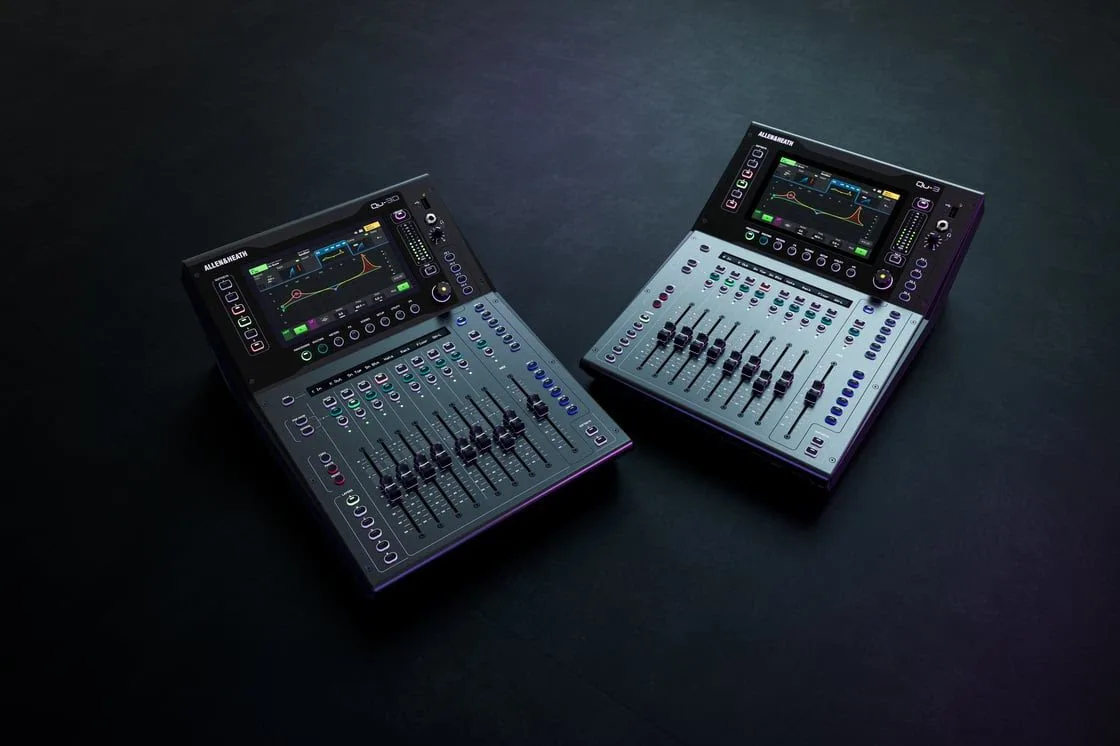
Allen & Heath keeps its grip on the working-digital-mixer segment. On November 4, 2026, the British maker introduced the Qu-3 and Qu-3D, two compact desks that carry the engine and workflow of the Qu range into a desktop chassis. The lineage is direct with the Qu-16, Qu-24 and Qu-32, but the format moves to another category: here a single block of nine faders drives the whole desk.
An XCVI core in a desktop format
Both models run on the 96 kHz XCVI engine, the same as the rest of the Qu range. Processing offers 36 inputs, that is 32 mono or linkable channels plus two stereo channels, for 24 output channels split into 12 mixes and 4 matrices. Six FX engines with dedicated stereo returns round out the internal processing. The surface adopts an 8+1 layout: nine 100 mm motorised faders across six layers, plus eight assignable SoftKeys and a 7-inch touchscreen.
Base local I/O includes 16 combo mic/line inputs, one stereo line input and 8 XLR outputs. To grow, a 128×128 SLink port opens the door to Everything I/O expanders, and a 32×32 USB-C audio interface links the desk to a workstation. Multitrack recording goes to an SD card, while stereo record and playback run over a USB-A port.
Qu-3 or Qu-3D: Dante makes the difference
The only distinction between the two desks is networking. The Qu-3D adds a built-in 16×16 Dante interface, at 48 or 96 kHz, with an optional upgrade to 32×32. The Qu-3 skips it and keeps the rest of the connectivity. For anyone already working in audio-over-IP, the D version avoids an expansion card and drops the desk straight onto a Dante network.
| Feature | Qu-3 | Qu-3D |
|---|---|---|
| Core | XCVI 96 kHz | XCVI 96 kHz |
| Inputs / outputs | 36 in, 24 out | 36 in, 24 out |
| Mixes / matrices | 12 / 4 | 12 / 4 |
| Faders | 8+1, 6 layers | 8+1, 6 layers |
| Built-in Dante | no | 16×16 (32×32 optional) |
| Announced price | $1,799.99 | $2,199.99 |
Mixing aids inherited from its bigger siblings
Beyond the spec sheet, the Qu-3 and Qu-3D carry tools built for live work. An automatic 32-channel microphone mixer handles speech panels, while Feedback Assist and Gain Assist help secure level before ringing out. On that ground, our guide to gain before feedback explains the mechanics those assistants automate. The desk also stays compatible with DEEP Processing modules from the dLive range, to load more advanced compressor and EQ models.
A compact format does not excuse a loose patch plan. Between the 16 local inputs, the SLink port and the Qu-3D’s Dante, preparing a technical rider and splitting the sources deserve the same rigour as on a large desk. If you share your microphones between FOH, monitors and recording, our article on stage mic splitters is a useful companion.
My take
Allen & Heath fills a real gap in its range. Between the small CQ desks and the large-chassis Qu mixers, a desktop board that keeps a true Qu’s 96 kHz engine and mix count was missing. Built-in Dante on the Qu-3D changes the deal for rental companies moving to networked audio without buying a separate card. The open question is how the six layers feel in the moment: nine faders to drive everything is compact, but it asks you to plan your layers carefully before the show.