Television production long sent a single coaxial cable per signal, SDI, which carried picture, sound and data in one place. The move to IP reshuffled the deck. The SMPTE ST 2110 family of standards sets a simple, powerful principle: instead of a single stream, you carry video, audio and data as separate streams over an Ethernet network, each with its own addressing. For pro audio, that split has a direct consequence, covered below.
A family of standards, not a single format
ST 2110 is not one document but a set of parts that complement each other. Three of them carry the signals themselves, called essences. ST 2110-20 carries video as uncompressed pictures. ST 2110-30 carries audio as pulse-code modulation, PCM. ST 2110-40 carries ancillary data, ANC metadata such as captions or timecode. Other parts frame the whole, notably ST 2110-10 for timing and session description.
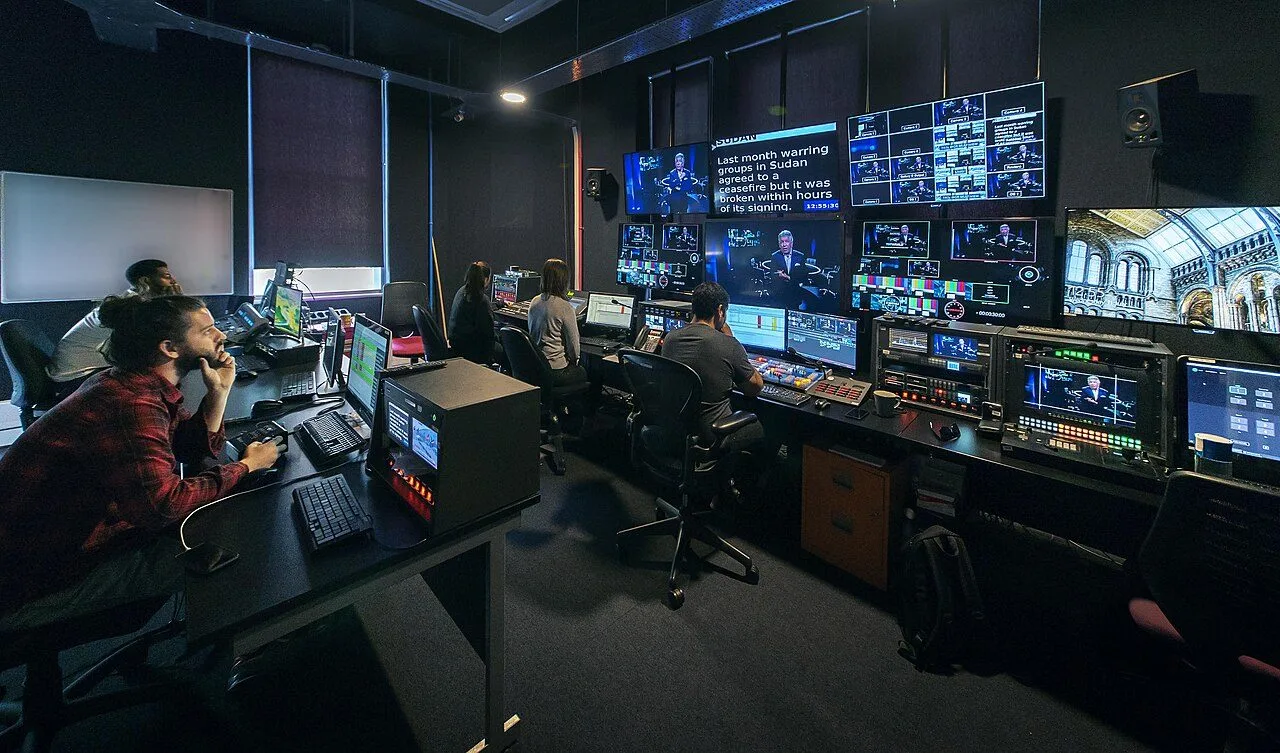
This split into separate essences is the real break from SDI. A video mixer can subscribe only to the video stream, an audio console only to the ST 2110-30 stream, a captioning system only to the data stream. Each takes what it needs, nothing more. A single network carries hundreds of independent streams, routed by multicast addresses.
The ST 2110-30 stream, the audio engineer’s ground
For anyone coming from audio, the good news fits in one line: the ST 2110-30 stream is built on AES67. Audio travels there as uncompressed PCM, in packets whose payload and timestamping follow AES67 conventions. An audio-over-IP device already AES67-compatible can therefore, in principle, receive an ST 2110-30 stream. The allowed packet sizes and sample rates are framed to guarantee that interoperability. If audio-over-IP is new to you, our overview of Dante, AES67 and SMPTE ST 2110 sets the scene, and the article on Dante details a neighbouring system common in the studio.
Everything rests on time
Carrying three separate essences only makes sense if they realign perfectly on arrival. That is the job of PTP synchronisation, the Precision Time Protocol, framed for broadcast by the SMPTE ST 2059 profile. Every device reads the time from a master clock on the network and timestamps its packets. On reception, audio and video realign thanks to those timestamps, with no lip-sync drift. Our article on PTP and clocking explains in detail why timing is everything in these networks.
Finding, connecting and securing the streams
Separating the essences solves transport, not organisation. How does a receiver know which stream to take, and at what address? Description is handled by SDP files, and automatic device discovery relies on the NMOS suite, a topic covered on its own in our guide to NMOS in ST 2110. On reliability, a live show tolerates no dropout: redundancy relies on ST 2022-7, which sends two copies of the stream over two network paths and rebuilds a seamless signal. Our article on ST 2022-7 redundancy explains the mechanism.
In practice, moving to ST 2110 commits a whole chain: network switches capable of multicast and IGMP, a reliable PTP clock, a rigorous addressing plan and monitoring tools. The investment pays off in flexibility, with one network replacing miles of coax and racks of routing matrices.
Key points
- ST 2110 carries video, audio and data as separate streams over IP.
- ST 2110-20 for video, ST 2110-30 for PCM audio, ST 2110-40 for metadata.
- ST 2110-30 is built on AES67, hence interoperability with existing audio-over-IP.
- PTP synchronisation (ST 2059 profile) realigns the essences on reception.
- NMOS handles discovery, ST 2022-7 handles seamless redundancy.
My take
ST 2110 impresses with its logic: separating the essences treats a live TV show like a modern computer network, modular and scalable. For the audio engineer, the real pleasant surprise is the kinship between ST 2110-30 and AES67, which saves relearning everything. The price to pay is the network itself, now the link to look after, with its addressing discipline and its master clock. Done right, a clear stream plan and a solid clock are enough to face show day calmly.