Few studio boxes cross the decades without ageing. The 1176 belongs to that small club. Designed by Bill Putnam in the late 1960s, this peak limiter has served on countless vocals, bass tracks and drums, and it still sits in the catalogue in a form very close to the original. Its longevity owes as much to a technical choice that was bold for its time as to a sonic behaviour that engineers learned to love.
A tube replaced by a field-effect transistor
In the mid-1960s, Putnam, the company’s founder, set out to modernise his 175 and 176 tube limiters. From 1966, he replaced the tubes with field-effect transistors, the famous FETs. The 1176 shipped in 1967 and stood out as one of the first all-solid-state studio peak limiters. Its gain-reduction element is a FET placed in a feedback loop, around Class A amplifier stages and input and output transformers. That last point matters: the transformers contribute to the colour people attribute to the unit.
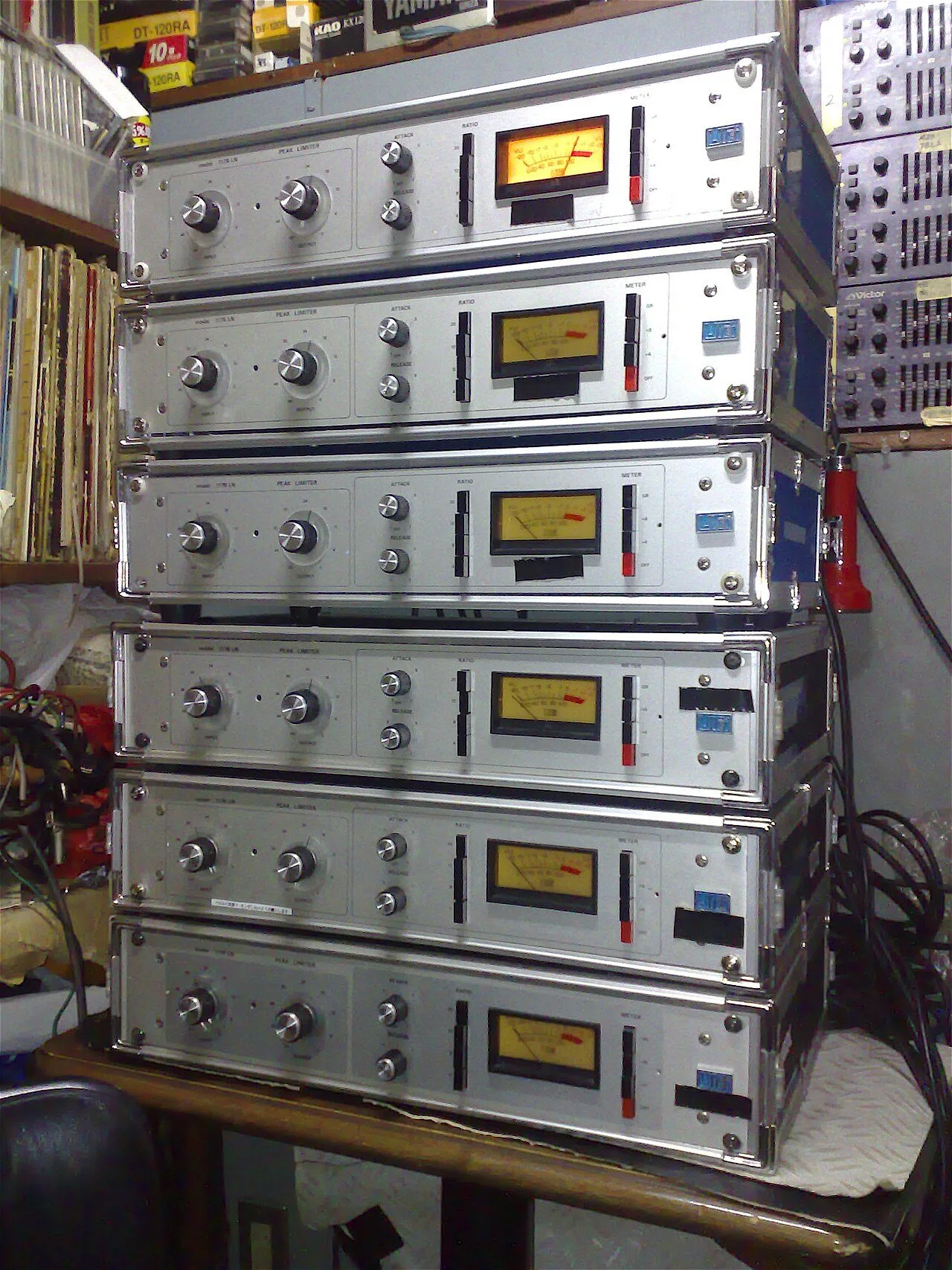
The controls throw you on first contact. There is no threshold knob. You set the amount of compression with the input level, then the output level makes up for it. The attack and release controls also work against intuition: turned fully clockwise, they give the fastest times, not the slowest.
Microsecond times and a sound that bites
Speed is the 1176’s trademark. Attack goes down to 20 microseconds and up to 800 microseconds, release spans 50 to 1100 milliseconds, with program dependence. Those figures put the unit among the most reactive of its kind, able to catch a snare transient or steady a vocal that jumps. Compression follows a soft knee, and two units link to work in stereo.
Ratios are chosen with push buttons: 4:1, 8:1, 12:1 and 20:1. In theory they are mutually exclusive. In practice, engineers found that pressing all four at once produces an effect of its own. The ratio climbs to roughly 12:1 to 20:1, harmonic distortion rises sharply and the attack and release behaviour changes. Will Shanks, at Universal Audio, describes an effect he calls a kind of reverse look-ahead. This all-buttons mode, nicknamed British mode, became a favourite colour on rock vocals and drum buses, so much so that modern versions handle it explicitly.
A family of revisions
The 1176 is not a fixed object. It went through a long series of revisions, marked by a letter, that change the sound and the reliability. The very first, the 1967 Rev A, is known by its blue meter section on a brushed aluminium faceplate. The Rev B replaced some preamp FETs with bipolar transistors. The 1970 Rev C added low-noise circuitry by Brad Plunkett, gained about 6 dB less noise, moved to an anodised black faceplate and took the 1176LN name. Revisions D and E are considered the best to the ear, with the E adding a power transformer switchable between 110 and 220 volts.
- Rev A (1967): blue faceplate, first generation.
- Rev C (1970): low-noise circuit, 1176LN name.
- Rev D and E: revisions reputed to be the most musical.
- Rev F: push-pull Class AB output stage.
- Rev G: differential-amplifier input, end of program dependence.
- Rev H: silver faceplate and red Off button, last series from the original company.
From vintage rack to plugin and clones
Universal Audio, refounded in 1999 by Bill Putnam’s sons, made the 1176LN its very first product as a reissue around the year 2000. A 2008 Rev AE anniversary edition, limited to 500 units, adds a 2:1 ratio, a 10-millisecond attack and restores program dependence. The architecture spread far beyond the brand: plugin developers and hardware makers offer their own takes on the FET limiter. The Lindell Audio LiN76 MKII is a recent, affordable example.
To get the most from an 1176, you still need the basics of a compressor. Our guide to setting a compressor lays the groundwork, and the article on bus compression covers the ground where the all-buttons mode shines.
My take
The 1176 stays a safe bet because it does one thing very well: lay a firm, coloured hand on a signal, fast. On a vocal that wanders or a snare with no body, it fixes the problem in three knobs. The all-buttons mode alone is worth the trip, as long as you use it sparingly. Between the pricey original and software clones for a few tens of euros, the basic sound is within everyone’s reach: it comes down to a taste for the grain of the transformers.