The Behringer JN-80 has just landed in Europe, bringing the Juno-60 sound for the price of a decent audio interface. The cult 1982 instrument now trades well above 2,000 euros used, when it still works at all. The JN-80 drops that entry ticket back to three figures. But it is far from alone: behind it, a whole army of clones, reissues and plugins is reviving the great analog polysynths of the 80s. Here are eight serious ways to get that grain without emptying your savings, from true analog to a free plugin.
One honest caveat up front: these products do not all clone the same instrument. Some chase the Juno, others the Prophet, the Polysix or the OB-Xa. But they answer the same need as the JN-80, getting the warmth and simplicity of a vintage analog polysynth without the price or the headaches of period hardware. They are sorted here into three clear families, from the most faithful to the most affordable.
The analog hardware clones: the real grain, in analog
This is the category closest to the JN-80’s spirit: analog circuits, real VCOs and VCFs, at a price that stays three to five times below the vintage original. Behringer owns this ground, with its strengths and its limits. The build is decent rather than luxurious, but the sound more than holds up.
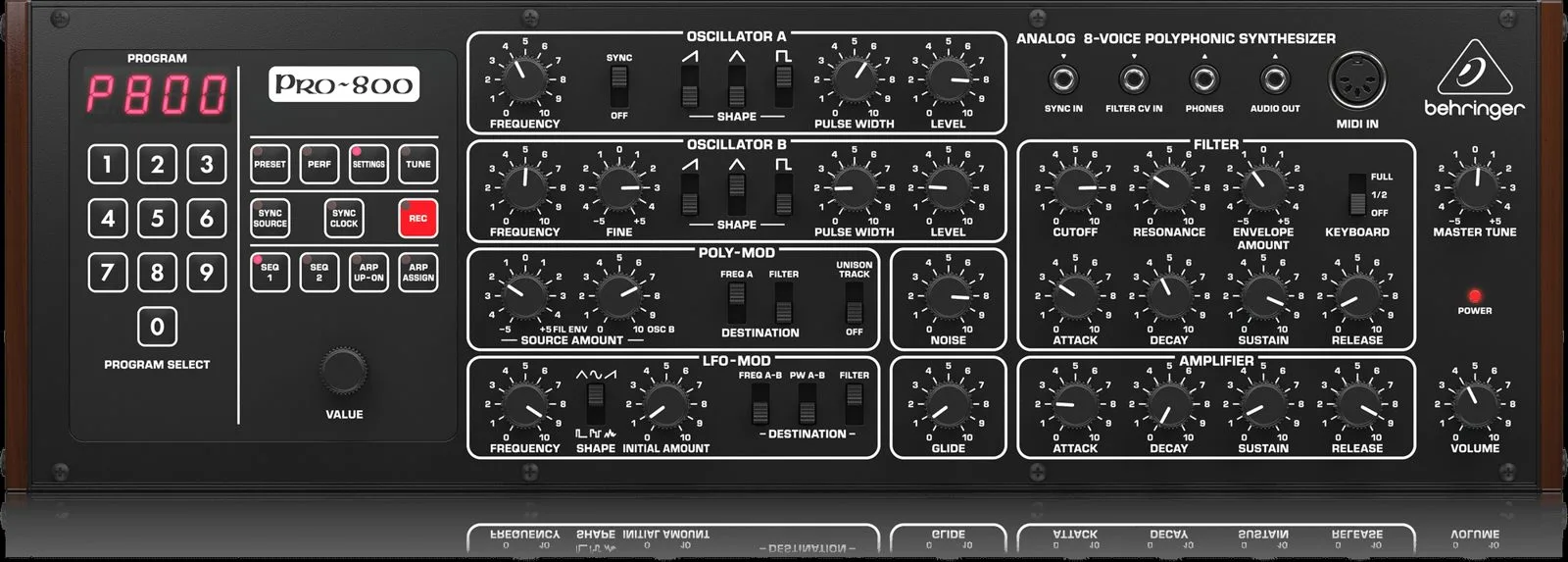
Behringer Pro-800: the Prophet-600 in a rack for $379
The Pro-800 recreates the 1982 Sequential Prophet-600, one of the very first synths to carry MIDI. Eight voices, two VCOs per voice and a 24 dB-per-octave low-pass filter put you squarely in American analog poly territory, grittier and rawer than a Juno. The desktop unit also screws into a Eurorack case, and 400 program memories make it genuinely livable day to day.
It is not a Juno and makes no attempt to be one: where the JN-80 plays soft and chorus-drenched, the Pro-800 bites. For growling basses and pads with character, it is one of the best sound-per-dollar deals in today’s analog market.
In short : Behringer · around $379 / €389 · 8-voice analog synth, desktop and Eurorack
Official Behringer Pro-800 page
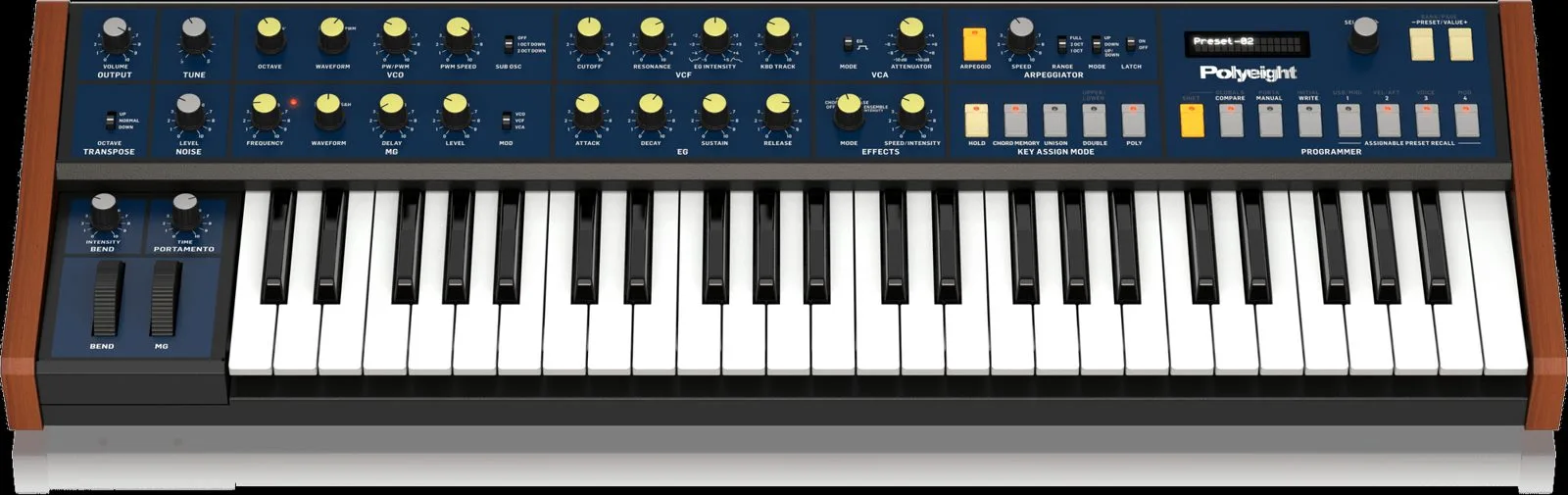
Behringer Polyeight: the Korg Polysix, with two extra voices
The Polyeight draws on the 1981 Korg Polysix but takes liberties: eight voices where the original had six, and a keyboard cut down to 49 keys with polyphonic aftertouch. It carries the famous BBD ensemble, a chorus and a phaser that gave the Polysix much of its charm. Let’s be blunt: this is not a clone in the strict sense, but an expanded re-read.
The result sounds wide, liquid, unmistakably early-80s. For synth strings and enveloping pads, it does exactly what you expect from a machine in this lineage. The lost octave of keyboard will annoy keyboardists; everyone else will barely notice.
In short : Behringer · around €500 · 8-voice analog synth, 49-key keyboard, BBD effects
Official Behringer Polyeight page
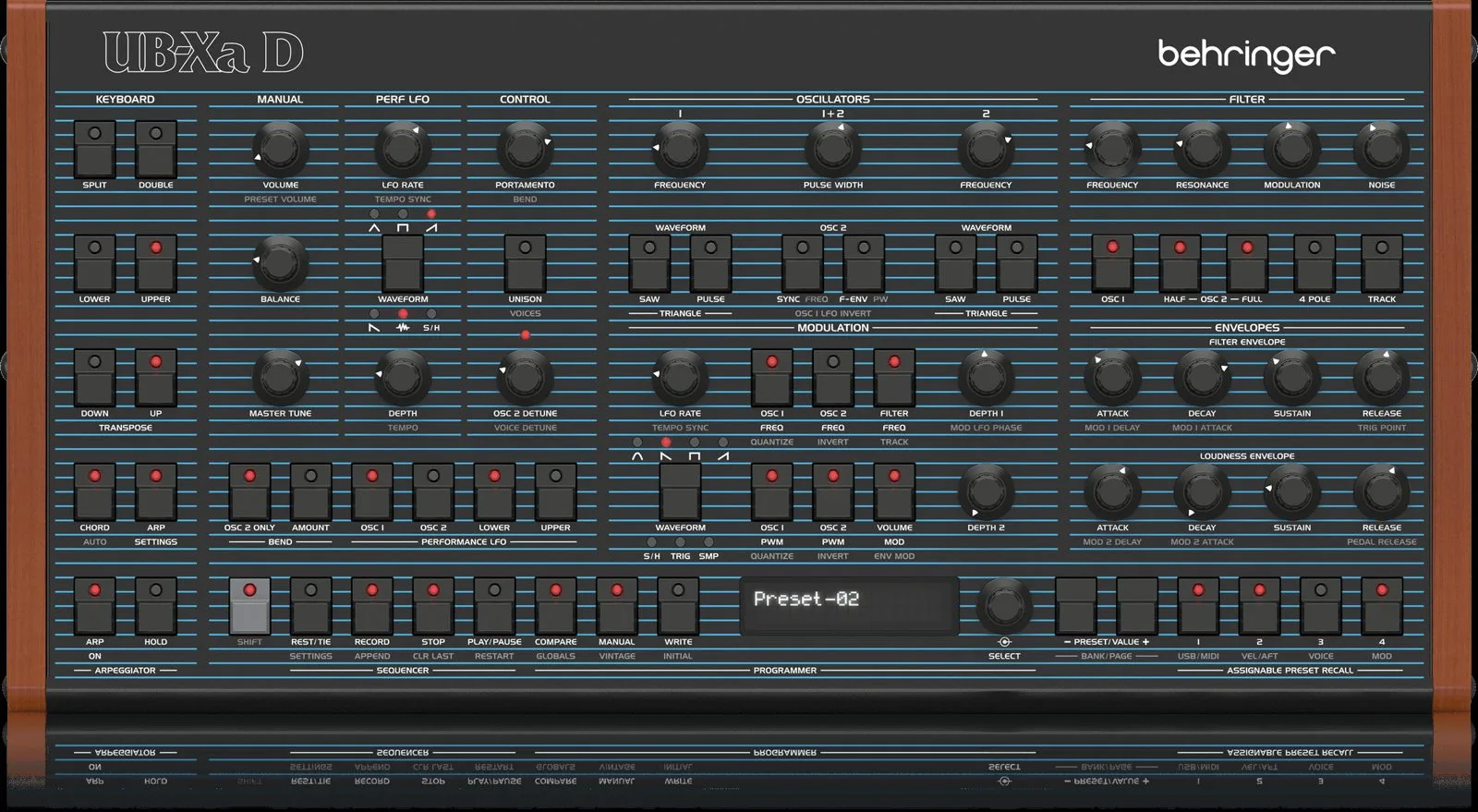
Behringer UB-Xa D: the Oberheim OB-Xa in desktop form
With the UB-Xa D you step up a level: sixteen analog voices, dual VCFs, and above all eight vintage modes that sweep across several Oberheim signatures (OB-Xa, OB-8 and friends). The name tells a small story: Behringer lost the right to call it OB-Xa after a dispute with Tom Oberheim, hence UB-Xa. The D is the desktop version, keyboard-free, built for cramped studios; rack ears are included.
This is the sound of the big 80s cinematic pads, massive and slightly unstable, which is exactly what makes an Oberheim an Oberheim. At this price, for a 16-voice multitimbral analog, there is simply no new equivalent.
In short : Behringer · around $799 / €849 · 16-voice multitimbral analog synth, desktop
Official Behringer UB-Xa D page
The official reissue: modeled, compact, made by Roland
Roland Boutique JU-06A: both Junos in a shoebox
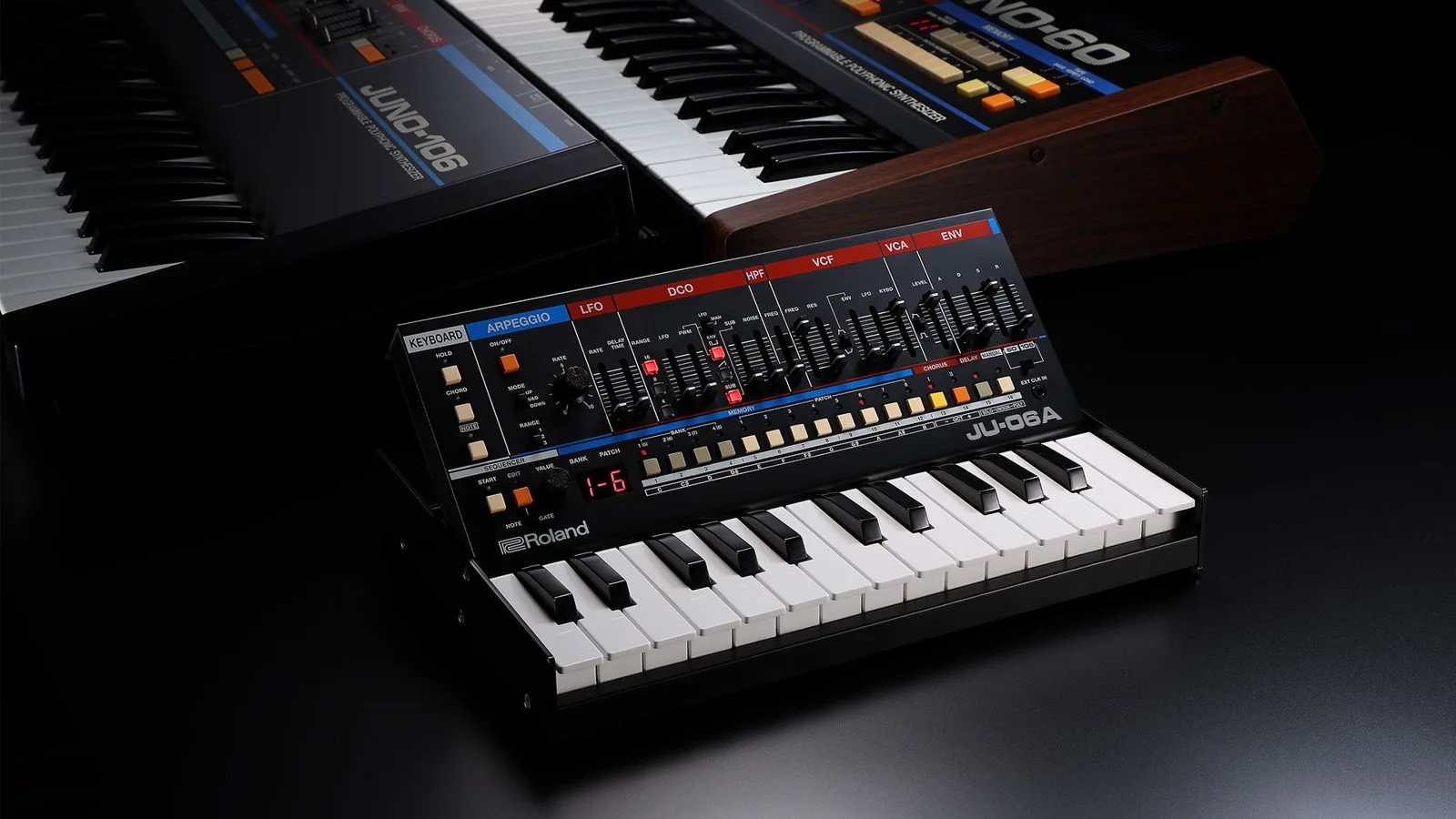
Roland is not doing analog here but ACB (Analog Circuit Behavior) modeling, and the JU-06A has an argument no one else makes: it holds both the Juno-60 and the Juno-106, switchable at the flick of a toggle. It is therefore the most direct digital cousin of the JN-80, in a tiny box, with chorus, delay, arpeggiator, sequencer and a built-in speaker.
The trade-off is well known: only four voices of polyphony, fewer than the originals, and a modeled sound that, excellent as it is, remains a model. But for the famous Juno chorus in a Roland-branded box that fits in a bag, this is the royal road. It is also the only option on this list that comes straight from the original manufacturer.
In short : Roland · around $479 · modeled (ACB) module, 4 voices, Juno-60 and Juno-106 modes
Official Roland Boutique JU-06A page
The sound in a plugin: from free to component-level
If your goal is the JN-80 sound inside a production rather than a box on your desk, the computer does wonders today. The four plugins below run from a free download to the most demanding emulation. Three chase the Juno; the last one goes after the Prophet, for anyone who wants to widen the palette.
TAL-U-NO-62: the free Juno-60, the classic starting point
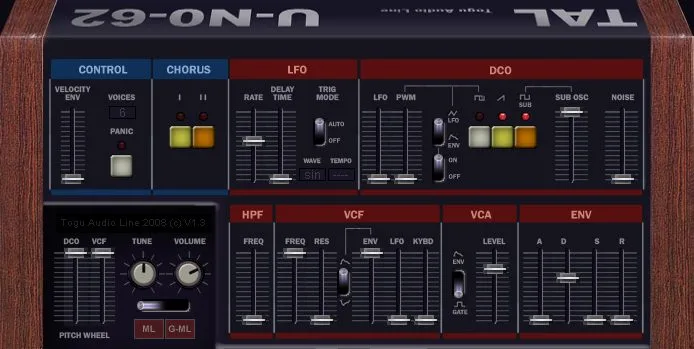
This is the plugin that introduced the Juno sound to a whole generation of producers with no budget. Completely free, modeled on a real Juno-60, it is still a perfect entry point to hear what the fuss is about. Let’s be honest: it shows its age, its polyphony can misbehave, and release tails sometimes cut off. It is no longer the reference tool, but for zero cost it still does the trick on a pad or a bass.
In short : Togu Audio Line · free · VST and AU, Windows and macOS
Official TAL-U-NO-62 page (free)
TAL-U-NO-LX: the modern paid version, the Juno-60 reflex
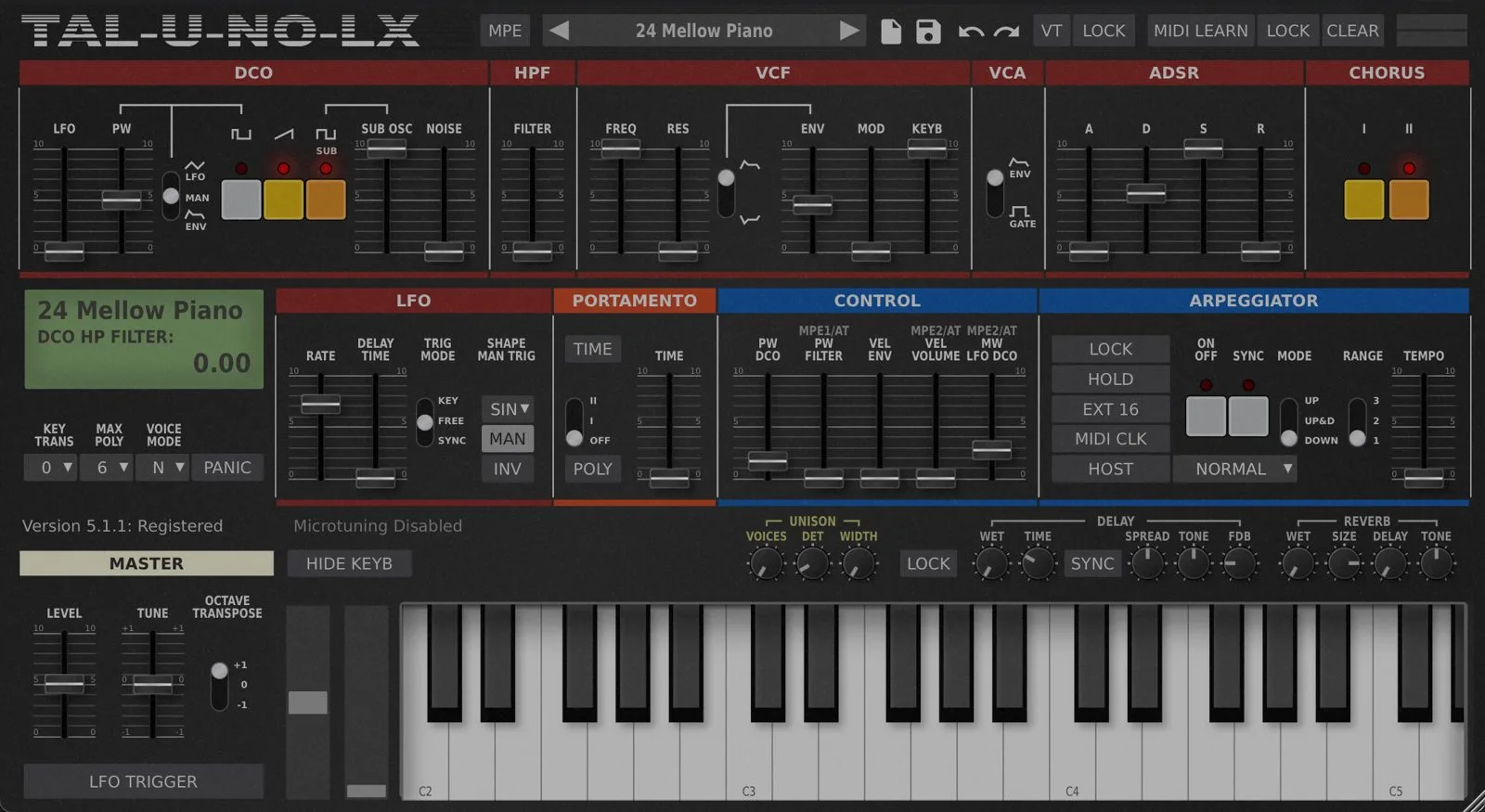
The commercial big brother of the above is, for many, THE Juno-60 plugin. For a trivial sum given what it delivers, you get far cleaner modeling, a faithful stereo chorus, support for current formats (VST, VST3, AU, AAX, CLAP) and rock-solid stability. If you keep only one software route to the JN-80 sound, this is it.
In short : Togu Audio Line · around $60 · VST/VST3/AU/AAX/CLAP, Windows, macOS, Linux
Cherry Audio DCO-106: the Juno-106, modernized and nearly given away
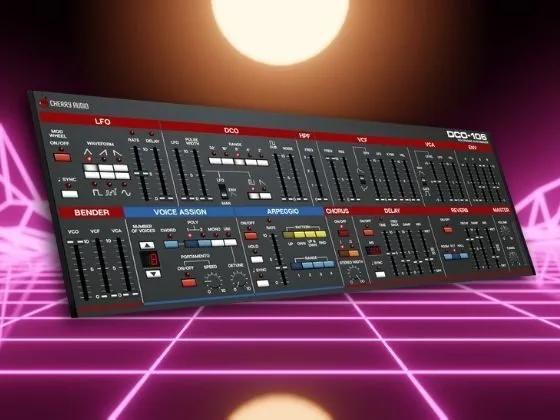
Cherry Audio went for the Juno-106 rather than the 60, and added features the original never had: extended polyphony, extra modulation, unison, and SysEx compatibility with the original machine. All of it at a price that borders on indecent, often slashed further on sale. For anyone after the 106 chorus and modern ergonomics, this is a no-brainer.
In short : Cherry Audio · $39 (often less on sale) · AU/VST/VST3/AAX and standalone, macOS and Windows
Official Cherry Audio DCO-106 page
u-he Repro-5: the Prophet-5 modeled component by component
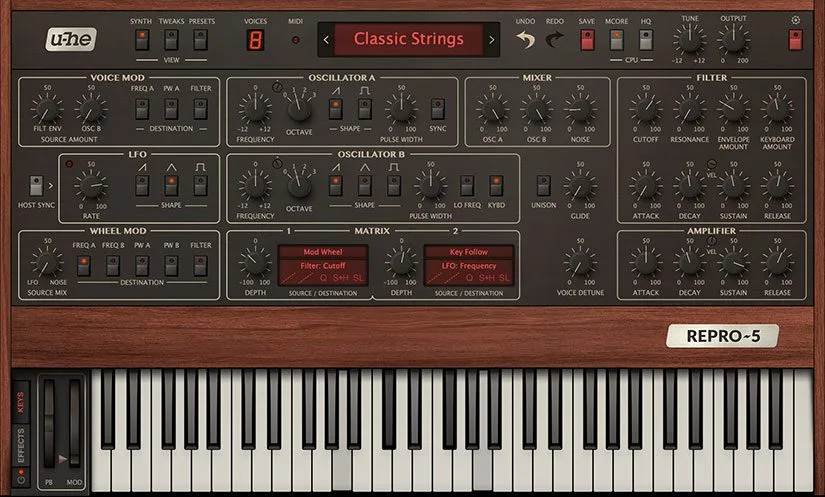
Now we switch legends: the Repro-5 chases not the Juno but the Sequential Prophet-5, and does it with rare detail, modeling the circuit down to the component. The sound is strikingly authentic, with that slightly dirty, living grain you can spot a mile off. The accepted trade-off is a heavy CPU load. It ships with the Repro-1 (the Pro-One clone) in a single pack. To step outside the Juno frame and touch the other pillar of analog poly, this is the software reference.
In short : u-he · €149 (Repro-1 and Repro-5 pack) · CLAP/AU/VST3/AAX, macOS and Windows
The quick recap
| Product | Maker | Price | The job in one word |
|---|---|---|---|
| Behringer Pro-800 | Behringer | ~$379 | Prophet-600 |
| Behringer Polyeight | Behringer | ~€500 | Polysix |
| Behringer UB-Xa D | Behringer | ~$799 | OB-Xa |
| Roland Boutique JU-06A | Roland | ~$479 | Both Junos |
| TAL-U-NO-62 | Togu Audio Line | Free | Juno-60 |
| TAL-U-NO-LX | Togu Audio Line | ~$60 | Juno-60 |
| Cherry Audio DCO-106 | Cherry Audio | $39 | Juno-106 |
| u-he Repro-5 | u-he | €149 | Prophet-5 |
Which one should you pick?
If you genuinely want the JN-80 sound in your tracks, start with software: the TAL-U-NO-LX costs the price of a meal and gives you almost all of the result; the DCO-106 if you prefer the grain of the 106. The free TAL-U-NO-62 is mainly there to train your ear before you reach for your wallet.
Set on hardware, knobs under your fingers and true analog? The Pro-800 is the best sound-per-dollar for a biting poly, the Polyeight for wide Polysix-style pads, and the UB-Xa D if you are chasing big Oberheim textures and the budget allows. The JU-06A is the most elegant answer when you want both Junos in a pocket box, provided you accept its four voices. And to widen toward the other great school, the Repro-5 opens the door to the Prophet-5 without giving up any character.
In the same spirit of low-cost clones, our selection on the 12-bit sampling sound around the Behringer SP1200X carries the thinking over to drum machines.