Fred’s Lab is putting its Töörö desktop synthesizer back into production, five years after its crowdfunding campaign. This second generation, the Töörö mkII, is more than a reissue: the digital oscillators move to 16-bit, a noise source and a ring modulator join the engine, the effects go stereo, and the control surface now handles MPE. The six-voice hybrid returns at €499 for pre-order, with the first units shipping this October.
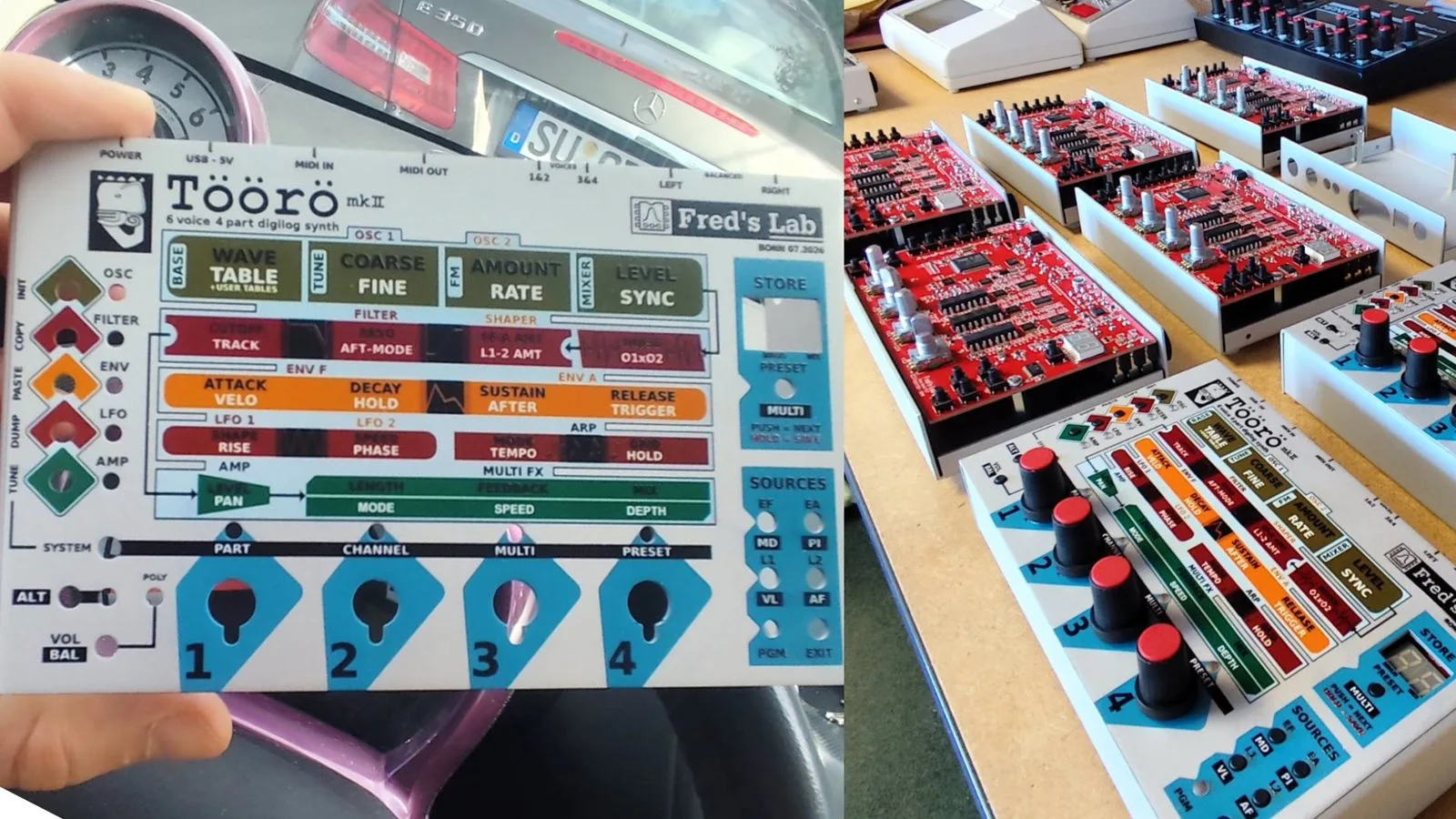
A relaunch as much as an update
Designed by Frédéric Meslin, the original Töörö carved out a quiet but loyal following among compact hybrids: a punchy digital engine, an analog filter, and a grain that recalls 1980s digital synths run through an analog stage. When key components went out of production, Fred’s Lab had to redesign the electronics — and used the chance to fix what deserved fixing rather than clone the old circuit verbatim.
The most audible change is oscillator resolution, up from 12-bit to 16-bit. In practice that means a lower noise floor and, above all, the end of zipper noise — those audible steps you hear when sweeping a control in real time. A dedicated noise source and a ring modulator round things out, two building blocks that push sound design toward metallic, percussive and inharmonic textures.
What actually changes on the mkII
- 16-bit digital oscillators instead of 12-bit: lower noise, smoother sweeps.
- New noise source and ring modulator, both absent from the first version.
- Stereo digital effects (modulated delays including ping-pong, chorus, flanger).
- Three-axis MPE, usable across two keyboard zones.
- Revised panel graphics, with blue control areas on the lower and right sections.
The architecture in detail
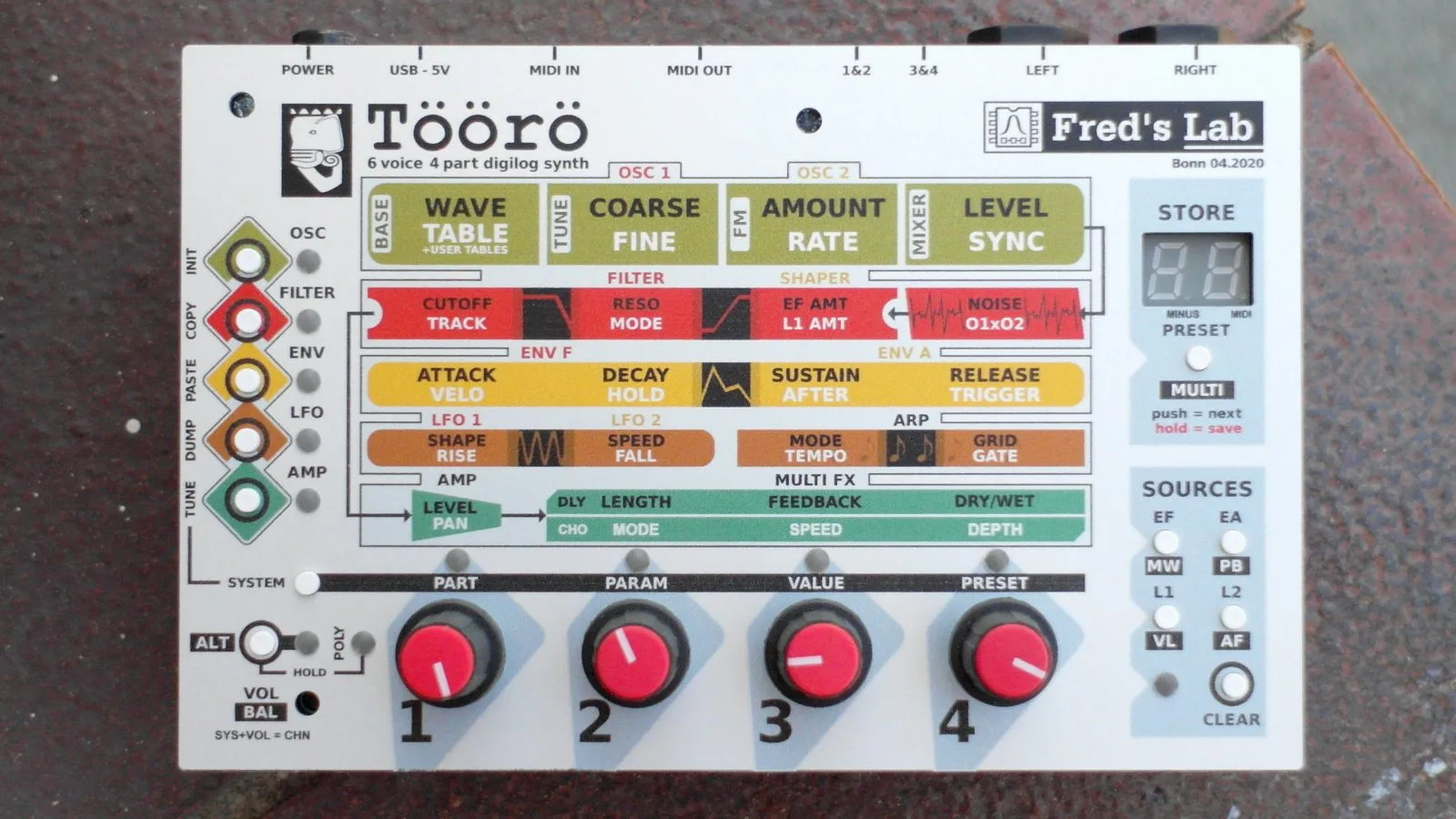
The Töörö mkII is still a six-voice hybrid, four-part multitimbral. In MPE mode it splits into two zones (lower and upper) driving two simultaneous patches. Each voice carries two complex digital oscillators with waveform morphing, two-operator linear phase modulation and self-sync — plenty to go well beyond plain subtractive synthesis if you enjoy building tones from partials and harmonics. For the theory behind that vocabulary, our feature on additive synthesis is a good primer.
The digital signal then feeds an in-house analog filter, the FL A847, a 12 dB-per-octave low-pass capable of self-oscillation and saturation, with a digital shaper adding bite upstream. Modulation comes from two multi-wave LFOs, two ADSR envelopes with velocity and hold, and an eight-slot modulation matrix.
Quick specs
| Item | Detail |
|---|---|
| Polyphony | 6 hybrid voices, 4-part multitimbral |
| Oscillators | 2 per voice, 16-bit, morphing, 2-op phase modulation, self-sync |
| Filter | FL A847 analog low-pass, 12 dB/oct, self-oscillation and saturation |
| Modulation | 2 LFOs, 2 ADSR (velocity, hold), 8-slot matrix |
| Effects | stereo modulated delays (ping-pong), chorus, flanger |
| I/O | balanced main outputs, 2 dual-voice outputs (1+2 and 3+4), 5-pin MIDI in/out, USB (5 V power and data) |
| Price | €499 incl. VAT, pre-order, shipping from October 2026 |
Where it sits
At €499, the Töörö mkII is not playing the budget-clone game: it targets players after a recognisable voice and real synthesis depth in a desktop footprint. The per-pair dual outputs are a detail that matters — they allow separate processing in multitimbral mode, which is rare at this size. The compact-hybrid market has grown busy lately, from grooveboxes to synth modules like the Twisted Electrons FLEXFM or the Erica Synths Konstrukt-8 drum machine; the Töörö stakes out a sound of its own.
Then there is stock: the first batch is said to be nearly sold out. Fred’s Lab runs are short, so if the grain speaks to you, do not wait. Full details are on the official Fred’s Lab page.
My take
The move to 16-bit and the arrival of ring modulation turn what was a charming little hybrid into a noticeably more complete instrument. The real argument was never the spec sheet but the character: those slightly rough digital oscillators married to an analog filter that knows how to saturate produce tones you will not find elsewhere. Separate outputs and MPE clearly widen the use cases, from production desk to expressive playing. At €499 and in a limited run, this is an enthusiast’s buy rather than a first synth — and that is exactly right.