Most synthesizers you know take material away: you start from a rich wave and a filter removes harmonics. Additive synthesis does the opposite. It builds sound by adding elementary bricks — pure sine waves — until you reach the timbre you want. It is the audible translation of a mathematical idea: per Fourier, any periodic signal can be described as a sum of sine waves.
Partials and harmonics: the vocabulary
Each sine wave you add is a partial. The lowest partial sets the perceived pitch: the fundamental. Partials at whole-number multiples of that frequency (2x, 3x, 4x…) are harmonics; those falling elsewhere are inharmonic partials, typical of bells, metallophones and percussive sounds.
What gives a sound its colour is the recipe: how many partials, at which frequencies, and above all at what relative amplitude. A square wave, for instance, is nothing but the fundamental plus odd harmonics at decreasing amplitude. In additive you do not pick a ready-made waveform: you build it, partial by partial.
Time changes everything: an envelope per partial
A real sound is never static. On a piano, the high harmonics die away far faster than the fundamental; that is what makes a note seem to ‘close’ as it fades. This is where additive shines: giving each partial its own amplitude envelope over time. You sculpt the spectral evolution, note by note. That fine control is also the catch: handling dozens or hundreds of envelopes by hand quickly becomes unmanageable — hence interfaces that group, draw or morph partials.
Where subtractive synthesis sets a global timbre with a few controls, additive thinks at the level of the partial. The two logics often complement each other inside a single instrument.
Resynthesis: additive meets the sample
The real modern turning point is resynthesis. You analyse a recording (a voice, a pad, an instrument), extract its spectral content frame by frame, then replay it additively. From there you can do what a plain sample player cannot: freeze a moment, time-stretch without changing pitch, transpose with no ‘chipmunk’ effect, or erase specific partials. It is the bridge between the world of sampling and that of synthesis.
Where do you hear it?
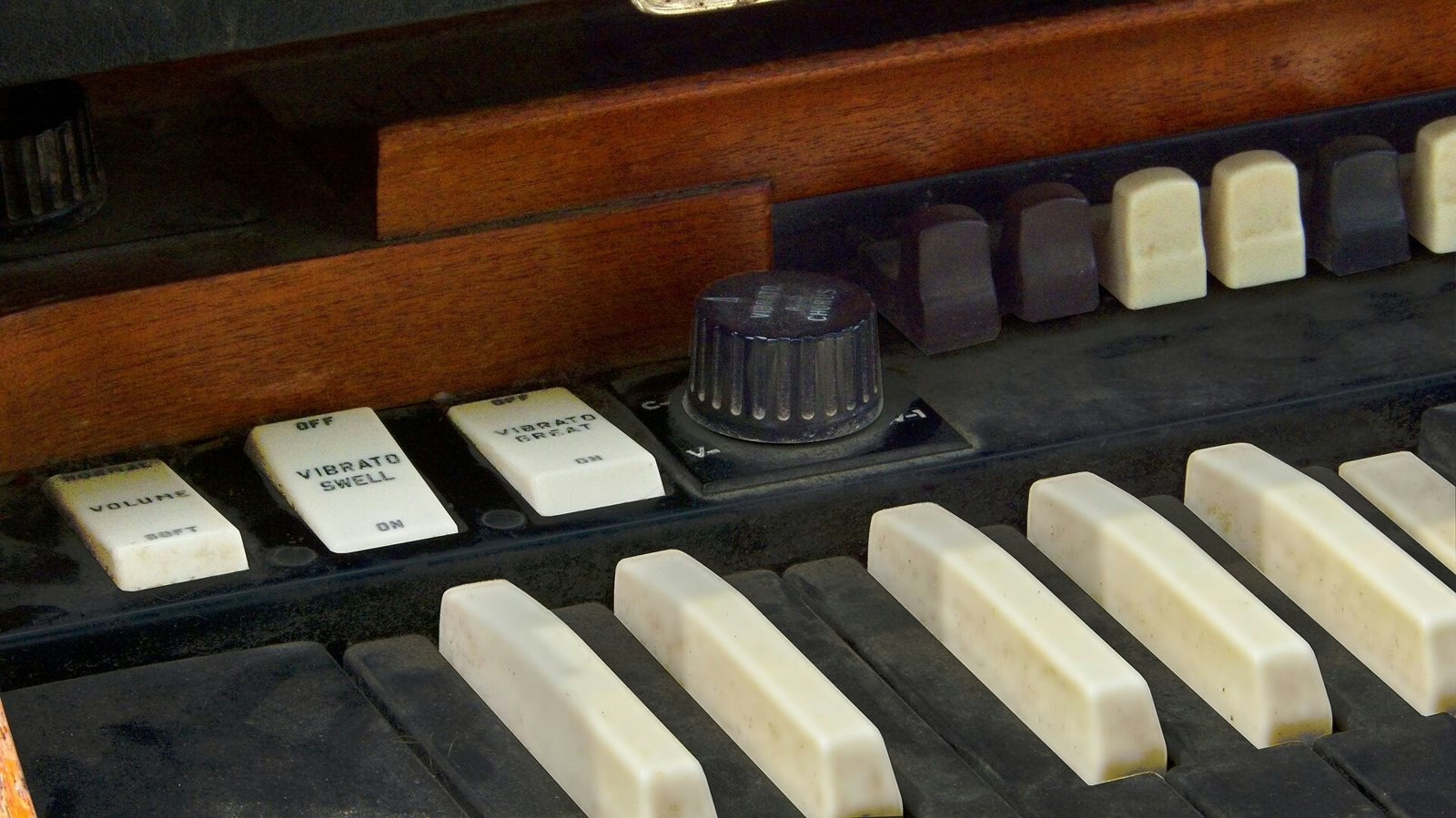
The clearest example is old: the Hammond organ and its drawbars. Each drawbar sets the amplitude of one harmonic; pulling the drawbars is additive by hand. Among synths, the Kawai K5000 marked the 1990s, and today software instruments like Harmor (Image-Line) or dedicated modules offer powerful additive engines, often paired with resynthesis and filtering. The additive logic also lives in the oscillator banks of many hybrid synths.
Strengths, limits and good habits
The upside: a spectral realism and plasticity few other methods reach, ideal for evolving pads, bell timbres, synthetic voices and sound design. The historic limit was CPU cost — summing hundreds of sines is not free — but modern machines take it in stride. The real trap is human: you drown in parameters. The good habit is to start from a clear spectral goal (bright and metallic? dark and round?), work a few key partials, then hand time evolution to envelopes or to a well-planned envelope setting.
To round out the method map, compare with FM synthesis, granular synthesis, and, to animate your patches, our piece on the step sequencer.
Additive or subtractive: which one?
They do not aim at the same ground. Subtractive shines for sounds shaped fast and played loud: basses, leads, warm pads, anything that lives on a moving filter. Additive takes the lead the moment you want a precise timbre, rich in spectral detail, or a fine evolution over time: bells, synthetic voices, textures that transform without ever looping identically. In short, one sets a global colour, the other composes a bespoke one. Many modern synths do not choose: they start from an additive bank of partials, then let a filter and effects finish the job.
When the filter comes back in
It is the paradox of today’s additive instruments: after building a spectrum partial by partial, you often apply a filter, distortion or reverb. Why? Because sculpting each harmonic by hand to get musical movement stays laborious, whereas a well-placed filter instantly animates dozens of partials in one gesture. Additive supplies raw material of unmatched precision; the rest of the chain turns it into music. That is also why resynthesis appeals so much: it gives a realistic starting point — a real voice, a real instrument — that you then deform freely, freezing a moment, gliding between two timbres, or erasing what gets in the way.
My take
Additive long carried a reputation as a fiddly beast, and that was not entirely wrong. But resynthesis changed everything: it is now one of the most creative playgrounds for anyone who loves digging inside a sound, stretching a voice or making a texture sing. The price of entry is no longer CPU power, it is patience and an ear that knows what it is after. Start small — a few partials, one moving envelope — and let the spectrum tell a story.