If you only ever learn one type of synthesis, make it this one. Subtractive synthesis is the logic that shaped the sound of the analog synthesizer from the late 1960s onward, and it is still the default behavior of almost every machine out there, hardware and software alike. The principle fits in a sentence: you generate a signal that is deliberately rich in harmonics, then you remove what you do not need until the tone you were after appears. You do not build the sound brick by brick; you carve it out of a block, like a sculptor.
Understanding this chain is what lets you actually program a synth instead of twisting knobs at random. It is also the foundation that makes everything else readable: once subtractive synthesis clicks, FM synthesis and wavetable synthesis become variations on a theme you already know.
The idea: start rich, then subtract
The founding idea feels counter-intuitive at first. It is tempting to imagine a synth adding harmonics to enrich a sound. Subtractive synthesis does the opposite: it starts with a waveform that already contains a huge amount of harmonic content, often more than the final result will keep, and the whole job is to take some of it away. That is exactly why the filter sits at the center of it all, arguably more important than the oscillator itself.
The canonical chain reads left to right and has barely changed since the Minimoog: one or more oscillators generate the raw material, a filter removes part of the spectrum, an amplifier controls level over time, and envelopes and LFOs bring the whole thing to life. Memorize that order — oscillator, filter, amp. Everything else is modulation.
Oscillators: the raw material
The oscillator (a VCO in the analog world, a DCO or a digital oscillator elsewhere) produces a periodic waveform at a given pitch. Each waveform has its own harmonic signature, and that signature sets the starting color before any processing.
| Waveform | Harmonic content | Character and typical uses |
|---|---|---|
| Sawtooth | All harmonics, even and odd | The richest of all: pads, brass, biting leads, basses. The workhorse of subtractive synthesis. |
| Square / pulse | Odd harmonics only | Hollow, woody tone; pulse-width modulation (PWM) moves it from square to thin and keeps it lively. |
| Triangle | Odd harmonics, heavily rolled off | Soft, close to a sine: sub-basses, flutes, subtle reinforcement. |
| Sine | Fundamental only | No harmonics to subtract: pure sub-bass and tuning references. |
| Noise | Continuous, non-periodic spectrum | Wind, breath, percussion, transients: essential for non-tonal sounds. |
Two techniques widen the palette immediately. Detuning two oscillators on the same note creates the thick beating that gives an analog lead or pad so much of its charm. Oscillator sync (hard sync) forces one oscillator to reset against another, producing those aggressive, metallic timbres you then sweep with an envelope. Add a sub-oscillator an octave down and you already have a solid bass before you have even touched the filter.
The filter: the heart of subtractive synthesis
This is where it all happens. The most iconic filter is the low-pass: it lets the lows through and attenuates everything above a cutoff frequency. Lowering the cutoff darkens the sound by removing high harmonics; raising it brightens the tone. That single gesture accounts for perhaps 80% of the timbral movement you hear on an electronic record.
Two parameters deserve special attention. Resonance emphasizes the frequencies right around the cutoff point: a touch adds focus and a vocal quality; pushed to the limit, it sends the filter into self-oscillation and turns it into a sine oscillator in its own right. Slope describes how steeply the filter cuts: 12 dB per octave (2 poles) is gentle and musical, 24 dB per octave (4 poles) cuts hard — that is the Moog slope, responsible for that round low end and basses that never turn to mush.
Other filter types round out the toolbox: the high-pass cleans up the low end, the band-pass isolates a midrange region (great for telephone tones and thin pads), and the notch scoops out a precise band. But let us be honest: on the vast majority of subtractive synths, you live on the low-pass 90% of the time.
Envelopes and amplifier: shaping sound over time
A sound is not static: it is born, it settles, it dies. That is the job of the envelope, almost always of the ADSR type: Attack (the time it takes to reach maximum), Decay (the fall to the sustain level), Sustain (the level held while the key is down) and Release (how it fades once the key is let go). Short attack and short release give you a percussive bass; slow attack and long release give you a pad that eases in and out.
The key point, often missed early on: an envelope is not just for volume. You typically route it to two destinations at once. The first envelope drives the amplifier (the VCA), i.e. volume over time. The second modulates the filter cutoff: that is what produces the “pluck” where the sound opens up brightly on the attack before closing again — the signature of an acid bass or a snappy lead. Grasping that you modulate the filter with an envelope is the single biggest step in subtractive synthesis.
LFOs and modulation: putting sound in motion
The LFO (low-frequency oscillator) is an oscillator too slow to be heard as a note: it works as a cyclic modulation source. Routed to oscillator pitch it creates vibrato; to volume, tremolo; to cutoff, that rhythmic sweep that makes a sound seem to “breathe.” Synced to tempo, it becomes the backbone of the filtered patterns of house and techno.
It is the combination of these sources — envelopes, LFOs, but also velocity and the mod wheel — that turns a static patch into an expressive instrument. A good subtractive sound is almost never a frozen setting: it is a network of modulations that responds to how you play.
One patch, start to finish
Take an acid bass, the textbook example. A single sawtooth oscillator, 24 dB low-pass filter. Bring the cutoff down fairly low, push the resonance up. Set a fast envelope (near-zero attack, short decay, low sustain) and send it to the cutoff with a healthy amount of modulation: every note opens then closes instantly. Add a little glide (portamento) to link the notes and you have the TB-303 signature with no mystery attached. Switch the waveform to a square, lengthen the envelope and ease off the resonance: the same chain hands you a lead. That is the beauty of subtractive synthesis — a handful of modules, a clear logic, an endless range of results.
Analog or digital? The false debate
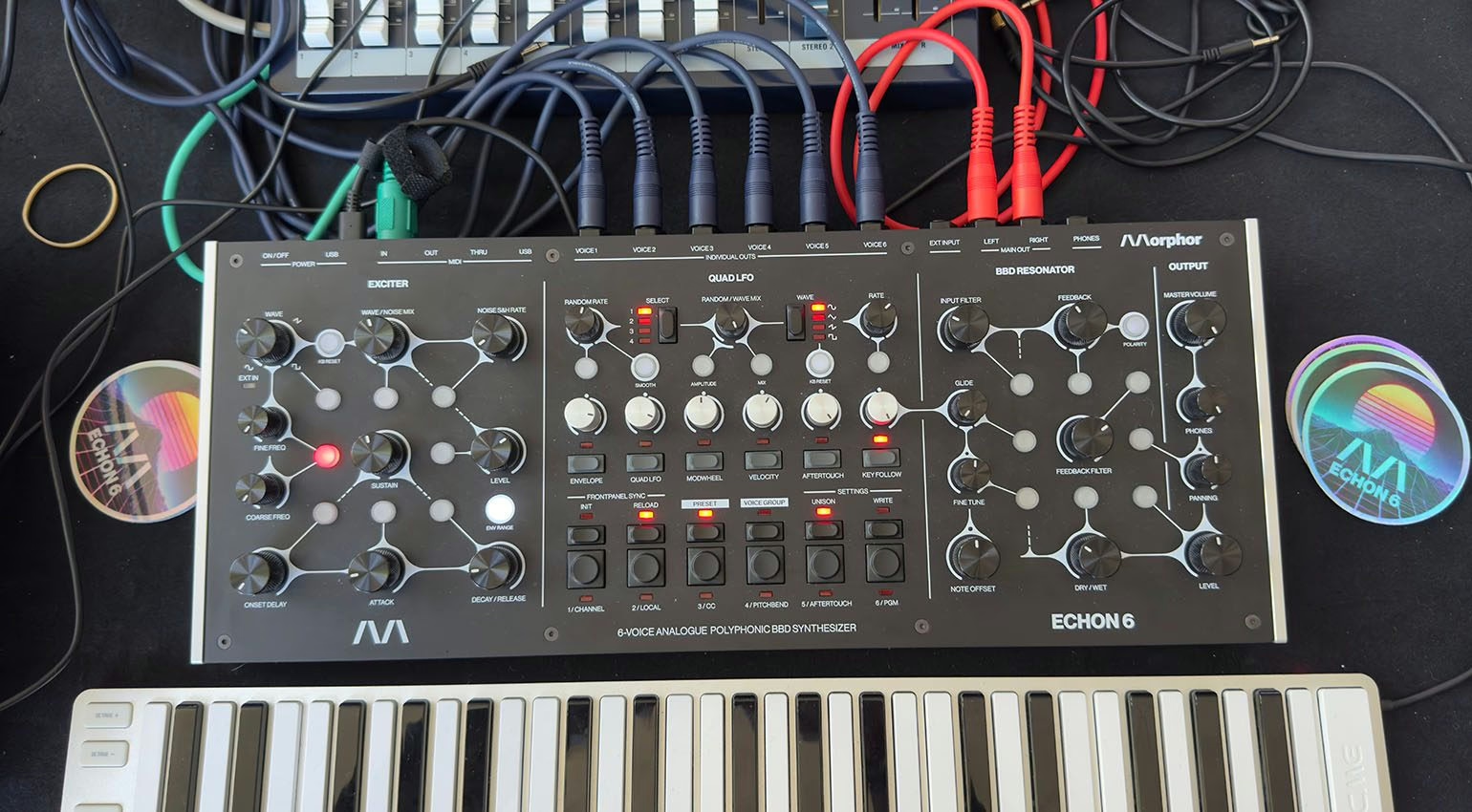
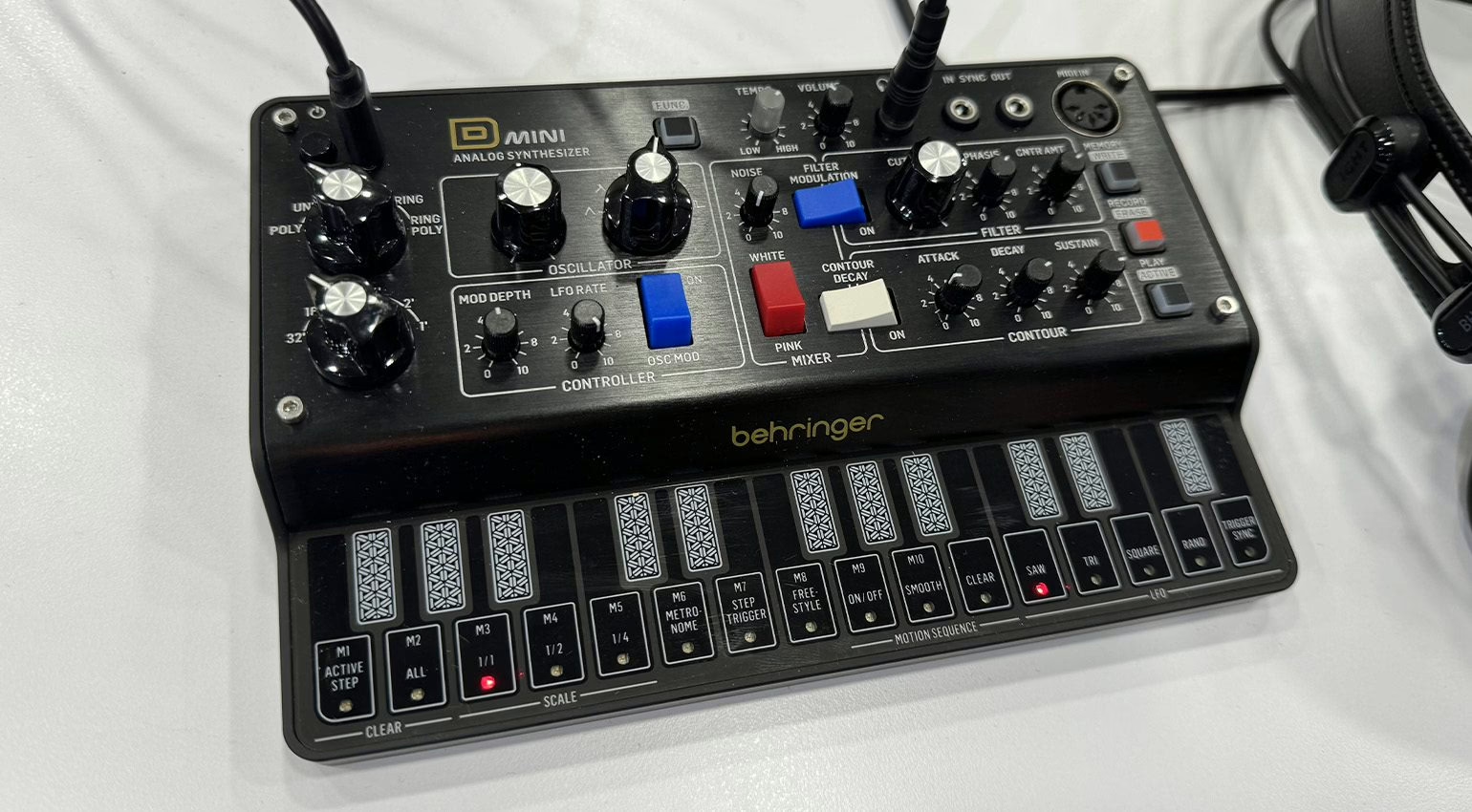
I get asked all the time, so let me be blunt. Subtractive synthesis is a principle, not a technology: a plugin implements it exactly like an analog VCO, and a modern software synth goes toe to toe with hardware on 95% of sounds. I lived through the shift from analog to computer-based music-making from the inside, and I hold no dogmatic nostalgia. Where analog still earns its keep is in audible details: the slight oscillator drift that thickens a unison, the way a filter behaves when you overdrive it, the sheer immediacy of a panel covered in knobs. Affordable reissues like the Behringer D Mini, a pocket Minimoog clone, or ambitious analog machines like the Morphor Echon 6 put that pleasure within reach of any budget. But if you are starting out, learn subtractive synthesis on whatever you already have, hardware or software: the concepts are exactly the same.
Where to go next
Subtractive synthesis is the basic grammar. Once the oscillator-filter-envelope trio is second nature, the other schools open up naturally: FM synthesis for metallic timbres and bells, wavetable synthesis for evolving textures, and the great historical divide between the East Coast and West Coast schools that shaped the synth. All of them lean, at one point or another, on reflexes you have just picked up here.