If you produce electronic music today, you use wavetable synthesis whether you know it or not. It sits at the heart of Serum, Massive, Vital, Ableton’s Wavetable instrument and a long line of hardware synths. Yet behind the phrase “wavetable” hides a principle that’s often misunderstood, stuck between two myths: it’s neither sample playback nor a simple bank of waveforms. Let’s set the record straight.
The principle: a single cycle, scanned
A single-cycle waveform is an extremely short piece of sound: one period of oscillation, a few dozen or few hundred samples. Looped at the right speed, it produces a sustained note — exactly like the sawtooth of an analogue synth would.
A wavetable is nothing more than an ordered collection of those single-cycle waveforms, filed side by side like the pages of a flip-book. The oscillator reads one at any given moment; but crucially, it can move through the table — call it the table index, the position, or the wave scan. That movement is where the magic lives: sweep across the table and the timbre morphs continuously, from one waveform to the next.
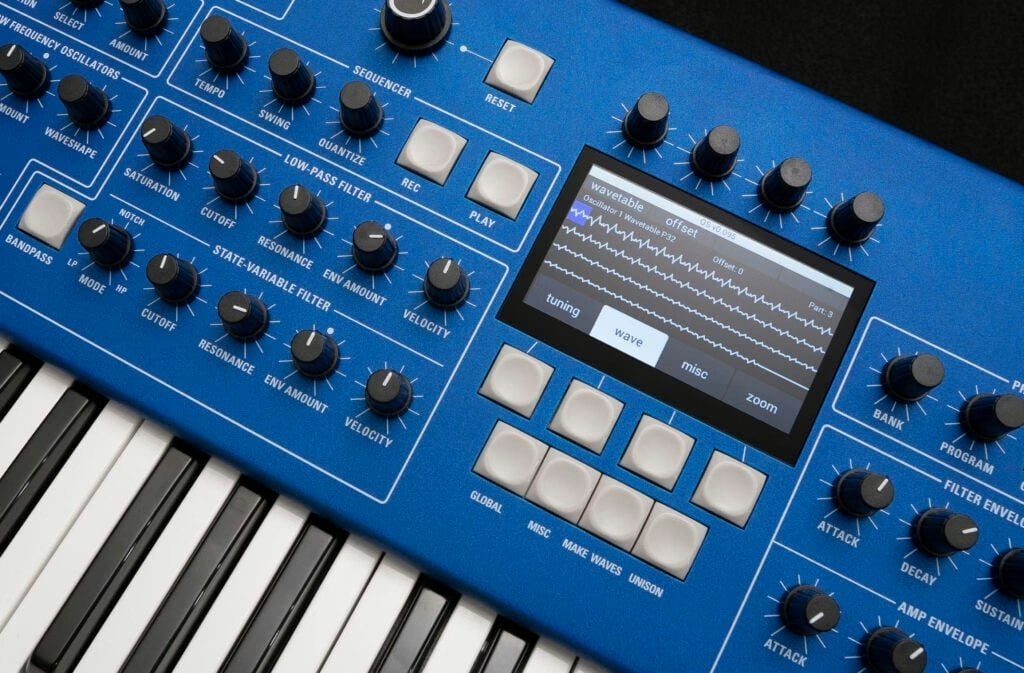
Two technical details separate a good implementation from a poor one. First, interpolation: between two neighbouring waveforms, the synth computes in-between states so the scan is smooth, with no stair-stepping or clicks. Second, anti-aliasing: because single-cycle waveforms are harmonically rich, their spectral content has to be limited according to the note played, or stray frequencies (the dreaded aliasing) will dirty the top end. That’s largely where a wavetable synth’s sonic reputation is won or lost.
Wavetable, FM, subtractive: don’t mix them up
The most common confusion pits wavetable against sample playback. A sampler plays back a long recording (a piano note lasting several seconds, with its attack and decay). A wavetable oscillator loops a tiny period and derives a pitch from it: it doesn’t “replay” a sound, it builds one. The table is a reservoir of timbres, not the memory of an event.
Against the other synthesis methods:
- Subtractive: you start from a rich wave (saw, square) and remove harmonics with a filter. Wavetable instead chooses its harmonic content by changing waveform — and the two pair beautifully, with the filter sitting after the wavetable oscillator.
- FM: timbre comes from modulating one oscillator’s frequency with another. Powerful but unintuitive; we broke it down in our FM synthesis explainer. Wavetable is far more visual: you see the waveform change.
A brief history, from Palm to today
The method isn’t new. In the late 1970s and early 1980s, German engineer Wolfgang Palm formalised it and brought it to the PPG Wave synths, whose crystalline digital sound marked a whole generation. Waldorf picked up the torch with the Microwave and then the Wave, keeping the approach alive through the analogue-to-digital decades.
The real explosion was in software. Massive, and then above all Serum, democratised wavetable for producers by finally making it legible: you draw your table, scan it with the mouse, and grasp at a glance what you’re hearing. The method is back in force in high-end hardware — Waldorf Iridium and Quantum, Groove Synthesis 3rd Wave — and stays central to recent releases, from discoDSP Corona 7 and Serum 2 reaching Linux to the wavetable oscillator built into browser DAW Suno Studio 2.0.
Taming wavetable in practice
Theory is useless without a few concrete reflexes. Here’s how I approach a wavetable patch:
- Modulate the position — that’s the core move. Assign an envelope to the table index for a motion that happens then settles (great on an attack), or a slow LFO for a cyclic, hypnotic evolution. Without position modulation, a wavetable oscillator is just a frozen waveform: you’re missing the whole point.
- Mind your table choice. A “harmonic” table (waveforms close to one another) gives smooth sweeps; a mixed-bag table (very different waveforms) gives abrupt jumps — sometimes wanted, often worth smoothing.
- Save the filter for last. Wavetable already delivers plenty of harmonic content: a simple low-pass is often enough. Piling on distortion and heavy filtering hides the table’s movement.
- Build your own tables. Most modern synths import a sample and slice it into waveforms — exactly what the spectral mode recently added to the 3rd Wave does. A voice, a field recording, a chord: anything can become a personal wavetable.
The bottom line
Wavetable’s strength is being both powerful and legible: you hear the timbre move and you see why. It’s also, to my mind, the most “modern” method to teach a synthesis beginner, because it makes visible the central idea behind every synthesizer: sound isn’t fixed, it evolves over time, and you’re the one steering that evolution. Once that reflex clicks, you’ll never wire up a wavetable oscillator like a plain sawtooth again.