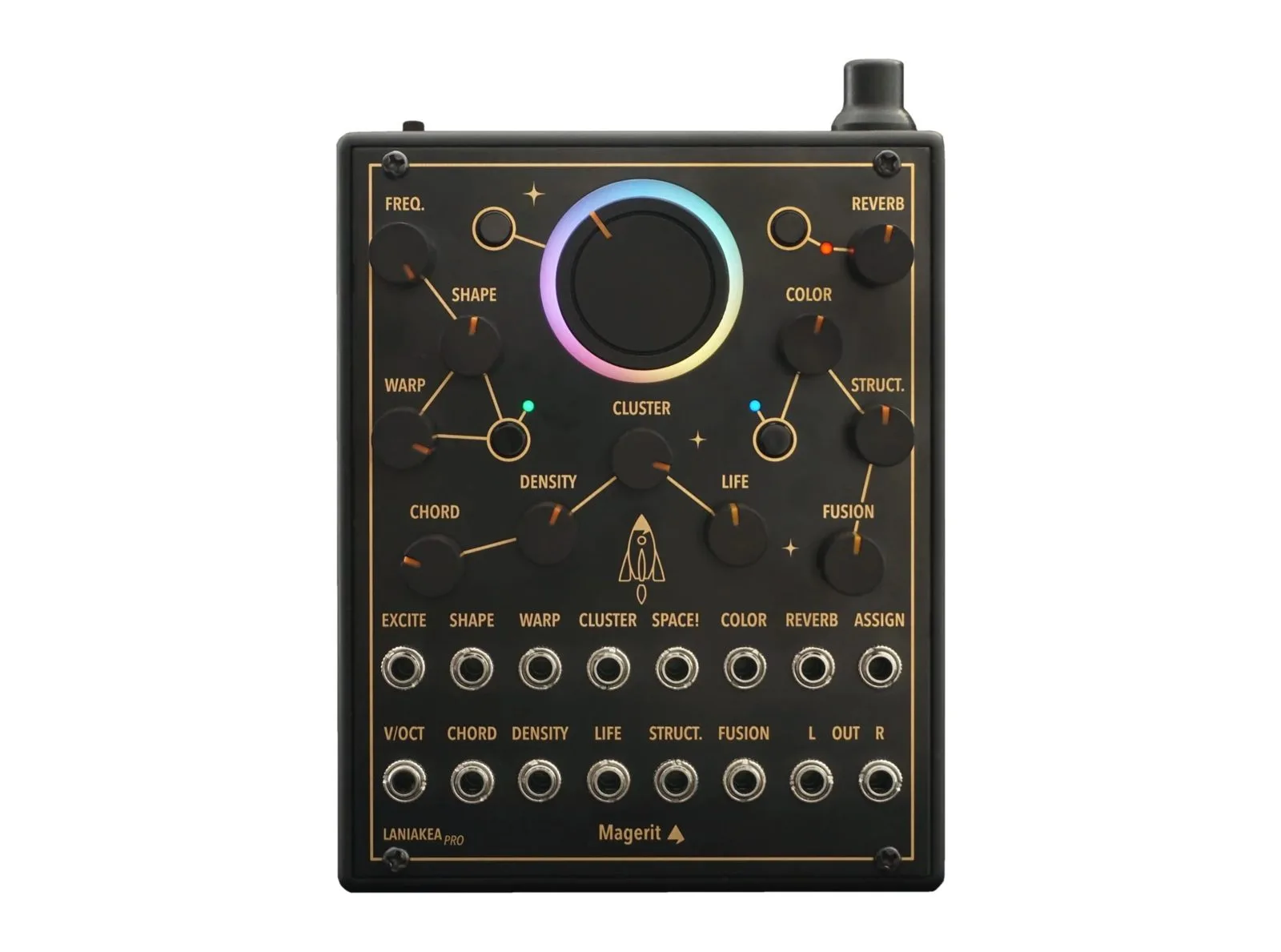
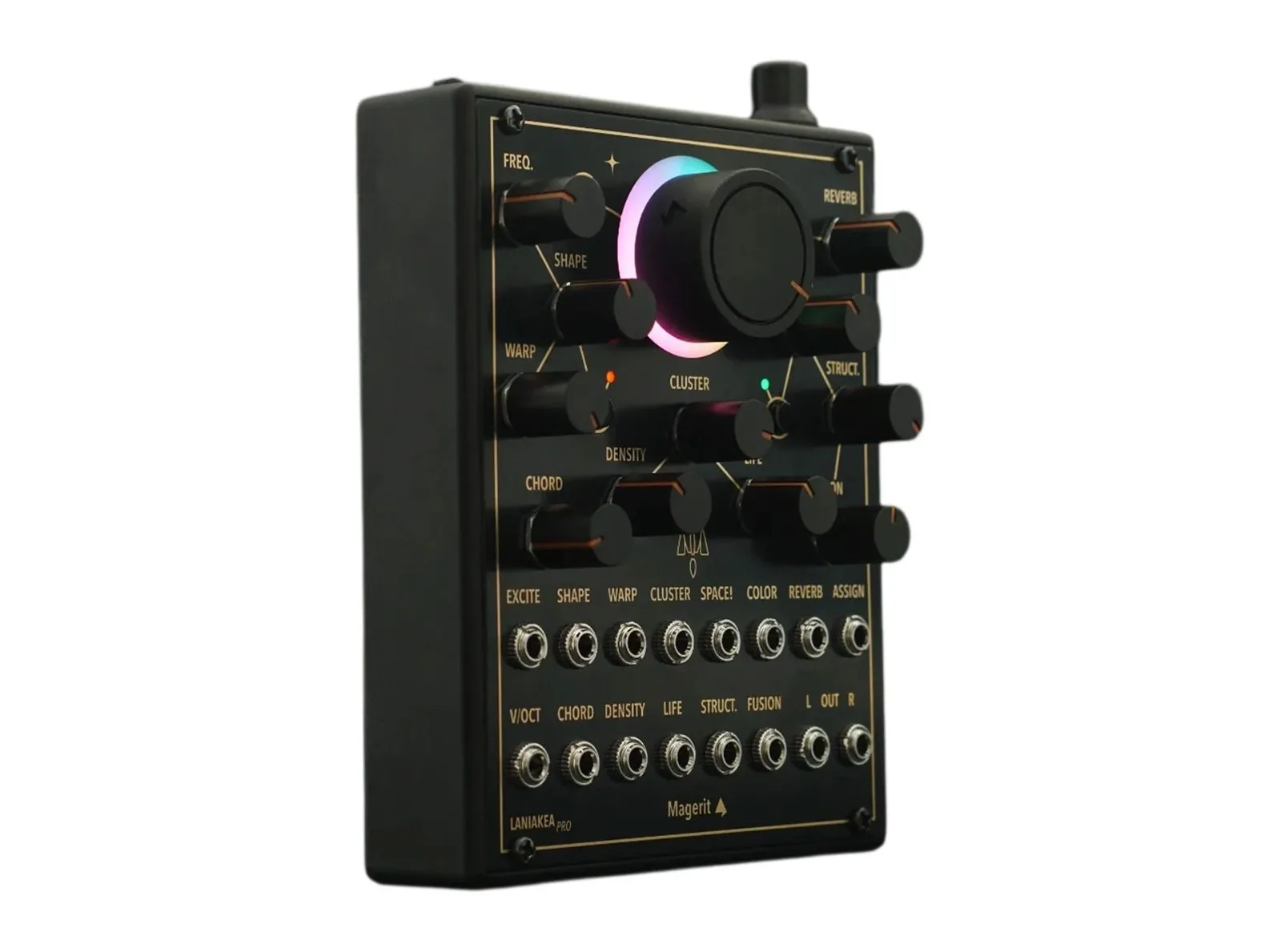
Madrid’s Magerit built a reputation with the Laniakea, a wavetable oscillator for Eurorack with a strong personality. The Pro version does not patch the old module, it rebuilds it from the ground up: five sound engines, up to eight voices and a battery-powered standalone mode. The Laniakea turns into a full instrument that lives as happily in a rack as on a desk.
Five engines in 20 HP
The heart of the Laniakea Pro sits under one knob, Shape, which switches the voice between five very different generators. You move from a 16-by-16 interpolated wavetable to a pair of bit-crushed chiptune oscillators, then to two-operator FM, to a bank of sustaining keyboards called Infinite Keys (electric piano, choirs, organs) and finally to a Karplus-Strong string, from a single pluck to a dense cloud.
| Engine | Character |
|---|---|
| Wavetable | 16 x 16 interpolated matrix |
| Virtual analog / chiptune | Two oscillators with bitcrushing |
| FM | Two operators |
| Infinite Keys | Six sustaining keyboard models |
| Karplus-Strong | Plucked strings, from single pluck to drone |
Each voice then runs through a texture stage with five processors to choose from (a waveshaper with clippers and wavefolders, a modal resonator, a multimode filter, a lo-fi degrader and a tape delay), followed by an in-house reverb with three profiles (Hall, FDN and Shimmer), each with freeze. The chain stays compact, yet it covers a wide territory, from a clean pad to the most broken grain.
Eight voices, as a chord or a cloud
The real news is the polyphony. The Chord knob stacks up to eight voices into chords, while Density and Life scatter those voices into grains, triggered or free-running. Fed with MIDI over USB, the Laniakea Pro behaves like a classic eight-voice polysynth; left to itself, it becomes a self-generating texture machine. The central Space macro knob modulates every parameter at once, with its own bipolar depth for each, so a whole sound can evolve from a single move.
For control, Magerit kept the flexibility of the modular world: every knob has a dedicated CV input, and an Assign input reaches secondary parameters such as root, scale, octave and output level. The CV inputs stay active even in standalone mode, which matters for anyone driving the instrument from a control-voltage sequencer.
Rack first, then the desk
The Laniakea Pro sells on its own, as a 20 HP Eurorack module, or as a bundle with a standalone enclosure powered by an internal battery rated for over twelve hours of play. A single USB-C port handles charging, USB audio and MIDI, and firmware updates. A headphone output with its own volume lets you play without a mixer. You return the module to a rack whenever you want, then pull it out for a session on the sofa: it is the same idea behind the performance enclosures that made desktop formats a hit, applied to a module born in the modular world.
A free companion app (standalone, VST3 and AU) manages presets, CC mappings and extends the built-in quantizer with custom scales, microtuning included. The instrument plays fine without it, but it opens the door to non-tempered tunings, a field few machines at this price touch.
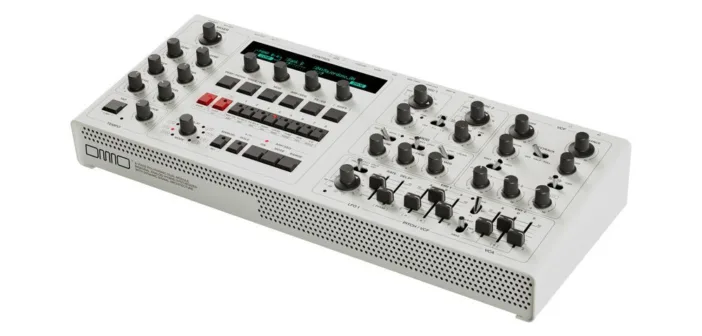
To place it, the Laniakea Pro crosses paths with other recent multi-engine boxes such as the Sonicware ELZ_1 core or the semi-modular Pittsburgh Modular Voltage Lab V, and shares the exploratory streak of a KOMA Elektronik Haloplane. On the desktop-hybrid side, the UDO Audio DMNO ON plays in a neighbouring class.
The module alone starts at €320 (about $345, £280) on the maker’s site, and the standalone bundle sits around €469 (about $505, £410). Magerit points to its dealers for exact availability.
My take
Turning a niche oscillator into a standalone eight-voice polysynth, without dropping the modular DNA, is a sound idea. The five engines and the built-in reverb avoid the trap of a module that needs a whole rack to sing, and the battery mode makes it a genuine sonic sketchbook. The open question is the finish of the most ambitious engines, Infinite Keys in particular, which promise a lot. At this price, with microtuning and a free app, the Laniakea Pro earns a short spot on the list for anyone after a voice of their own.