Can a twenty-year-old synth get a second wind without anyone touching its engine? That is the bet behind Gigantic, a complete new interface laid over Native Instruments’ original Massive, the 2007 one, not Massive X. The project comes from Matt Lara, a former Native Instruments employee, who openly says he built it with the help of artificial intelligence. The result is in beta, due soon, and it asks for one simple thing: your own licence of the original Massive.
A new shell on an engine everyone already knows
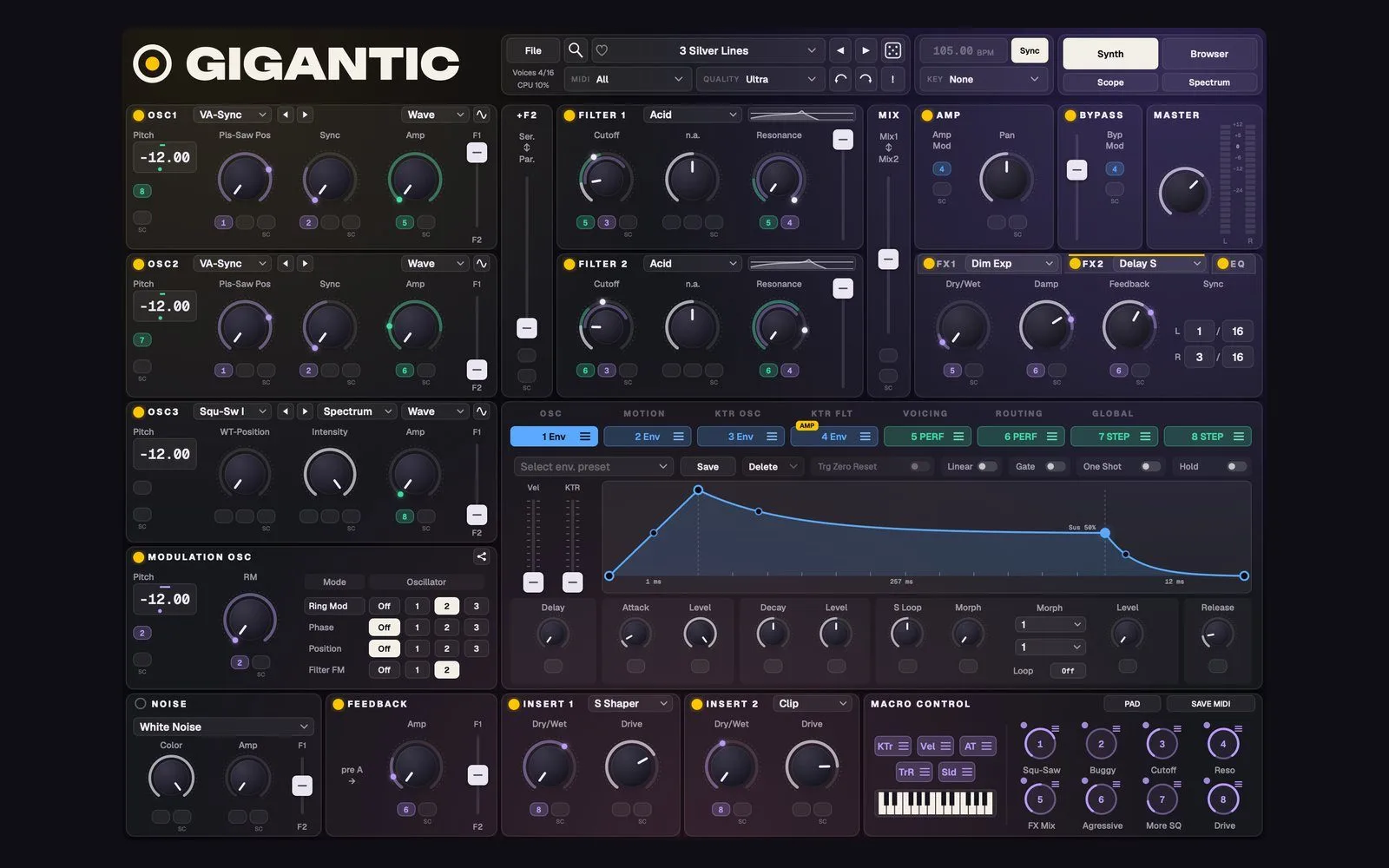
Gigantic is not a new synth. It reuses the original Massive’s code and sounds, sits on top and replaces the look. You need a valid Massive licence, installed and authorised, and the software reads existing presets in the .nmsv and .ksd formats, which sound identical. Your sound bank stays the same; only the window changes. Two limits are worth knowing up front: no compatibility with Massive X, and nothing on Linux.
The timing is what makes the move interesting. Native Instruments shipped Massive XL, the big update to its in-house wavetable synth, in late October 2026 and retired Massive X. The original Massive still runs in thousands of sessions: its character never aged badly, its interface did. Gigantic takes the problem from that end, keeping the engine and modernising everything around it.
What the new interface adds
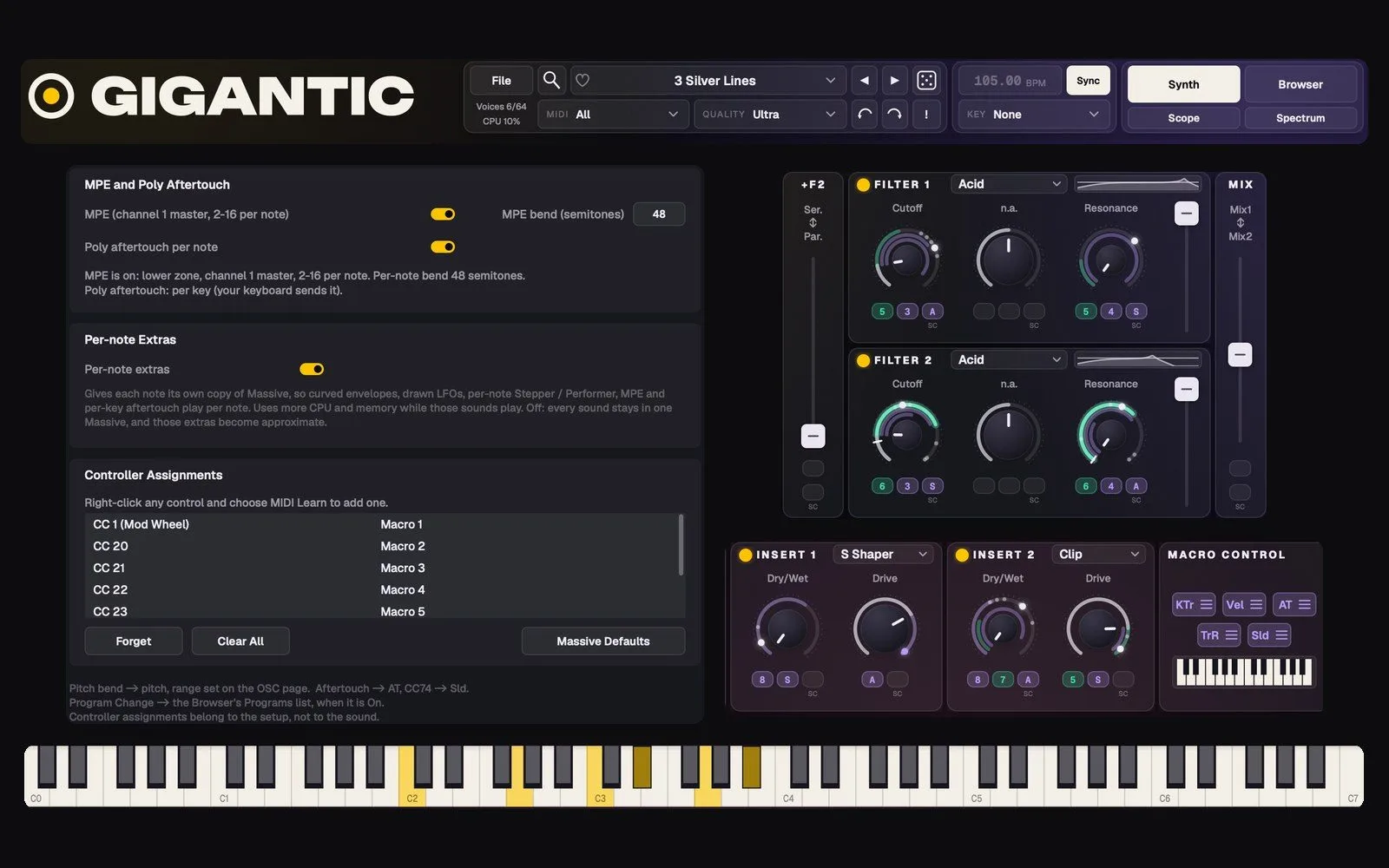
The window scales from 75 to 200 per cent and offers several themes, black, white and a few more. Every knob shows its modulation dots live, and the display adds filter curves, EQ graphs and both 2D and 3D wavetable views. The preset browser reads .nmsv and .ksd files with preview, offers a sound map in the vein of Absynth 6, favourites, ratings, colour tags and up to one hundred undo steps. None of that existed in the original window.
A wavetable editor and an in-house sampler
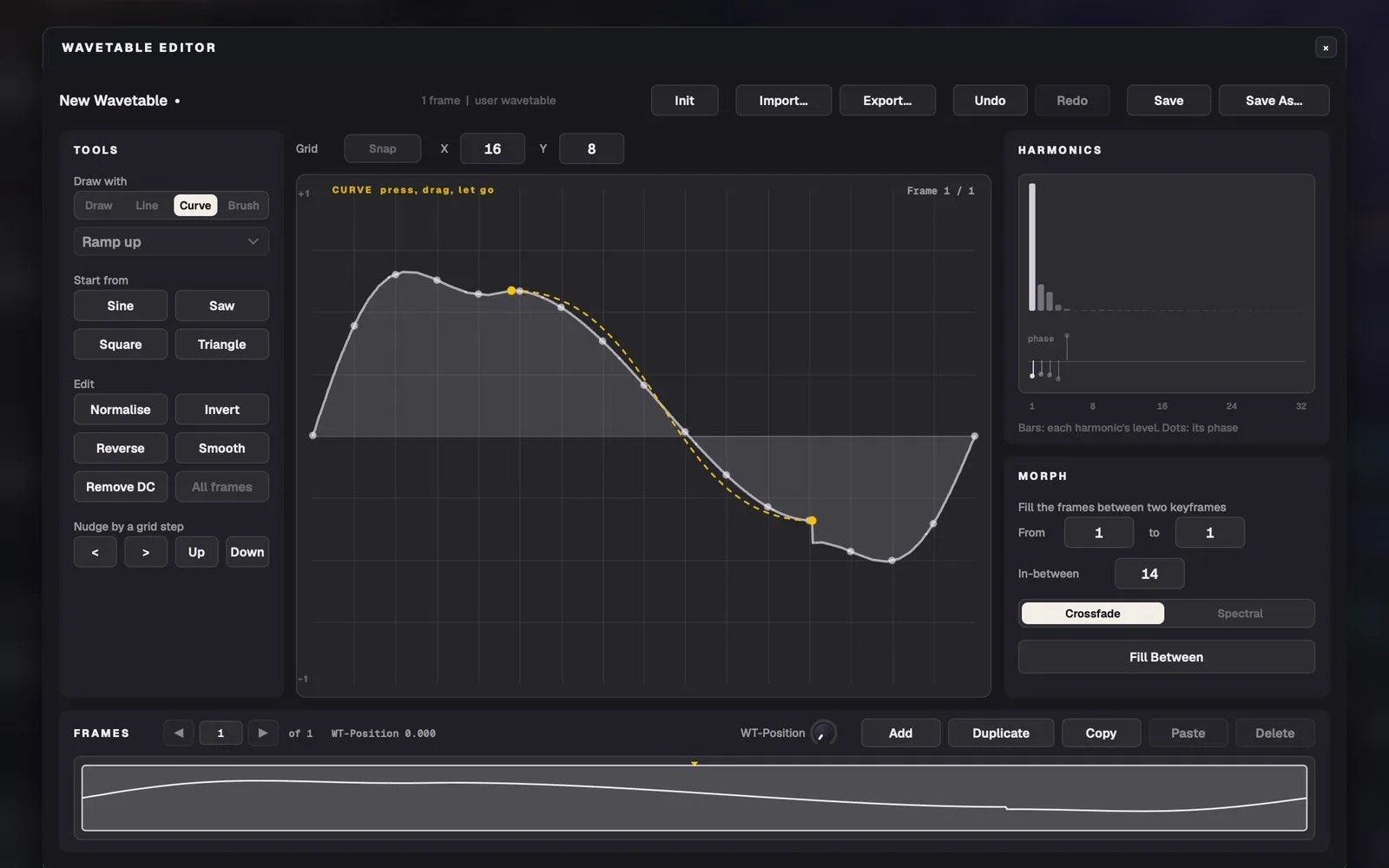
The wavetable engine gains a proper drawing workshop: freehand, line, curve and shape brushes, up to 256 frames, harmonic and phase editing, one-click morphing between two frames, plus import and export. Enough to build your own tables rather than dig through the library.
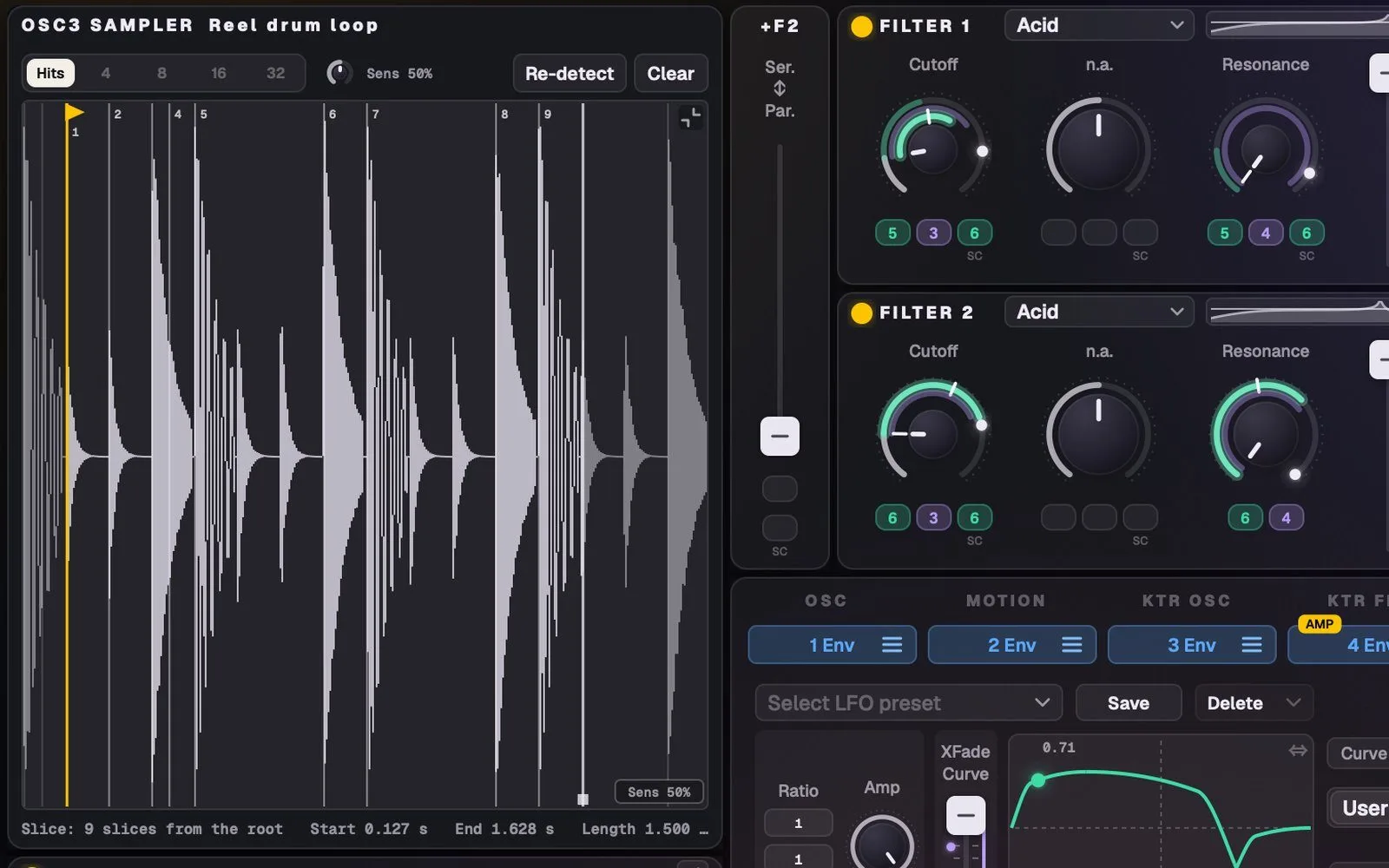
The sampler, for its part, is brand new. Loop playback with modulatable start and length, several play modes, slicing spread independently across the keyboard, with time-stretch and sync. On top of that sit a granular engine, whose principle we cover in our guide to granular synthesis, and an audio input mode that takes a live signal or a sidechain feed. Even the noise generator moves on: it can load a sample as a looping source.
Modulation, MPE and sequencer
The matrix keeps its eight modulation slots, but each one does more. You draw your LFOs, trace performer curves and morphable envelope shapes, with a free curve on attack, decay and release. XY pads morph the eight macros toward four corners. On the playing side, polyphonic aftertouch and MPE open per-note bend, pressure and slide, with a per-note mode that climbs to 64 voices, each with its own modulation. MIDI learn covers every control and automation runs through the DAW.
The onboard sequencer holds its own: per-step ratchet from 1 to 4, tie, shorten, reset and skip options, forward, backward, ping-pong or random playback, and step snapping to a scale. For an engine designed before the era of software grooveboxes, the addition changes how you play the synth.
Availability and formats
Gigantic is in beta, its release is listed as “coming soon”, and the price has not been announced. It runs on Mac (macOS 12 or later) and PC (Windows 10 or 11, 64-bit), with a single licence covering both platforms. The formats are standalone, VST3 on Mac and PC and AU on Mac, with a Gigantic FX variant in the same flavours; AAX for Pro Tools is “being looked at” after launch. There is no demo, but a 14-day refund. The tool is not NKS-compatible, though it ships a MIDI template for Kontrol S MK3 keyboards. The free Xfer Shrub remains another way in for anyone who wants to draw tables without an existing licence.
My take
The idea is clever because it aims right. The original Massive never had a sound problem, only a window problem: too small, too fixed, a dated browser. Dropping a wavetable editor, a granular sampler and serious MPE on top gives a second life to an engine many kept out of habit. The stated use of AI to build Gigantic is as intriguing as it is unsettling, and leaning on an existing Massive licence will narrow the audience. What remains is a likeable bet: price and stability after the beta will decide it.
Source: The Signal Supply.