Two boxes, two philosophies. The Neve 1073 and the API 312 rank among the most copied mic preamps in studio history, yet almost everything about how they bring a signal up to line level sets them apart. One stacks Class A transistor stages and an inductor EQ, the other leans on a single discrete op-amp. Understanding their choices means understanding two tonal colours engineers still reach for every day.
| Neve 1073 | API 312 | |
|---|---|---|
| First seen | 1970, Wessex A88 console | 1970s, API’s first mic preamp |
| Gain stage | several Class A transistor stages | a single discrete op-amp, the 2520 |
| Transformers | input and output, Marinair lineage | in-house input and output |
| Built-in EQ | yes, three-band inductor EQ | no, the 312 is a preamp only |
| Claimed signature | dense, warm, with body | fast, forward, transient-rich |
Neve 1073, Class A and a broadcast heritage
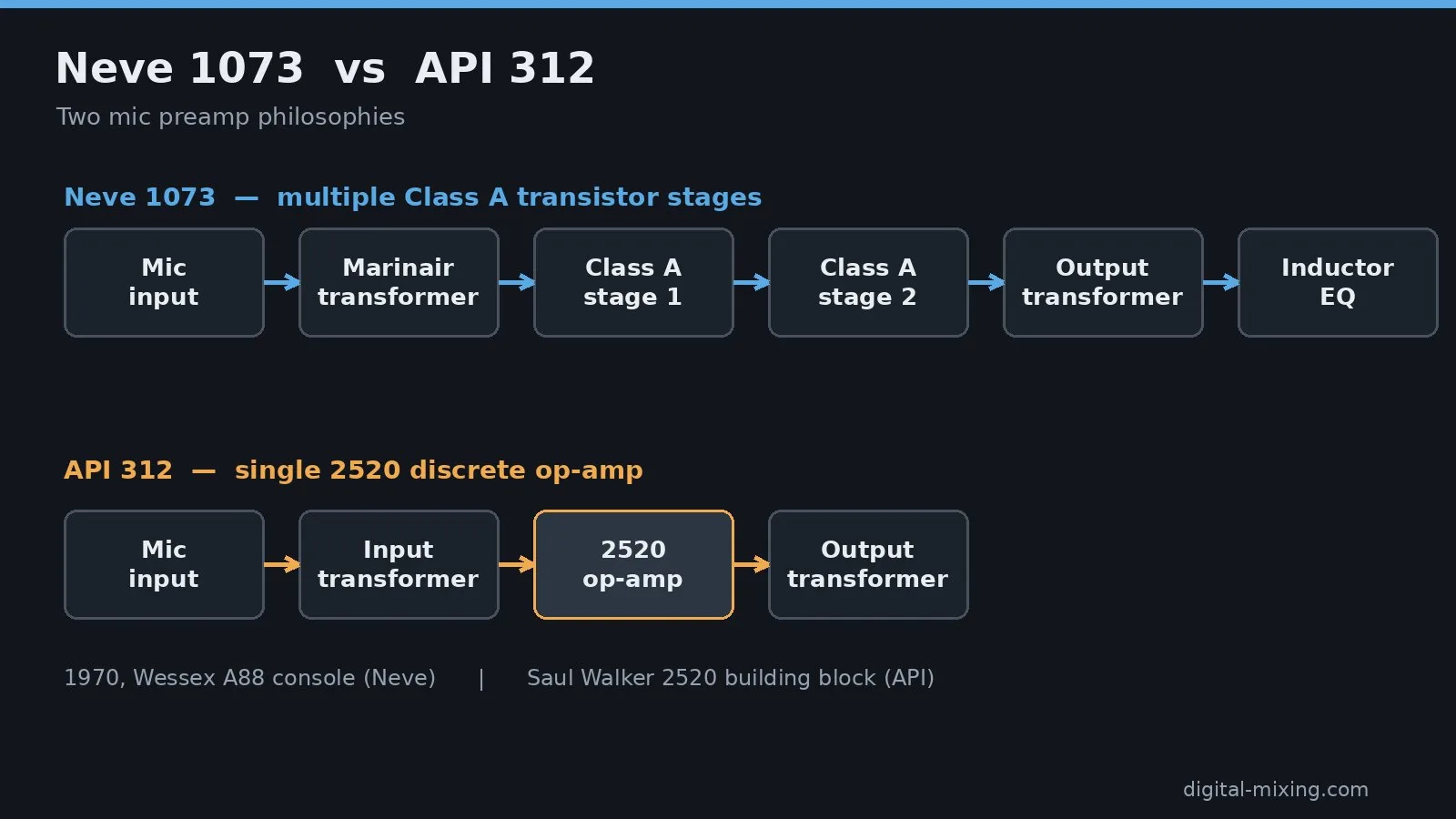
The 1073 was born in 1970 to fit the Wessex A88 console, commissioned by Wessex Studios in London. According to the AMS Neve history page, the module runs two transistor gain stages on the input, followed by a transformer-coupled output amplifier. The whole thing works in Class A, a biasing choice that keeps the components working hard and shapes the brand’s familiar roundness.
Transformers are central. The 1073 sits in the Marinair lineage, the windings that came out of a late-1960s collaboration between Neve and the Marinair radar company. They handle isolation and gain staging, and they add to the signature. The 1073 also carries a part the API lacks, a three-band inductor EQ with a low shelf, a mid bell and a high shelf, plus a high-pass filter. To place that kind of console EQ, our piece on the Trident A-Range in 500 format shows another school of legendary equalizers.
API 312, one op-amp doing it all
The API 312 follows the opposite logic, the one of a short signal path. Designed by Saul Walker, it was the brand’s first mic preamp, and its recipe still runs through almost the entire API catalogue. The signal goes from an input transformer to a single discrete op-amp, the famous 2520, which acts as the variable gain stage, then out through an output transformer. That 2520 is so common across API gear that it nearly defines the house sound on its own, the fast attack and forward presence engineers chase on drums or a punchy vocal.
The 312 offers no EQ. In API tradition, equalization comes from a separate module placed right after. That division of labour partly explains the system’s modularity and the architecture’s long life. To revisit how gain, impedance and transformers shape a preamp, our guide to the mic preamp explained walks through each stage.
Two colours, two uses
At the mix, the choice comes down to the ear and the source. The 1073 thickens, rounds and flatters, with the body you want on a lead vocal, a bass or a brass line. The API 312 snaps, pushes forward and lets transients breathe, an asset on a snare, a rhythm guitar or a percussion hit. Neither is right in the absolute, and plenty of studios keep both on the patchbay, exactly as they keep a tube compressor and a FET 1176 for opposite characters.
The EQ question often settles it. If you want to sculpt at the source without adding a module, the 1073 solves it in one box. If you prefer the shortest possible chain and want to equalize later, sometimes in Mid/Side processing at the mix, the 312 imposes less of itself up front.
Reissues and modules everywhere
Both architectures have largely outlived their original consoles. AMS Neve reissues the 1073 in several forms, from the classic module to rack versions and the 500 format, and a crowd of makers offer their own takes, more or less faithful. On the API side, the 2520 and the in-house transformer show up in the 512 Lunchbox preamp and in countless channel strips. Choosing today is no longer about tracking down a rare box, but about a family of sounds available at almost every budget, from the affordable clone to the official reissue.
One detail matters when you set the gain. The 1073 likes being pushed, since its distortion rises gently and adds density, which is why engineers often chase colour by opening the input and making up at the output. The API, more neutral as long as you do not hammer it, delivers its signature mostly through its speed of response. Two routes to character, one through saturation, the other through dynamics, and that is exactly why keeping both makes sense.
My take
Pitting these two against each other is not a points match. The 1073 and the 312 are a painter’s tools, not rivals: you grab one to lay down body, the other to keep bite. The real lesson is in the longevity. Fifty years on, people still copy a stack of Class A transistors and a discrete op-amp the size of a stamp. When a circuit stays this relevant for this long, the design clearly got something right. The rest is picking the colour that serves the song.