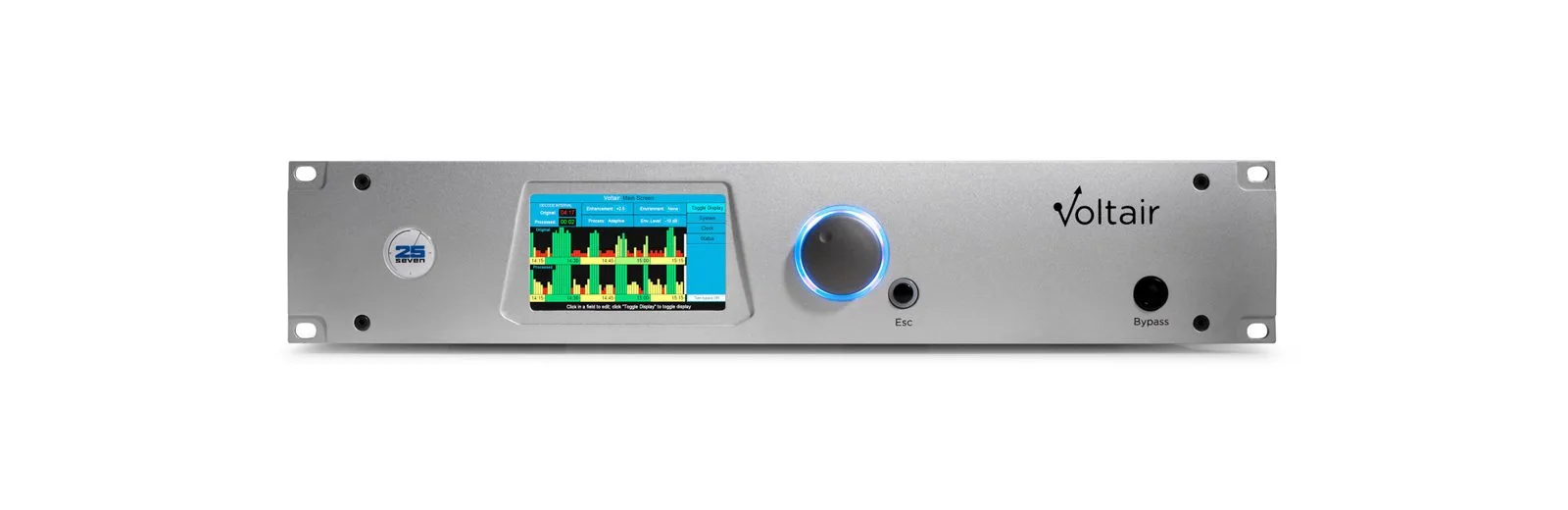
Eleven years after a launch that shook American radio, Telos Alliance is bringing back one of its most talked-about machines. The Voltair II follows the original Voltair, which arrived in late 2014 and was discontinued after more than a thousand units sold. Under its 25-Seven brand, the group ships a 2RU box with the same aim: helping a station be measured accurately in markets fitted with Nielsen’s Portable People Meter.
What the Voltair actually does
The principle is worth stating plainly. Nielsen’s PPM system identifies listening by detecting an inaudible code tucked into the station’s audio, a process we broke down in our feature on audio watermarking for ratings. The snag is that some programming carries that mark poorly, and a code that goes undetected is listening that never gets counted. The Voltair strengthens the robustness of that code so measurement better reflects reality. Telos keeps repeating the point: the unit does not raise actual listenership, it lowers the risk that real listening slips past the count.

Three functions in one rack
The Voltair II’s novelty lies in bundling three tools in a single chassis. First comes the original processor, the one that made the first version famous. Next is the function inherited from the TVC-15, which adjusts the enhancement level in real time based on the program. Marty Sacks, executive vice president of strategic partnerships, describes it as “an AGC for the Voltair,” designed to limit audible artefacts when a user pushes the enhancement knob too far.
The third block is called Pascal. This algorithm tackles hard-to-encode material, such as speech or some contemporary urban productions, by boosting energy in specific regions of the spectrum. Telos has not detailed how it works internally, but the intent is clear: secure the mark where it faltered most.
Hardware only, no software
Telos owns a firm choice: the Voltair II stays a physical machine and will not be offered as software. The reason lies in the timing precision required and in how the unit talks to the hardware encoder. Stations that encoded PPM inside a broadcast processor, such as the company’s Omnia .9, will therefore need to return to a hardware encoder to benefit. Good news on integration: the Voltair II keeps the 2RU format, the same connectors and the same pin-out as its predecessor, so it drops in without rewiring. Analog and AES versions are in the catalogue.
Price, availability and expected gains
The price is set at $19,500, a figure Marty Sacks frames as the first version’s price from about twelve years ago, adjusted for inflation. Sales are direct from the factory, and only to U.S. stations. The first units are in stock and shipping, but Telos warns that supply will stay tight, with server and memory shortages tied to data-center demand weighing on production.
On results, the message is measured. “This is not like when the original Voltair hit,” Sacks cautions in Radio World. The brand’s testers estimate an overall gain of 1.5 to 2% at the low end, and 4 to 5% at the high end, depending on the material. The unit was evaluated in several markets, including Los Angeles, Chicago, Boston, Dallas and Columbus. Telos notes that it uses neither Nielsen’s trademarks nor its data. To decide which meter to watch on air, our comparison of VU, PPM, peak or loudness puts these readings in perspective, and facilities beefing up their transmission chain will find more in the same company’s Zephyr Connect SE codec.
My take
A box near twenty thousand dollars whose only job is to make an inaudible code easier to detect sums up the very particular economics of American PPM-market radio. The claimed gains are modest and honestly presented as such, far from the shockwave of 2014. The Voltair II’s merit is to gather three settings that used to be scattered and to tame the enhancement when it turns audible. The real question for a technical director remains the return on investment against a fleet of encoders to replace.