A listener at the back of a room hears the main PA coming from the stage and, often, a delay speaker set much closer to them. Left alone, the delay speaker dominates, and the sound seems to come from the nearest wall rather than from the musicians. The Haas effect holds the key to putting the sound image back in its place. Understood well, it changes how you set the smallest fill box.
The law of the first wavefront
When two identical sounds reach the ear a few milliseconds apart, the hearing system does not perceive them as two separate events. It fuses them into one and localises the whole on the first arrival, the first wavefront. The second sound, even a little louder, adds energy and loudness, but it does not move the perceived direction. Acousticians call this the law of the first wavefront, or the precedence effect.
Physicist Helmut Haas quantified this behaviour in 1949. His most quoted figure: a delayed second arrival can be up to about ten decibels louder than the first without the localisation tipping toward it, as long as the delay stays inside a window of a few tens of milliseconds. Past a certain threshold, fusion breaks and the delay is heard as a distinct echo.
{SVG}
The timing landmarks to keep in mind
Three zones follow one another. Below about one millisecond the two arrivals combine in the realm of comb filtering, with dips and peaks across the spectrum. Between one and about thirty milliseconds you enter the precedence zone: the sound stays fused and localised on the first source, the useful range for live sound. Past roughly forty to fifty milliseconds, depending on the material, the delay detaches and becomes a distracting echo.
These numbers are landmarks, not walls. A sharp transient, like a percussion hit, reveals an echo earlier than a sustained pad. The practical rule is to stay inside the fusion window and watch for echo on the most percussive sources.
The real application: delay speakers
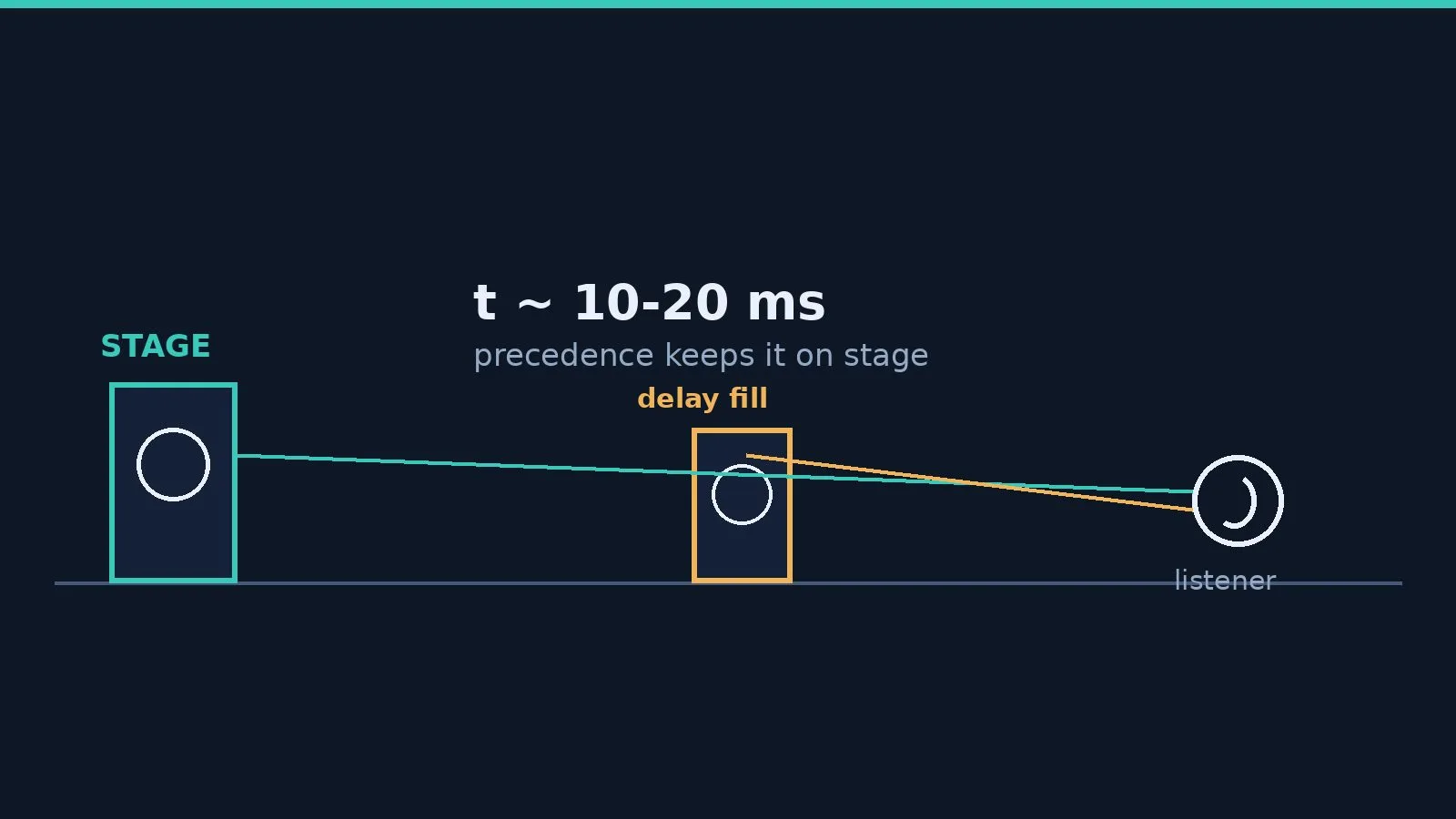
Here is the heart of it. A delay speaker, set mid-room, receives the same signal as the main PA. Being closer to the listener, its signal would arrive before the stage sound if nothing were done, and the image would stick to the fill. To correct this, you electronically delay the fill by the difference in flight time between the stage and that speaker, worked out from the distance and the speed of sound, about 2.9 milliseconds per metre.
The subtlety comes next. If you set the delay exactly to the distance, the two arrivals are simultaneous and the image goes vague. So you add a small extra amount, often five to fifteen milliseconds, so the main PA always reaches the ear first. Thanks to precedence, the listener localises the sound on the stage while enjoying the level and intelligibility the fill provides. This fine tuning is at the core of placing delay speakers and front-fills.
The same logic applies to a front-fill at the stage lip, to a delay tower outdoors, or to a distributed system in a long venue. Each time, you measure the distance, convert it to time, then add the precedence margin. A transfer function measurement then confirms the real alignment on site, handy when temperature shifts the speed of sound.
The trade-off to watch
The Haas window does not license everything. If the fill exceeds the main PA by much more than ten decibels, precedence no longer holds and the image sticks back to the fill. So you set the fill level to complete the main PA, not to replace it. Likewise, a badly set delay, too short or zero, drops both arrivals into comb-filtering territory, and the sound goes hollow. That is why timing and level go together, and why a distributed system is checked by walking the covered area and listening.
In the studio, the same principle widens a stereo image: a short delay on one side shifts the perception without changing the level. Attention then turns to mono compatibility, because a signal widened by time can weaken once the channels are summed.
My take
The Haas effect is one of the few psychoacoustic principles that genuinely changes a field setting. The reflex fits in one sentence: always delay the nearest speaker so the stage arrives first, then add a handful of milliseconds of margin. The result is immediate, the image snaps back to the musicians and the fill disappears as a source. The only thing to watch is the fill level, which should support the main PA without covering it. A tape measure, a calculator and a bit of listening are enough to hold a whole room.