You set a sequencer to sixteen steps, you want five hits and you need to decide where they go. Spacing them by hand quickly turns lopsided. Euclidean rhythms answer that question with surprising economy: they spread a given number of pulses as evenly as possible over a given number of steps. The output often lands on patterns you already know without knowing they had a name.
From a computing algorithm to a grammar of groove
The idea comes from a 2004 paper by mathematician Godfried Toussaint, who noticed that Euclid’s algorithm, more than two thousand years old and built to find the greatest common divisor of two numbers, produces exactly the most even spread of a set of hits around a cycle. A Euclidean pattern is written E(k, n): k hits spread over n steps.
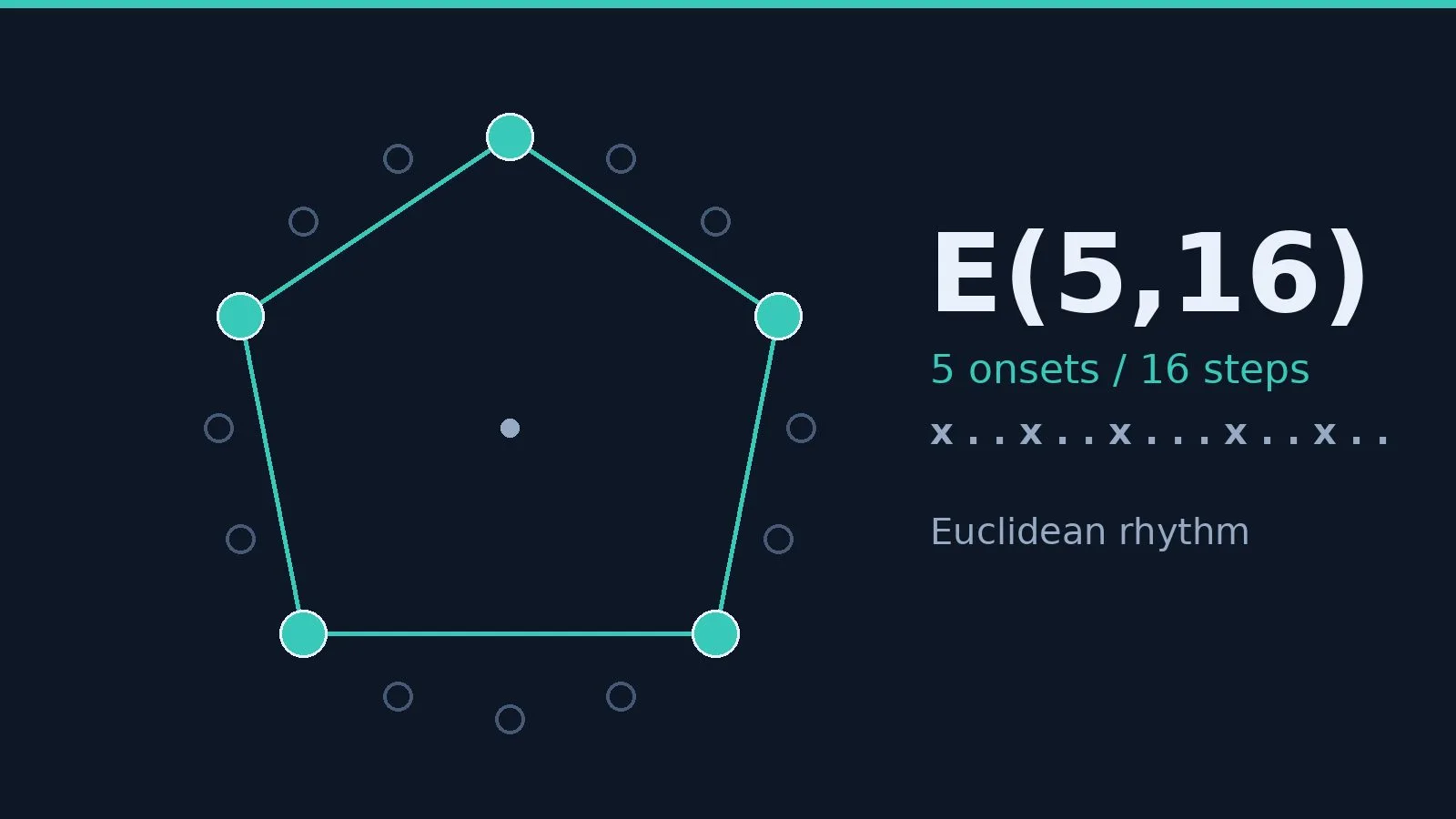
The mechanics are easy to follow. For E(5, 16) you start with five marked steps and eleven empty ones, then repeatedly group them in pairs, like a Euclidean division, until the remainders can no longer be distributed. The hits end up separated by an almost constant interval, 16 divided by 5 being 3.2, so gaps that alternate between three and four steps. You get {SVG} a pattern that breathes instead of hammering equal beats.
Why these patterns sound right
Maximal evenness is exactly what makes these rhythms musical. A cycle with every hit bunched at the top of the bar sounds thin; a cycle with perfectly equidistant hits, when that is possible, gives a flat pulse. The Euclidean algorithm sits between the two: the hits are as spread out as the arithmetic allows, but since n is almost never a multiple of k, an asymmetry remains, and that asymmetry is where the swing comes from.
The examples speak for themselves. E(3, 8) gives the tresillo, the building block of much Afro-Cuban music and, today, of reggaeton. E(5, 8) gives the cinquillo. E(2, 5) turns up in West African traditions, E(7, 16) in electronic patterns. You also stumble onto claves and bembé figures without looking for them. Toussaint catalogued dozens of traditional rhythms from around the world that coincide with a Euclidean pattern, which explains part of their universality.
Rotation, the parameter that changes everything
A Euclidean pattern is not fixed. By shifting the starting point, the rotation, you keep the same spacing but move the accent relative to beat one. E(5, 8) started on a filled step or an empty one does not tell the same rhythmic story, even though the grid is identical. That control turns a correct pattern into a groove that pushes, which is why most Euclidean sequencers offer three per-track commands: the number of steps, the number of hits and the rotation.
With those three knobs you cover huge ground without ever drawing a hit by hand. Set a hi-hat track to 9 steps while the kick stays on 16, and the two patterns drift slowly against each other, building a polyrhythm that takes several bars to come back around. It is the same logic that drives an arpeggiator or a tempo-synced LFO, applied to where the hits land.
Where to find them in your gear
Euclidean generators are everywhere. In hardware they live in dedicated Eurorack modules, in sequencers that drive a modular system, and in sequencing brains such as the Squarp Core, which makes it one of its generative engines. In software, most digital audio workstations ship a Euclidean MIDI plugin, and many groovebox sequencers include a per-track Euclidean mode.
The way in is the same everywhere. Lay down a reference pulse first, often the kick, Euclidean or not. Add a percussion track with a small number of hits over a large number of steps, then use the rotation to lock it against the first. Then stack one or two more tracks with step counts that share no common divisor, like 7 and 16, for a texture that keeps evolving. That is the whole point: you write a rule, not a list of hits, and the machine unfolds a coherent pattern you would have taken a long time to find step by step.
The limits worth knowing
A Euclidean rhythm is no magic recipe. When n is a multiple of k, the algorithm gives perfectly equidistant hits, so a regular, predictable pattern, useful as a pulse but flat as a groove. The other way, a hit count very close to the step count fills the cycle and loses interest. The good ground sits in the unbalanced ratios, where k and n share no divisor. Finally, a Euclidean pattern distributes identical hits: to get dynamics you still work the accents, the velocity and the synthesis of each sound, for example by shaping the drum synthesis that carries the pattern.
My take
The Euclidean generator is the first generative tool I point people to when their rhythms feel too square. Three knobs, no theory to revise, and results that stand up within the first minute. The real value is not reproducing a tresillo you could program in ten seconds, but stacking two or three patterns on offset cycles and hearing the polyrhythm build itself. One habit to pick up: stop when the pattern sounds right, instead of twisting the knobs forever.