Hold three notes on a synth, switch on the arpeggiator, and the chord starts galloping on its own. Behind that magic hides one of the oldest and most misunderstood tools in electronic instrument design. The arpeggiator isn’t a gimmick: it’s a little machine that turns a chord into a rhythmic pattern. Here is how it works, mode by mode, and how to make it sing.
What an arpeggiator actually is
An arpeggiator takes the notes you’re holding down and replays them one at a time, in a defined order and at a defined tempo. Instead of hearing a C-E-G chord struck together, you hear C, then E, then G, looped as long as you hold the chord. The word comes from the arpeggio, the act of spelling out a chord’s notes rather than playing them together — except here the machine does it, with metronomic regularity.
The key nuance: an arpeggiator doesn’t generate notes, it reorders the ones you give it. Change chord on the keyboard and the pattern follows instantly. That’s what makes it so alive to play, and so different from a fixed melody.
Modes: the order of the notes
The heart of an arpeggiator is its mode — the rule deciding the order in which held notes cycle:
- Up: lowest to highest, then repeat. The classic.
- Down: the reverse, top to bottom.
- Up/Down: up then back down, looped. Watch the end note, played once or twice depending on the implementation.
- Random: a random order, perfect for shifting textures.
- As played: notes cycle in the order your fingers pressed them. The most expressive, because you draw the pattern.
- Chord: all notes replayed together in rhythm, for a pulsing effect.
On paper these modes seem trivial. To the ear, going from Up to As played completely changes a line’s personality.
Rhythm: rate, octaves, gate and swing
An arpeggiator is only as good as its rhythmic setting. Four parameters do most of the work:
- Rate (division): the speed, expressed as tempo divisions (quarter, eighth, sixteenth notes, triplets). Synced to the clock, the arp locks to the track; free-running, it floats at its own pace.
- Octaves (range): the pattern can repeat over one, two or three octaves, stacking the same notes higher. That’s what gives those cascades typical of synthwave and trance.
- Gate (length): the duration of each note. Short, the arp is staccato and nervous; long, notes overlap and create legato.
- Swing: a slight offset of the even notes that adds groove, exactly like on a drum machine. Without it, an arp can sound mechanical.
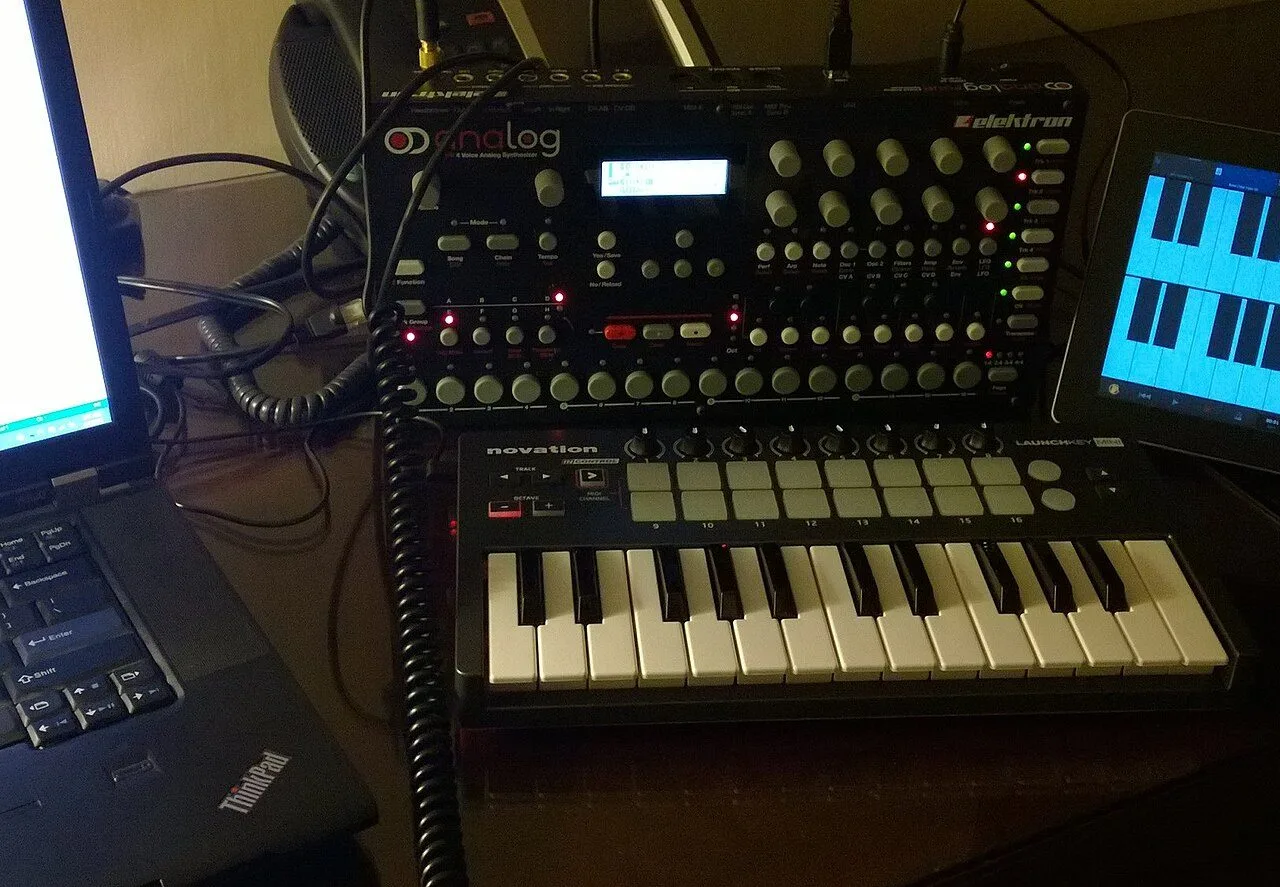
These ideas of division, gate and swing are the same as a step sequencer‘s — the arpeggiator is its automatic cousin.
Hold, latch and modulation
The Hold (or Latch) function keeps the arp running even after you release the keys: you let go of the keyboard and go twist a filter or an LFO while the pattern carries on. That’s where the arpeggiator becomes a real performance instrument. Combine it with a short envelope and a resonant filter — our pieces on the ADSR envelope and synth filters explain how each note takes shape — and the same pattern can shift from crystalline rain to a muffled pulse.
Arpeggiator or sequencer: don’t confuse them
Both produce repeated patterns, but the logic differs. A sequencer stores specific notes, programmed step by step, independent of what you play. An arpeggiator stores nothing: it reacts in real time to the notes held. One is a recording, the other a reflex. Many modern machines combine both, and you can often capture an arp into the sequencer to edit it afterwards. The boundary, historically, goes back to when everything was patched over MIDI and CV/Gate.
In practice
The arpeggiator is everywhere: the pulsing basslines of house, the shimmering pads of ambient, the hypnotic lines of synthwave, the patterns of trance. The basic recipe is three moves: hold a chord, set the rate to a division that breathes with the track, then play with octaves and gate to find the density. Add a touch of swing to humanise, and run the pattern through a modulated filter. On an instrument like those in our guide to subtractive synthesis, the arpeggiator becomes the rhythmic engine of a whole track.
My take
The arpeggiator is one of the best effort-to-reward ratios on a synth: three fingers and an “as played” mode is enough to find an idea in ten seconds. Its strength is also its trap — it’s easy to lean on the pattern running itself, and a lot of productions sound alike because of it. The real fun starts when you subvert it: varying octaves live, modulating the gate by hand, capturing the arp then breaking the regularity in the sequencer. It’s a brilliant starting point, rarely a finishing one. For anyone learning a synth, it’s also the best doorway into programmed rhythm.