A perfectly static sound tires the ear within seconds. What makes a synth feel alive is movement: a filter opening and closing, a note gently shimmering, a pad that seems to breathe. Behind almost all of that movement sits one circuit, the LFO. Understand how it works and you stop twisting knobs at random and start shaping the sonic gesture you already hear in your head.
What is an LFO?
LFO stands for Low Frequency Oscillator. It is an oscillator, just like the one that produces a synth’s tone, with one difference: it cycles too slowly to be heard. Where an audio oscillator works between 20 Hz and 20 kHz, an LFO usually sits between a fraction of a hertz and around fifteen hertz. You never listen to it directly; you use it as a modulation source, a control signal that automatically varies another parameter over time.
The idea is simple and powerful: instead of moving a control by hand, you hand that movement to a steady signal that repeats it for you, endlessly and precisely. An LFO is less a sound generator than a gesture generator. The logic mirrors an envelope, except an envelope fires once per note while an LFO loops. If modulation vocabulary is still fuzzy, our piece on the ADSR envelope lays down the useful groundwork first.
The three controls that matter: rate, depth, shape
Whatever the brand, an LFO almost always comes down to the same three controls.
Rate (or speed, frequency) sets how fast the cycle runs. Slow, it gives a broad, gradual sweep, ideal for a pad or a filter move over several seconds. Fast, it produces a shimmer, a vibrato, even metallic artefacts as it nears the audible range. On most current machines the rate is either in hertz (free mode) or synced to the project tempo in note values: 1/4, 1/8, 1/16, dotted or triplet. Tempo sync is almost always the right call in production because it locks the movement to the grid instead of drifting alongside it.
Depth (amount, intensity) decides how wide the variation is. At zero the LFO spins in a vacuum and nothing moves. Pushed too hard, the modulation turns into a caricature. It is the control that demands the most restraint: a musical vibrato is often a few cents of a semitone, not octaves.
The waveform sets the trajectory of the movement, the way the value rises and falls across the cycle.
- Sine / triangle: smooth, symmetrical rise and fall. The most natural shape for vibrato, tremolo or a discreet filter wobble.
- Sawtooth (ramp): a gradual rise then an abrupt drop (or the reverse). Great for effects that “restart” every cycle, like a filter that keeps climbing.
- Square: two values, no transition. Ideal for a trill, a rhythmic gate or a binary octave jump.
- Sample & Hold / random: the LFO grabs a random value each cycle and holds it. The signature of “bubbling” sequences and evolving textures.
Where to send the LFO: destinations
An LFO does nothing until you assign it to a parameter. The same slow oscillator changes role entirely depending on its target.
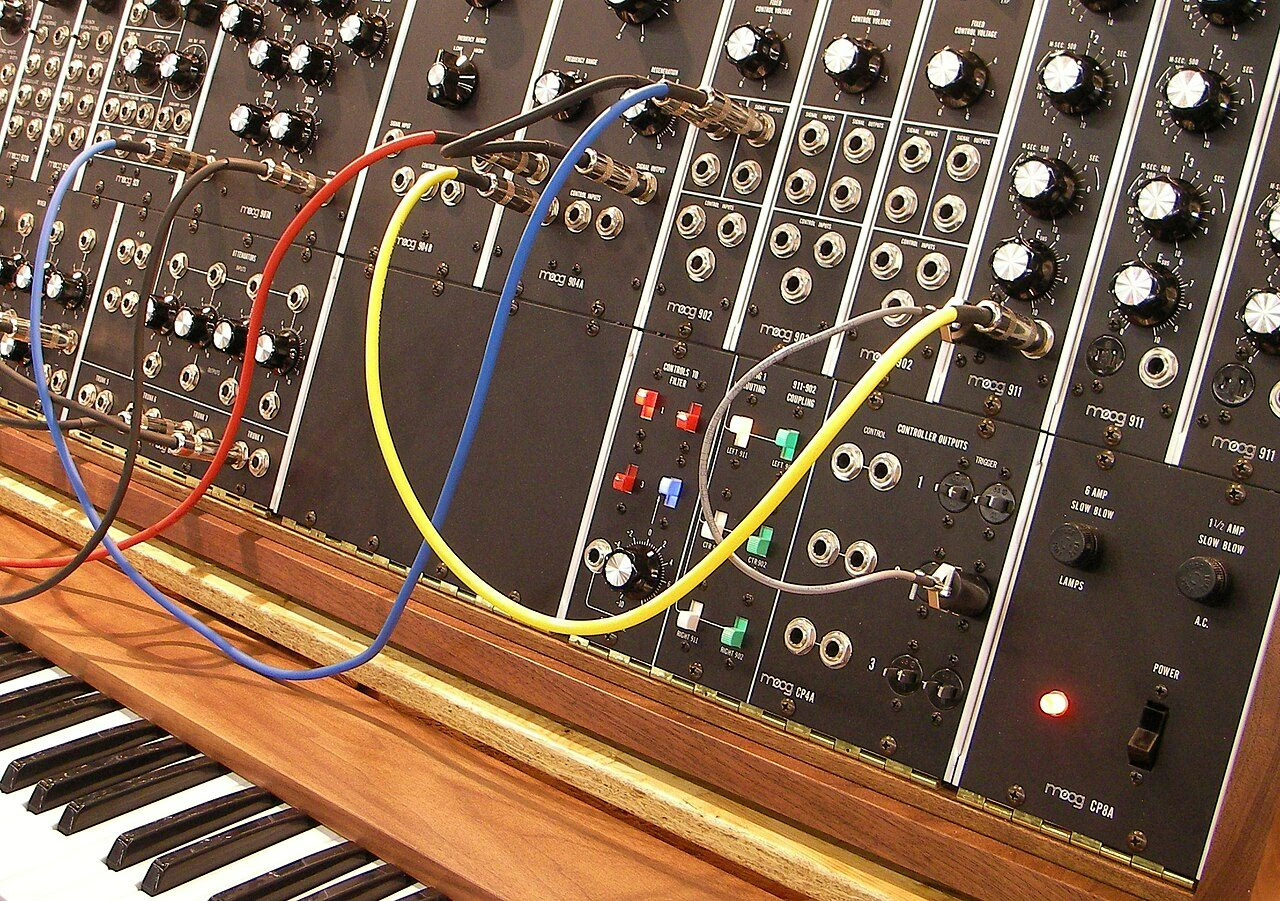
Routed to oscillator pitch it produces vibrato — as long as it stays subtle. Routed to filter cutoff it creates the classic sweep or “wobble” that built the fortune of electronic bass. On amplitude it gives tremolo. On the pulse width of a square wave (PWM) it thickens the tone with that internal chorus typical of analogue strings. You can also route it to pan for left-right motion, to a delay time, a resonance, an effect amount. Synths with a modulation matrix let you assign one LFO to several destinations with different amounts, or even modulate one LFO’s rate with another. That is where synthesis becomes a real playground: the routing logic echoes the MIDI and CV/Gate dialogue between machines.
| Destination | Result | Suggested shape |
|---|---|---|
| Pitch | Vibrato | Sine / triangle, low depth |
| Filter cutoff | Sweep, “wobble” | Sine, saw or square by style |
| Amplitude (volume) | Tremolo | Sine / triangle |
| Pulse width (PWM) | Thickening, internal chorus | Slow sine / triangle |
| Pan | Stereo motion | Slow sine, tempo-synced |
The options that make the difference
Beyond the three big controls, a handful of parameters turn a basic LFO into an expressive tool.
Key sync (retrigger) decides whether the cycle restarts from zero on every note. On, each note attacks the movement from the same point, making the result predictable and “played”. Off (free-running), the modulation floats independently of your playing, which sounds more organic but less controllable.
Unipolar or bipolar sets whether the LFO pushes the parameter in one direction only, or on both sides of its centre value. Vibrato wants bipolar (the note rises and falls around its pitch); a filter that must never drop below a certain point prefers unipolar.
Fade-in (or delay) brings the modulation in gradually after the attack: exactly how a player adds vibrato at the end of a sustained note rather than from the first instant. Some LFOs also offer a one-shot mode: they play a single cycle and behave like an extra envelope, handy for a kick pitch drop or a one-off sweep.
Then there is mono versus poly. A monophonic LFO applies the same movement to every note in a chord; a polyphonic LFO gives each voice its own phase. The first welds the chord into a single gesture, the second animates it from within and creates that shimmering pad feel.
In practice: setting an LFO that serves the music
The most common mistake is the LFO you hear too much. Good modulation is often noticed when you switch it off, not when you add it: the sound suddenly loses its life. A few reflexes. Sync to tempo whenever the movement should be rhythmic, keep free mode for textures. For believable vibrato, pair fade-in with minimal depth. To animate a pad, a very slow LFO (one or two bars per cycle) on the filter or PWM is enough to fake life. And when one source of movement is no longer enough, layer two LFOs at different rates instead of pushing one harder: the result feels far less mechanical. That movement finally converses with the rest of synthesis — granular textures, samples or step sequences — and it is from that combination that the patches you remember are born.
My take
The LFO is probably the most underused control on a synth: everybody has one, almost nobody really sets it. The turning point is two gestures — sync to tempo, then halve the depth you thought was right. It is nearly always too much on the first pass. Recent machines, from the MiniFreak to modern grooveboxes, ship modulation matrices that make all of this reachable without a manual: one more reason to stop enduring movement and start composing it. The real luxury today is not having more LFOs, it is knowing when to switch one off.