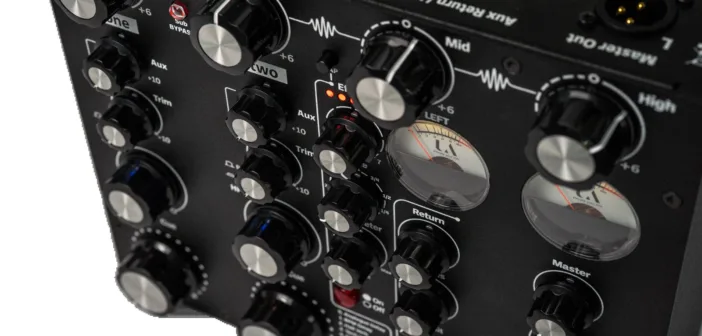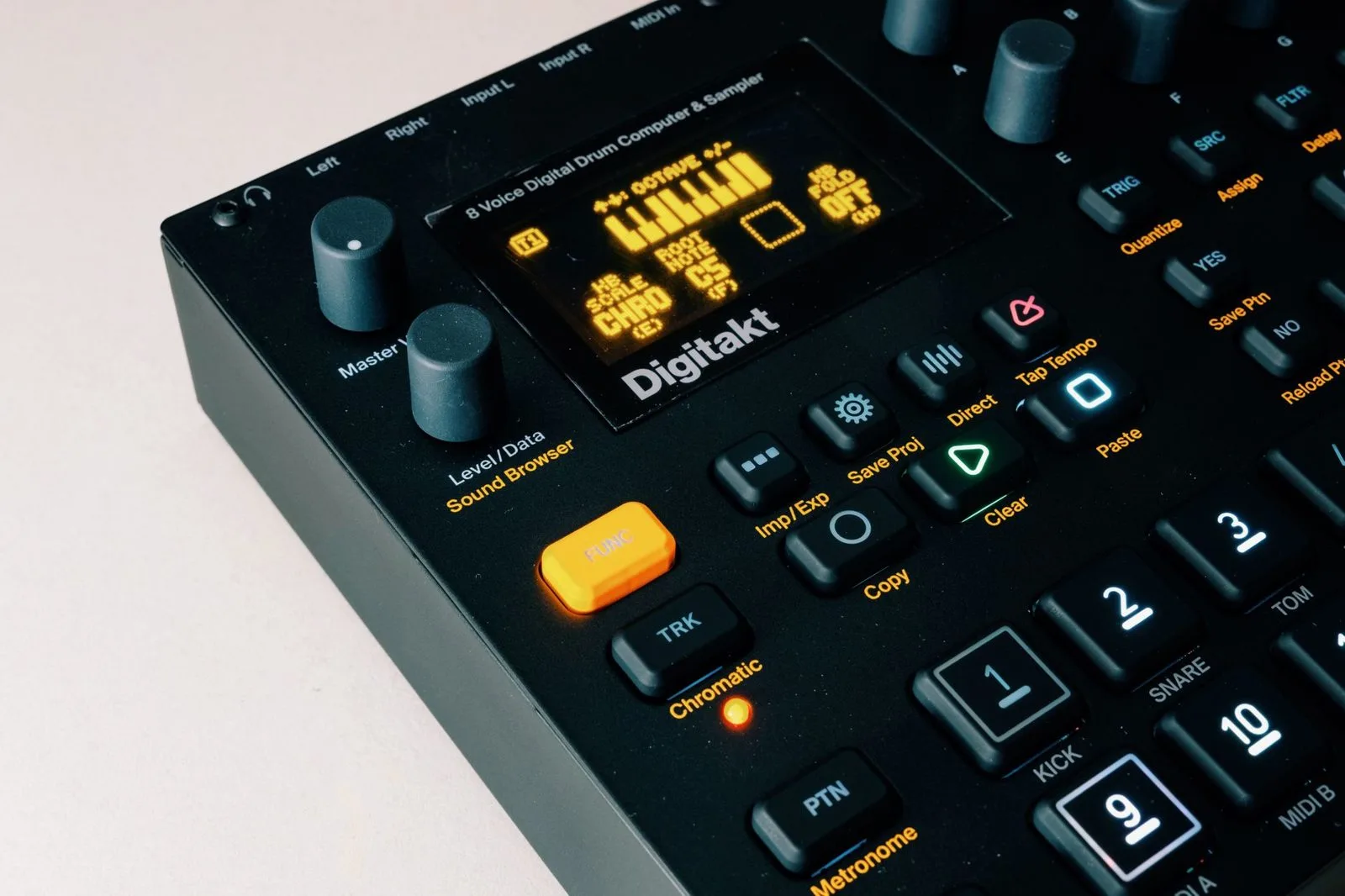
Behind the sound of a TR-808 or a TR-909 there is no recording of a real drum kit, just a few oscillators, a noise generator and some envelopes. Synthesising a drum rather than playing a sample changes everything: you set the pitch, the length, the attack and the grain of each element, and you get a sound that sits in the track instead of being stuck on top of it. Here is how the main families of drum sounds are built, voice by voice.
Why synthesise rather than sample
A sample is a photograph, perfect but fixed. A synthesised sound is a recipe: change one ingredient and the result follows. Need a kick that goes lower to hold a drop, a drier snare, a hi-hat that breathes at the right tempo? You work on the parameters, not on a file. This logic builds directly on subtractive synthesis and on envelopes, the two blocks found in every voice.
The kick drum, a sine wave diving down
The synth kick is the easiest to understand and the most satisfying to tune. Take a sine oscillator, around 50 to 60 Hz for the body. Apply a very fast pitch envelope: at the attack, the frequency briefly rises toward 100 or 200 Hz, then falls back within a few milliseconds. That pitch drop is the famous beater kick, the sense of impact. A short amplitude envelope with no sustain sets the length: brief for a tight house kick, long and booming for the trap low end of an 808.
Two details make the character. The attack click first, from adding a spike of noise or a very short transient right at the start: it is what makes the kick cut through a dense mix. Saturation next: running the kick through a little distortion adds harmonics and lets it exist on small speakers that cannot reproduce the low end.
The snare, a body and a rattle
A snare is two sounds stacked together. The body first: two oscillators, often slightly detuned triangles or sines, around 180 and 330 Hz, with a short pitch envelope as for the kick, higher up. The rattle next, imitating the metal snares buzzing under the drumhead: white noise through a band-pass filter, with its own envelope, a little longer than the body’s. The balance between the two is everything: plenty of body for a deep snare, plenty of noise for a cracking, aggressive one.
Hi-hats and cymbals, the realm of noise
Hi-hats are built in two ways. The most direct starts from white noise filtered by an aggressive high-pass around 8 kHz, with a very short envelope for the closed hat, longer and open-ended for the open one. The historic TR-808 and TR-606 method instead stacks six square oscillators at inharmonic frequencies, giving that characteristic metal impossible to get from plain noise. FM synthesis also renders cymbals very well, since its inharmonic spectra match the metallic, bright quality.
The clap, a bouncing burst of noise
The synth clap is an elegant trick. You take band-pass-filtered white noise, but instead of one envelope you trigger three or four very close together, a few milliseconds apart, followed by a slightly longer tail. These successive bursts imitate several hands not clapping exactly together, and the tail simulates the room reverb. That train of envelopes is what gives the characteristic crowd effect.
Toms and percussion
Toms are cousins of the kick: a sine or triangle with a pitch envelope, but tuned higher and with a slower fall that lets the note sound. Congas, rimshots and cowbells reuse the same principles, tuned oscillators and short envelopes, sometimes two detuned oscillators for the metal of the bell. Once the kick and snare mechanisms are understood, all percussion becomes a variation on the same theme.
From sound to groove
A drum sound only lives inside a pattern. The step sequencer turns these voices into a groove, and the micro-settings of velocity, swing and accent bring it to life. At the mix, a touch of shared saturation, bus compression and coherent tuning of the elements glue the kit together. Today’s machines, from the all-analog Gene Synths GENE 616 to the Dreadbox Alecto percussion synth, all rest on these same synthesis blocks.
My take
Learning to synthesise drums is the best use of time for anyone making electronic music. Once you hear a kick as a sine wave with two envelopes, you stop digging through sample folders for an hour: you shape the sound the track needs, in thirty seconds, and it sits in the mix on its own. Samples keep their place for a specific texture or a sound you cannot get otherwise, but synthesis hands you back control. Start with the kick, it is the most telling, and the rest will follow.