It took forty years, but the Oberheim Matrix-12 finally has a software version the brand calls its own. GForce Software released it on 5 November 2026, rebuilding the architecture of the 1985 polysynth with Oberheim’s blessing and input from Marcus Ryle, co-designer of the original. It is the only title that can call itself the official Matrix-12 and Xpander in software.
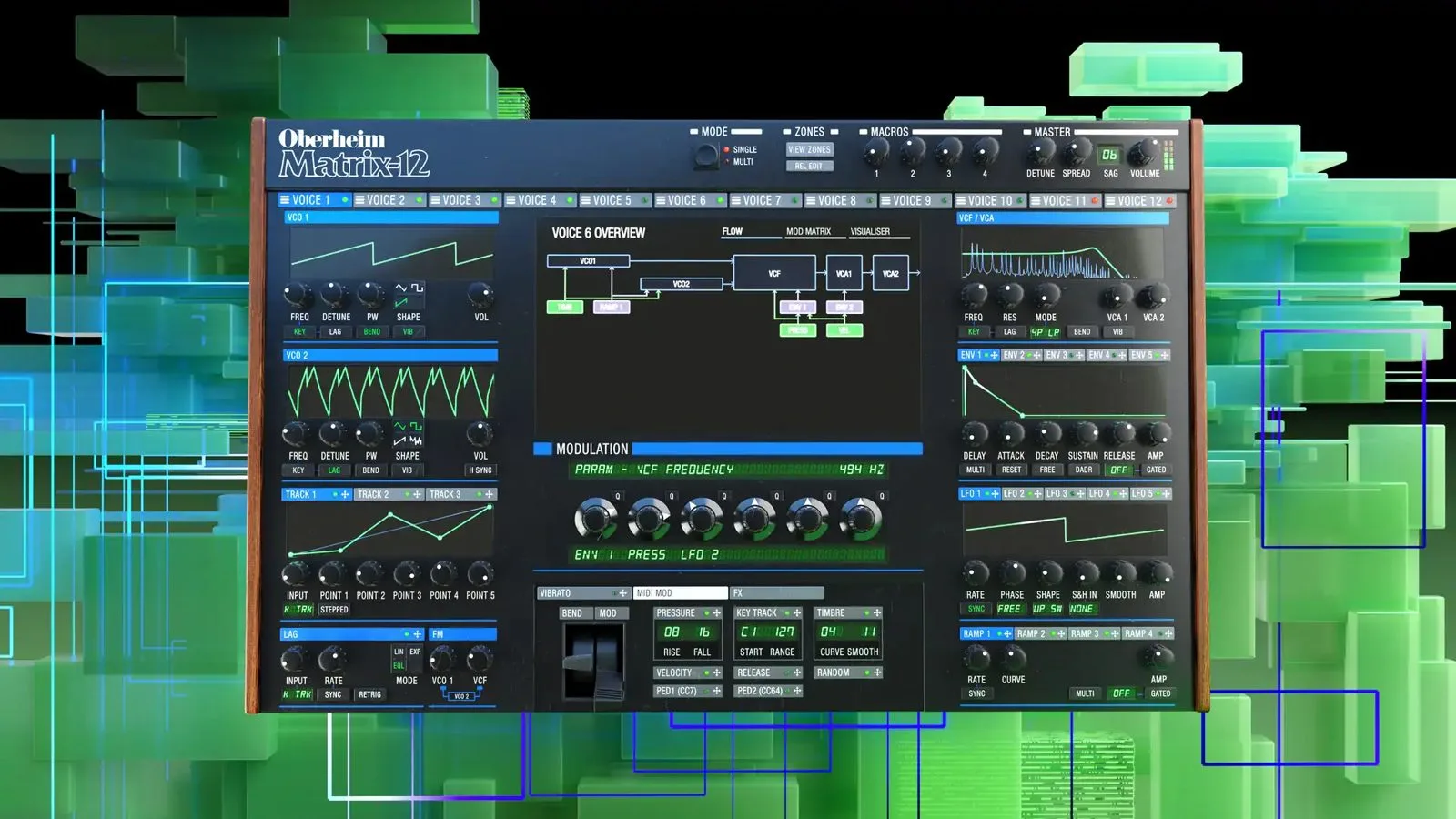
A 1985 classic brought to software under licence
The hardware Matrix-12 paired twelve analog voices with a then-new idea: instead of hard-wiring a few modulation paths, Oberheim let the player route any source to any destination through internal software. That matrix gave the instrument its name and shaped many synths that followed. Originals now sell for serious money and stay tricky to service, so the plugin lands on fertile ground, as recent hardware clones show, from the Behringer UB-1 Micro to the Shear Electronics Relic.
This is not GForce’s first Oberheim: the British developer already built recreations of the OB-X and OB-E. Here, working with Marcus Ryle is the difference, since it opens up the instrument’s exact behaviour rather than an approximation. Arturia’s version, long the only serious software option, relies on in-house modelling without that direct line to the designers.
Twelve voices, two oscillators and fifteen filter modes
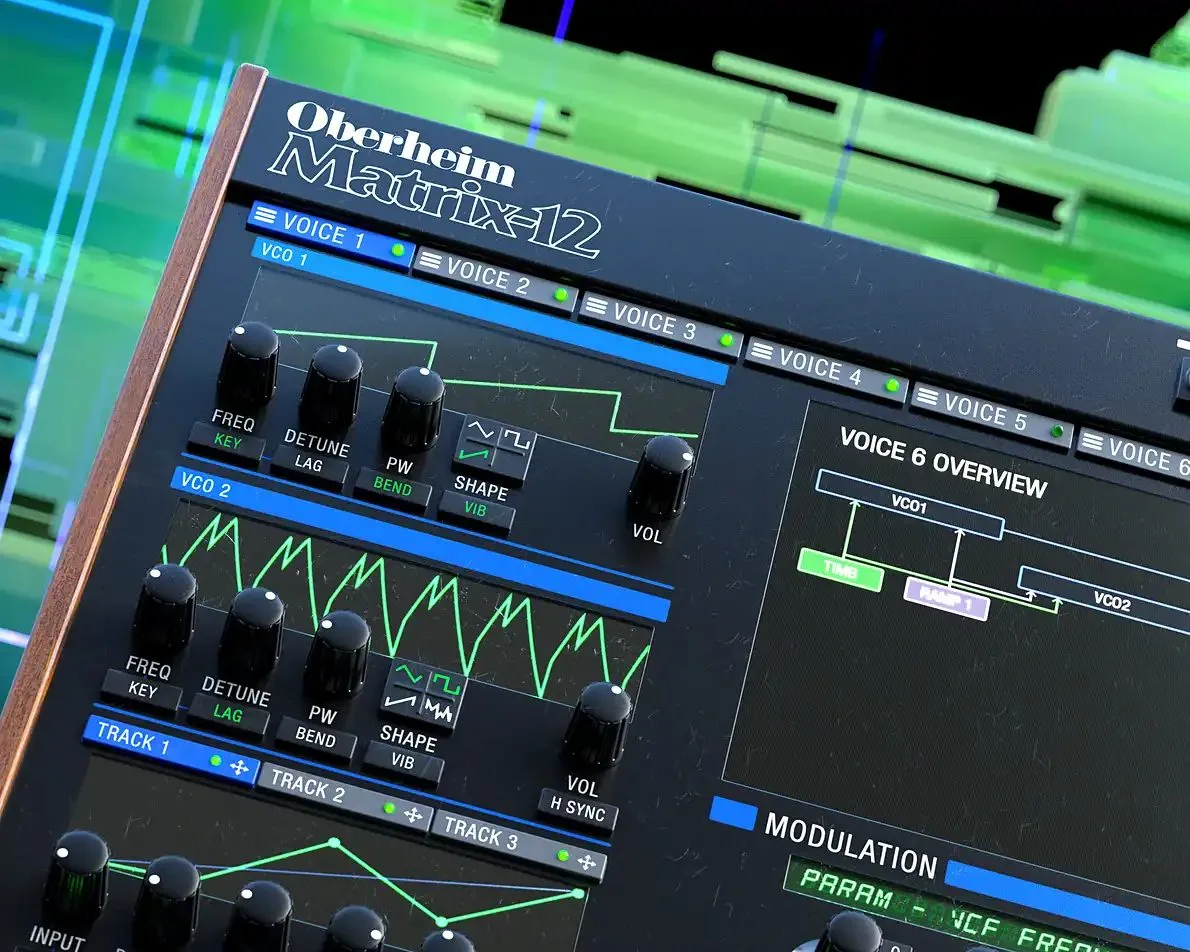
Each voice carries two oscillators with triangle, sawtooth and pulse waves. The second adds noise, hard sync and frequency modulation, enough to move beyond warm pads into more metallic territory. Then comes the filter, still the machine’s strong suit: fifteen modes in all, from one- to four-pole low pass through high pass, band pass, notch and phase, with the combinations that built the Matrix-12’s reputation. Two amplifiers in series close the chain.
The modulation matrix, the heart of the instrument
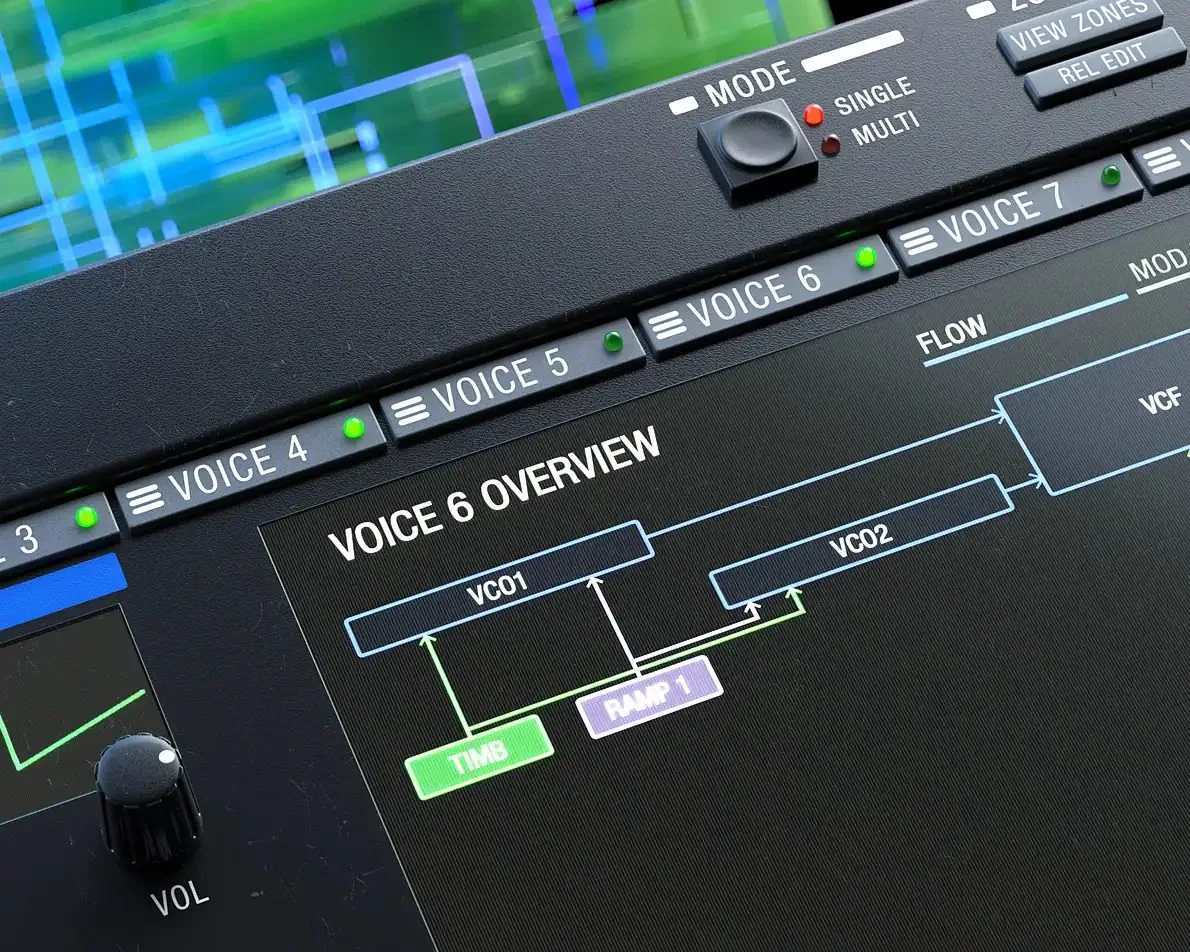
The real story is modulation. Each voice has five envelopes, five LFOs, four ramps, three trackers, a lag processor and a dedicated vibrato. Performance sources fill out the list: keyboard, attack and release velocity, pressure, pitch bend, mod wheel, full MPE, a random value per note and four global macros. Any of those sources reaches any destination, including itself, and every parameter offers six bipolar modulation slots. GForce modernised the workflow with drag-and-drop routing and real-time visualisation, which makes a matrix readable that once asked for patience and memory on the hardware.
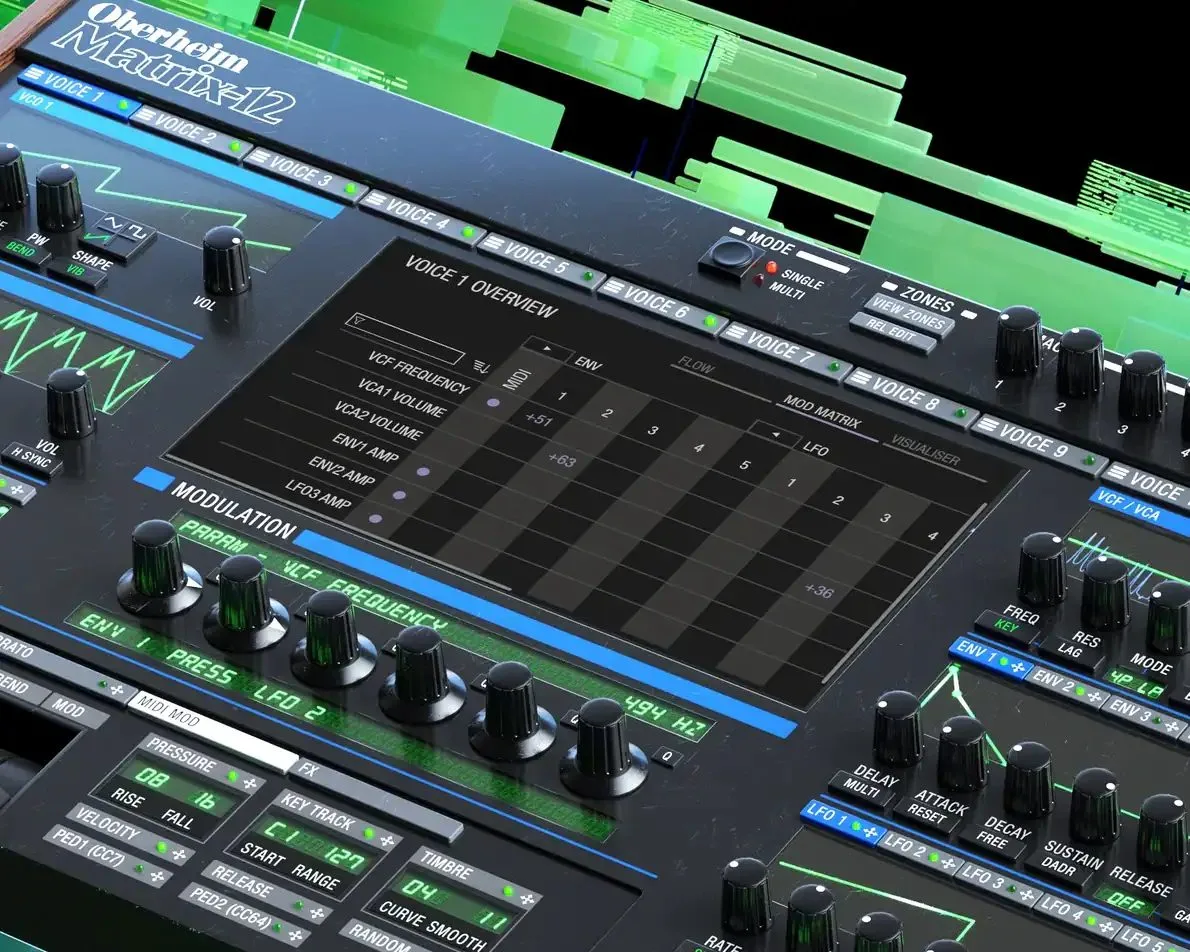
Multi mode, MPE and built-in effects
In Single mode the instrument plays as a straight polysynth with unison, detune and stereo spread. Multi mode revives the original’s multitimbral spirit: six keyboard zones that can overlap, each with its own voice allocation, MIDI channel and micro arpeggiator. Two effects are on board, a stereo delay and a matrix reverb, with per-voice sends in Multi mode. The patch library passes 570 presets, more than 380 of them new and over 190 drawn from the original Matrix-12 and Xpander memories.
Price, availability and formats
The instrument is available now for Mac and PC, standalone and as a plugin. Pricing and compatibility at a glance:
| Item | Detail |
|---|---|
| Intro price | 83.99 dollars / 69 pounds / 83.99 euros, until 5 December 2026 |
| Full price | 119.99 dollars / 99 pounds / 119.99 euros |
| Formats | Standalone, AU, AAX, VST2, VST3 (Mac and PC) |
| Mac requirements | Intel or Apple Silicon, macOS 10.15 or later, 8 GB RAM |
| PC requirements | Intel i5 / Ryzen 5, Windows 8 or later, 8 GB RAM |
| Trial | Free 14-day demo |
Anyone at home with virtual analog recreations will find a familiar logic in the Isla Electronics ASYX, another heavyweight polysynth that went software this autumn.
My take
An official Matrix-12 built with one of its fathers is the best possible news for anyone who only ever watched the original from a distance. The modulation matrix gains hugely from a wide screen: a routing that took ten minutes on the hardware now reads at a glance and edits with a drag. The filter is what to judge by ear, because everything on this synth lives there. If the grain delivers, the launch price makes an easy door into a sound that used to cost as much as a small car.