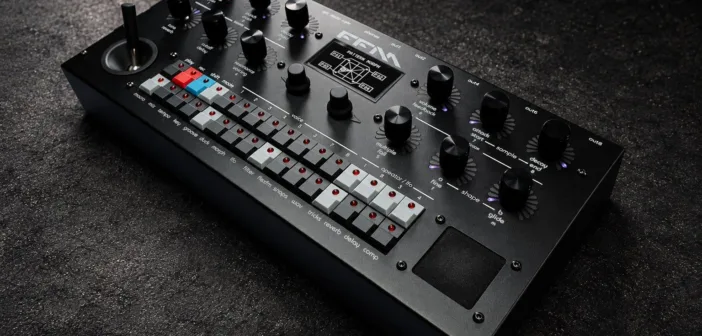
Nine years after first showing a prototype as he came of age, Jacob Brashears is finally moving the Shear Electronics Relic into production. This polyphonic analogue synthesiser is not yet another “inspired by” model: it is a stubbornly fully discrete reconstruction of the Oberheim OB-X, with eight bi-timbral voices, announced at around €14,000. An extreme object, which raises a real question about what fully discrete analogue is still worth in 2026.
An OB-X rebuilt component by component
The starting point of the Relic can be summed up in one sentence: reproduce the 1979 Oberheim OB-X circuit without ever resorting to a modern shortcut. Whereas most reissues and clones rely on off-the-shelf synth chips — the Curtis and other integrated circuits that precisely replaced discrete electronics at the turn of the 1980s — the Relic claims a fully discrete architecture, built with surface-mount components but faithful to the original topology.
Each voice carries two SEM-topology oscillators, named after the Synthesizer Expander Module that established the Oberheim sound, and a continuously sweeping multimode state-variable filter. This is precisely where the colour of the OB-X lives: unlike the OB-Xa and OB-8, which later switched to four-pole Curtis filters, the OB-X relied on this morphable two-pole filter, able to move seamlessly from low-pass to notch, to high-pass and band-pass. Recovering this discrete filter section means recovering the three-dimensional, slightly unstable character that made the instrument’s reputation.
The features that really matter
- 8 voices, each based on a completely independent analogue core, with bi-timbral operation (layering or keyboard split between two sounds).
- 2 SEM-topology oscillators per voice, in the spirit of the original Oberheim circuits.
- A multimode state-variable filter with continuous morphing, a replica of the OB-X two-pole section.
- 4 DAHDSR envelopes and 4 LFOs per voice, a modulation provision far beyond the original, with classic envelope profiles simulated digitally.
- 7 discrete operational transconductance amplifiers per voice, with self-calibration — one of the real headaches of a polyphonic analogue synth, handled automatically here.
- Touch-sensitive light-bar interface: eight precision encoders, a main high-resolution light fader and eight small light faders.
You can see the gap with the 1979 machine: where the OB-X was limited to one envelope per section and very sparse modulation, the Relic stacks four envelopes and four LFOs per voice, plus a large programme memory and multitimbral management. The ambition is not to freeze a relic — the name is ironic — but to give the discrete architecture the controls and flexibility it never had.
OB-X from 1979, Relic from 2026: what changes
| Oberheim OB-X (1979) | Shear Electronics Relic (2026) | |
|---|---|---|
| Polyphony | 4, 6 or 8 voices | 8 voices, bi-timbral |
| Oscillators / voice | 2 VCOs (SEM-based) | 2 SEM-topology oscillators |
| Filter | 2-pole state-variable | Multimode state-variable, continuous morphing |
| Envelopes / LFO | 2 envelopes, 1 LFO | 4 DAHDSR envelopes, 4 LFOs / voice |
| Electronics | Discrete | Discrete (SMD), self-calibration |
| Interface | Potentiometers, limited memory | Encoders, light bars, large memory |
A decade of development for a run of rare instruments
The story of the Relic is worth a look. Jacob Brashears first showed it at NAMM 2017, at the age of eighteen, before vanishing from view, then resurfacing at SynthPlex 2022 with a significantly wider and more polished version, and again at NAMM 2024. Developed in Silicon Valley and manufactured in Taiwan, the instrument is now moving into production, with preorders open and the first deliveries imminent. The target price, around €14,000, bears little resemblance to the range mentioned at the start of the project — a brutal reminder of what fully discrete analogue really costs, pushed to this level of fidelity, in small batches.
My view. I’ve seen enough “ultimate clones” go by to remain cautious, and I’m happy to defend all-digital when it does the job. But to be fair: at this price, the Relic is not a market product, it is a manifesto. What interests me here is not the vintage folklore, it is the technical stance — rejecting synth chips to rebuild a discrete voice core with self-calibration, when it would have been a thousand times easier to stick a Curtis behind a good converter. This is exactly the kind of hardware link that still has a place: not out of analogue dogma, but because the SEM filter section brings something audible that no emulation quite reproduces. That said, compared with an Oberheim OB-X8 or other excellent current polysynths, €14,000 confines the Relic to a handful of enthusiasts. And that’s perfectly fine: not everything has to be profitable to make sense.
A signal against the current
There is something revealing about this release. Ten years ago, the dominant narrative was heralding a complete shift to computer-based music production; we were living through that transition from the inside, and it was real. And yet, at the same time, an engineer was spending nearly a decade rebuilding, transistor by transistor, the most faithful analogue synth possible to a 1979 machine. The Relic does not contradict the viability of all-digital — it simply reminds us that certain discrete characters remain objects of desire, and that the value of an instrument is not reducible to its price/features ratio.
To situate the Relic within the recent analogue landscape, you can read it in light of the Frap Tools Magnolia FM analogue polysynth, the monophonic Analogue Solutions Filtopia or, at the other end of the price spectrum, the Behringer AKS Mini: three radically different ways of approaching analogue in 2026. Preorders and technical details are available on the official Relic page.