UVI crosses the symbolic 300-machine mark with Synth Anthology 5. The fifth version of its library of sampled hardware synths adds 100 new instruments, a redesigned dual-layer engine and brand-new modelled filters. Here’s an overview of a collection that distils half a century of synthesis into a single plugin.
300 synths in one plugin: what Synth Anthology 5 actually contains
Since 2014, Synth Anthology has been pursuing the same goal: sampling hardware synthesisers one by one and making them playable within a common engine. Version 5 marks a step up, taking the catalogue from 200 to 300 machines, meaning 100 new multi-sampled instruments. In practical terms, the library weighs in at around 28.5 GB in FLAC, with over 4,700 presets and more than 38,000 samples. Everything runs in Falcon or in the free UVI Workstation player — still the most underrated selling point of the range: no extra software dongle to buy just to get in the door.
The new additions cover a wide spectrum, from affordable polysynths to rarities that few of us have ever actually plugged in:
- Akai AX60 and AX73, two often-overlooked Japanese analogue polysynths;
- Crumar Bit 99, an Italian hybrid with a strong personality;
- Sequential (DSI) Prophet 08 and Korg Poly 800;
- several Oberheims — headed by the OB-Xa — and the Marion Systems MSR-2, a rare offshoot of the Matrix line.

An engine that does more than just replay samples
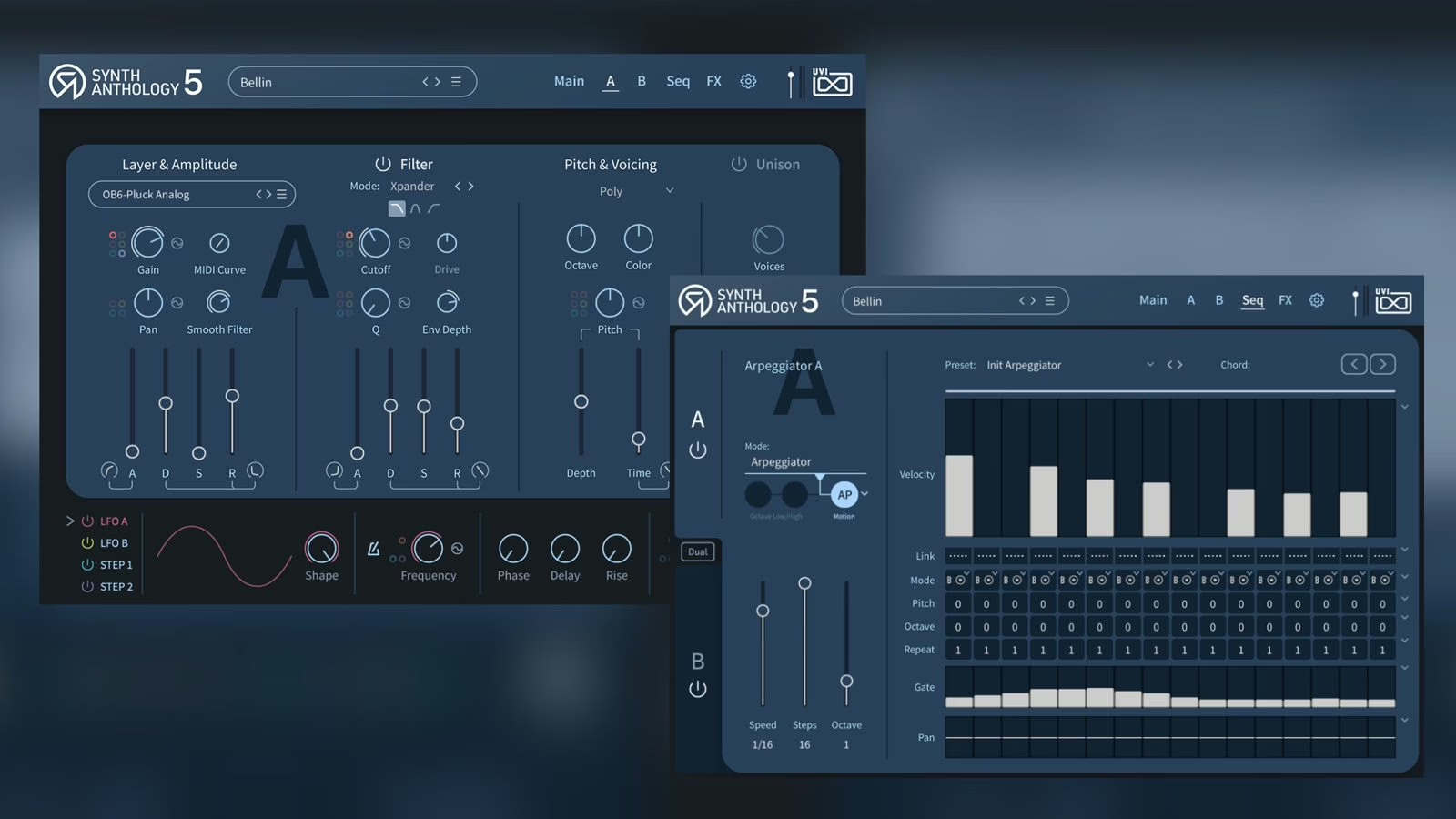
This is where the credibility of a library like this is decided. Multi-sampling a synth is easy; recreating its living, breathing behaviour is much harder. UVI answers with a dual-layer architecture: each voice can stack two of the 300 machines, with filters, modulation, multi-effects and a polyphonic sequencer equipped with per-step note repeat. You’re not just playing a frozen snapshot of the hardware, but a raw material you can rework.
Two additions are worth highlighting. First, an analog drift control, which brings back the tiny pitch and level instabilities inherent to analogue circuits — exactly what’s usually missing from sampled versions, where everything sounds too clean. Then the new modelled filters: a Moog ladder and the ARP Odyssey MK1’s VCF 4023, patched on top of the samples to restore a range of resonance and saturation that sampling alone can’t provide.
The logic isn’t that far from software recreations faithfully modelling a single machine, such as Jun Murakami’s Roland MKS-80 emulation; except here you trade the modelling of one specific circuit for the breadth of a whole catalogue. Where a suite like Korg Collection 6 focuses on one brand’s classics, Synth Anthology sweeps across every era and every manufacturer.

Finding a sound among 4,700 presets: the Proximity Explorer
The real Achilles’ heel of big libraries isn’t the sound, it’s navigation. Once you get past the first few hundred presets, you always end up playing the same ones again. UVI introduces a Proximity Explorer that analyses the loaded sound and instantly offers eight similar patches to audition. In theory, it turns an endless list into a guided exploration path — the real test will be, in day-to-day use, whether the suggestions actually make sense.
| Item | Synth Anthology 5 |
|---|---|
| Sampled synths | 300 (+100 vs version 4) |
| Presets | over 4,700 |
| Samples | over 38,000 |
| Size (FLAC) | ≈ 28.5 GB |
| Engine | Dual-layer (2 synths per voice) |
| New modelled filters | Moog ladder, ARP Odyssey MK1 (VCF 4023) |
| Host | Falcon or UVI Workstation (free) — VST/AU/AAX |
Opinion: sampling has won, but it knows its limits
I lived through the shift from analogue to computer-based music from the inside, and I switched fully to digital quite early. A library of 300 machines for the price of a decent multi-effects pedal is still a value proposition my generation would never have dared to imagine: instant recall, zero maintenance, no tuning to fix before you hit record. If I need a pad or a bass line in a mix, it’s sorted, and I don’t feel the slightest guilt about doing it all in the box.
Still, multi-sampling a synth means capturing a moment, not an instrument. The real-time interaction between envelope, filter and VCA — the reason an Oberheim moves when you play it — is always imperfectly recreated via samples. That is precisely what analog drift and the new filters are aiming at, and it’s also why a good piece of hardware keeps earning its place when it brings something audible to the table: a synth like the UDO DMNO will not let itself be truly replaced by a sample capture. The right mindset isn’t to pick a side, but to know when convenience is enough and when a living circuit is what the track really needs.
Price and availability
Synth Anthology 5 is available for €149 / $149, with an introductory price of €89 / $89 until 20 July 2026. Owners of version 4 can upgrade to version 5 for €49, and SonicBundle subscribers get an extra €10 voucher. At this entry price, the question isn’t whether the collection is worth the money — it more than is — but whether the Proximity Explorer and the dual-layer engine genuinely turn this huge pool of sounds into a production tool, rather than a museum you visit twice and then forget.