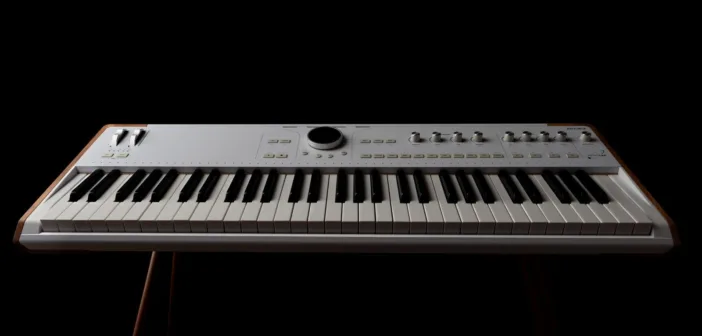
The Magnolia, an imposing eight-voice analogue polysynth with through-zero FM from Frap Tools, receives its 1.10 firmware. MIDI CC control over every parameter, MIDI over USB and eleven velocity and aftertouch curves: enough to turn a niche machine into an instrument that can be fully integrated into a modern studio.
Frap Tools has built a reputation in the Eurorack world with modules renowned for their build quality and sonic precision. With the Magnolia, the Italian manufacturer leaves the modular format behind to deliver its first stage and studio keyboard: an eight-voice analogue polysynth, housed in a solid aluminium chassis and topped with a five-octave Fatar keyboard with polyphonic aftertouch. It is not an instrument you buy on impulse — it comes in at around €4,200 — but it unapologetically targets the high end, and that is precisely the territory Frap Tools knows best.
A synth that refuses menus
The entire ergonomics of the Magnolia rest on a clear stance: one control per parameter, or almost. Milled aluminium knobs, ARP-style sliders, a four-character display that serves as a reference rather than a gateway into submenus. You tweak, you listen, you recall. Under the bonnet, each voice lines up two analogue oscillators: the first, with a west coast flavour, includes FM, wavefolder and flip-sync; the second, more east coast in spirit, handles pulse-width modulation. Two filters — high-pass and low-pass, both modulatable — close the signal path.

The Magnolia’s calling card lies in its fully analogue through-zero FM. Where classic exponential FM merely bends pitch, through-zero FM dives into negative frequencies when the modulator crosses zero: the spectrum remains symmetrical, metallic timbres stay solid and in tune even when you push the modulation index. It is a behaviour we usually associate with digital; achieving it in analogue, over eight voices, without audible drift, is an engineering feat.
On top of that, there is a modulation matrix that connects sixteen sources to thirty-two destinations with a simple press-and-turn, three LFOs, three envelopes and a random generator per voice. The instrument is bi-timbral: its eight voices can be split or layered across two patches, with a Morph function to fade from one to the other as you play.
What firmware 1.10 actually changes
This is the real reason it is in the news. Until now, the Magnolia was a somewhat insular instrument: superb to play by hand but stingy when it came to integration. Version 1.10 corrects that quite decisively:
- Full bidirectional MIDI CC implementation: every front-panel parameter becomes addressable and automatable from a sequencer or DAW, and sends its value back.
- MIDI over USB: a single connection now suffices to control the instrument, without going through a dedicated MIDI interface.
- Eleven user-definable velocity and aftertouch curves so you can match the Fatar keyboard’s response to your own playing feel.
- Two hundred additional memory slots, independent brightness settings per LED colour, and a round of fixes.

On paper, these are just boxes to be ticked. In practice, this is what separates a beautiful standalone machine from an instrument you leave permanently wired into a production chain. Automating a wavefolder or the FM index from the timeline, recalling a patch byte-perfect alongside a project, playing eight polyphonic aftertouch-sensitive voices from a master controller: this is exactly the level of integration you expect from an instrument at this price. Frap Tools delivers it via a free update, without any software ransom — a healthy approach.
The key points at a glance
| Feature | Frap Tools Magnolia |
|---|---|
| Polyphony | 8 voices, bi-timbral (split / layer + Morph) |
| Synthesis | 2 analogue oscillators per voice, through-zero FM, wavefolder, PWM |
| Filtering | Dual modulatable high-pass / low-pass filter |
| Modulation | Matrix 16 sources → 32 destinations, 3 LFOs, 3 envelopes, per-voice random |
| Keyboard | 5-octave Fatar, polyphonic aftertouch |
| Connectivity 1.10 | MIDI DIN + MIDI over USB, full bidirectional CC |
| Indicative price | ≈ €4,200 |
Where it sits on the market
The high-end analogue polysynth segment is far from empty: you will find established names from Sequential, Oberheim and Moog. The Magnolia sets itself apart through its modular DNA — the west coast mindset, the open matrix, the analogue FM — rather than nostalgia for a reissued classic. It is playing a different game from software reissues or emulations, like the ones proliferating on the plugin side: where a library such as Synth Anthology 5 captures hundreds of machines through sampling, the Magnolia bets on a living, unpredictable analogue engine that responds under your fingers.

This news also fits into a broader trend: firmware as a genuine product milestone. We saw it recently with the Teenage Engineering EP-133, whose 2.5 update unlocked USB audio and an arpeggiator. The value of a modern instrument is no longer fixed on release day; it is extended through software. And in the FM arena, the topic is particularly lively at the moment, even in far more affordable formats like the EMW DX7000 hardware FM sound player.
The editorial viewpoint
I spent enough years as a studio technical director, back when the industry was shifting from analogue to computer-based music, to steer clear of dogmatism: an all-digital setup works perfectly well, and I do not demand hardware on principle. But when a hardware link in the chain brings something audible — and eight-voice analogue through-zero FM certainly does — it still has every right to be there. The Magnolia is not a collector’s showpiece: it is a well-designed machine, and firmware 1.10 finally removes the only real criticism one could level at it, its isolation. The price remains, which reserves it for a knowledgeable audience. At this level of ambition, that is coherent; you just need a genuine use for such an instrument rather than mere desire.

Firmware 1.10 is available as a free download; technical details and control templates are listed on the manufacturer’s product page.