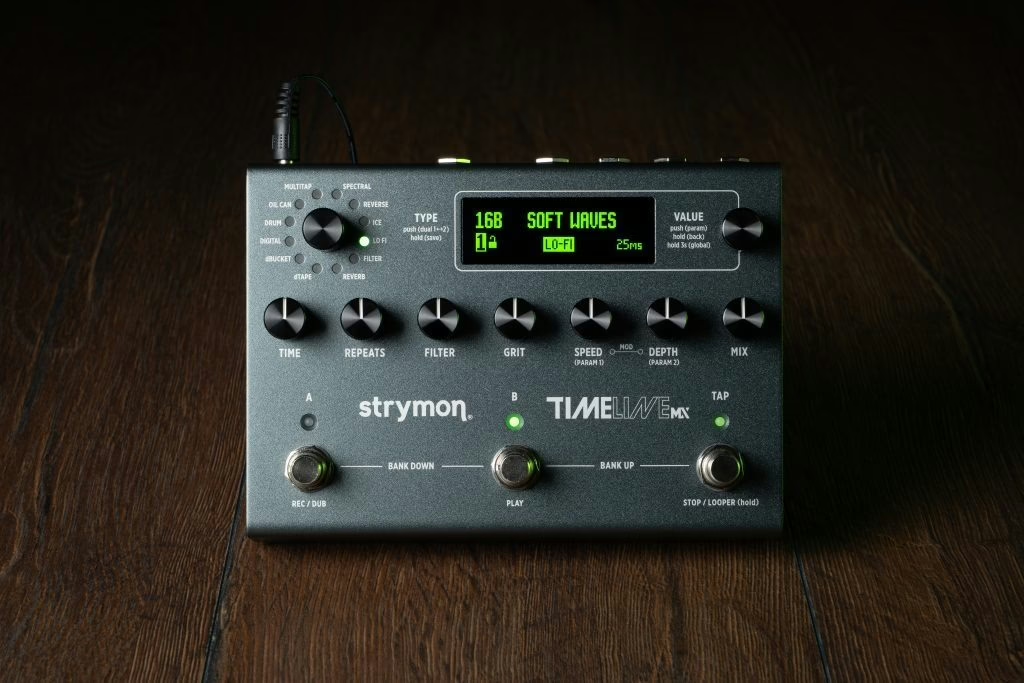
Strymon is relaunching the delay pedal that built its reputation. The TimeLine MX features a tri-core processor, a dual engine capable of running two delays at the same time, five new machines and a five-minute looper. Here is what actually changes, and why this overhaul goes beyond a simple pedalboard update.
A classic redesigned from the ground up
The original TimeLine has been sitting on pedalboards and in effects racks for more than ten years, to the point of becoming the de facto reference for versatile digital delay. Strymon is not content here with a cosmetic facelift: the TimeLine MX starts again from an entirely new hardware platform, built around an 800 MHz tri-core ARM processor, with 32-bit floating-point processing and 24-bit / 96 kHz conversion. All of this processing power is dedicated solely to rendering the echoes, which you can immediately hear on long tails and modulated repeats, where the previous generation would eventually begin to show its limits.

The dual engine, the real turning point
The structural change is the move to a dual engine. The TimeLine MX runs two delay algorithms simultaneously, with three routing modes that cover most real-world needs:
- Series: the second delay processes the output of the first, so you can stack textures and build complex rhythmic soundscapes.
- Parallel: the two engines work side by side and are blended together, ideal for combining a short slapback with a long ambient tail.
- Split: two independent delays, each of which can be panned separately in the stereo field.
This logic moves the TimeLine from the status of single-task pedal to that of a genuine delay workstation. In the studio, this is the kind of feature that replaces two separate rack units driven from aux sends; in a hybrid setup, it saves you from stacking devices just to get a coherent stereo delay response.

Twelve machines, including five brand-new ones
The TimeLine MX offers twelve delay machines. You get the engines that made the original model a success — dTape, dBucket, Digital, Reverse, Ice, Lo-Fi, Filter — but reworked, with new voices and access to Swell and Duck functions across all algorithms. On top of that come entirely new machines that significantly broaden the sonic territory:
- Oil Can: a simulation of oil-can delays, with their dark, unstable character.
- Spectral: a granular delay capable of freezing and scattering the sound material.
- Drum: an emulation of vintage drum-echo style magnetic head delays.
- MultiTap: up to eight repeats with individual tap control.
- Reverb: a fully fledged reverb engine with optional tremolo — a first on a TimeLine.
The table below sums up what concretely separates the two generations.
| Feature | TimeLine (2011) | TimeLine MX (2026) |
|---|---|---|
| Processor | Single-core SHARP DSP | 800 MHz tri-core ARM |
| Simultaneous engines | 1 | 2 (series / parallel / split) |
| Delay machines | 12 (single-engine) | 12, including 5 new ones + Reverb |
| Looper | 30 seconds | 5 minutes, stereo |
| Connectivity | DIN MIDI, mini USB | DIN MIDI, USB-C, Nixie 2 editor |
| Indicative price | ~$449 (at launch) | $679 |
My take: delay as a mix effect, not a gimmick
I will be blunt: on paper, a £679-class delay pedal can make people roll their eyes. But I never judge a link in the chain by its format, only by what it brings sonically. And here, the dual engine in split mode with panning solves a problem I know well from having worked around it for years in control rooms and as a studio technical director: obtaining a truly decorrelated stereo delay image without tying up two aux sends and two units. Being able to place a tight slapback on the left and a long granular tail on the right, on a vocal or a synth, in a single MIDI-recallable box is a real time-saver both in a session and on a stage plot. The built-in Reverb engine interests me less: I already have my reference reverbs, and I would rather see a manufacturer excel at its core speciality than just tick boxes. But it is handy, and it is there when space is at a premium.

Connectivity, looper and integration
In terms of connections, the TimeLine MX clearly embraces a dual role for studio and stage: stereo inputs/outputs on TRS jacks, mono configurations, stereo effects loop, wet/dry or wet/dry/wet, MIDI IN/OUT on DIN, assignable expression jack and, crucially, a USB-C port that handles MIDI, firmware updates and the Nixie 2 software editor. The looper jumps from thirty seconds to five minutes in stereo, which finally makes it usable for building full structures rather than just short utility loops. The anodised aluminium chassis is still designed and assembled in the United States.
In line with the editorial thread of recent months, the TimeLine MX continues a clear trend: that of legendary effects condensing processing power once reserved for rack gear into a compact, recallable format. We saw it with the Eventide H9 Harmonizer Gen 2, which squeezed the entire H90 engine into the cult pedal; it shows up again, in a different guise, with the Korg Kaoss Pad V on the touch-effects side, or the Boss GX-1 floor multi-effects. The TimeLine MX pushes this movement a step further by fully embracing the role of a true delay station.
Price, availability and positioning
The TimeLine MX has been announced at a list price of $679 and is already available. The positioning is high but coherent: Strymon explicitly places it at the top of its delay range, mirroring the BigSky MX on the reverb side. For those who use delay as a genuine composition and mixing tool — and not just as a background effect — the proposition stands up. For more occasional use, the first-generation TimeLine, still in the catalogue and now more affordable, remains a perfectly defensible choice. Full details can be found on the official product page.