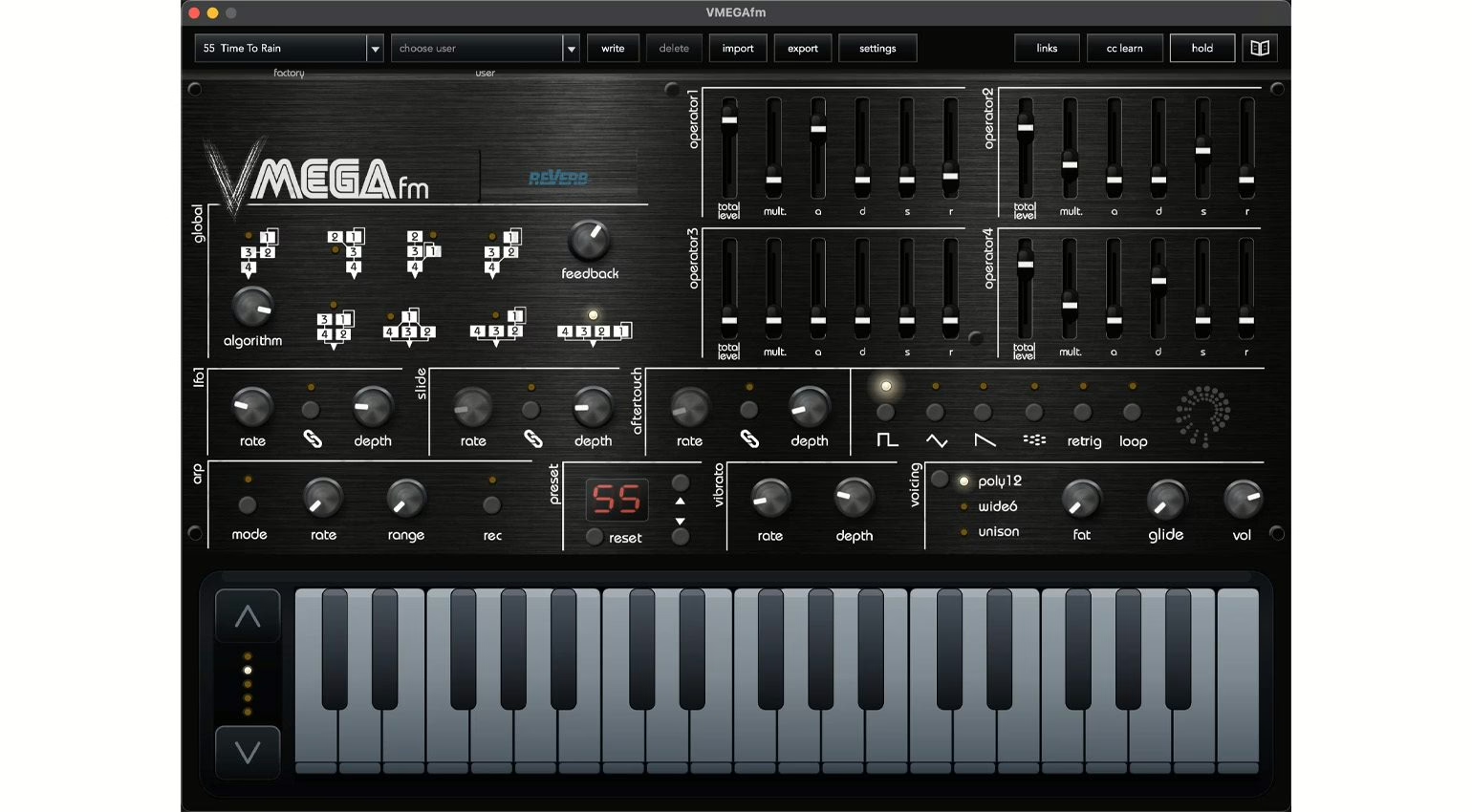
FM synthesis carries a reputation for being arcane, a reputation that goes back to Yamaha’s DX7 and its endless menus. Yet the principle fits in one sentence: you modulate the frequency of one oscillator with another oscillator, and that modulation generates new frequencies, harmonics, that weren’t in the original signal. Everything else is a variation on that idea. Once you grasp it, you stop turning knobs at random and start shaping sound on purpose. This article lays the groundwork, without indigestible maths, so you can finally tame an FM engine.
Where FM synthesis comes from
Frequency modulation applied to audio was formalised by John Chowning at Stanford University in the late 1960s. The insight is elegant: when you modulate an oscillator’s frequency fast enough, in the audio range, the ear no longer hears vibrato but a change in timbre. Yamaha industrialised the process and, in 1983, produced the DX7, one of the best-selling synthesizers in history. That digital keyboard defined a large part of the 1980s sound: crystalline electric pianos, snappy basses, bells and chimes. FM arrived at a pivotal moment, the shift from analogue to computer-based music, and it suddenly made accessible timbres that subtractive synthesis struggled to produce.
The operator, the basic building block
In FM, we don’t talk about oscillators but about operators. An operator is an oscillator (usually a simple sine wave) paired with its own volume envelope. Each operator can play one of two roles. If it’s sent straight to the output, it’s a carrier: you hear it. If instead it modulates another operator, it’s a modulator: you don’t hear it directly, but it transforms the timbre of the carrier it drives. This role-play is what gives FM its richness.
FM synths are often distinguished by their operator count. Four-operator engines, like the Yamaha chips in game consoles or recent software reissues, already offer a huge palette. Six-operator engines, like the DX7, allow more complex stacks. More operators means more possibilities, but also more difficulty predicting the result.
Algorithms: who modulates whom
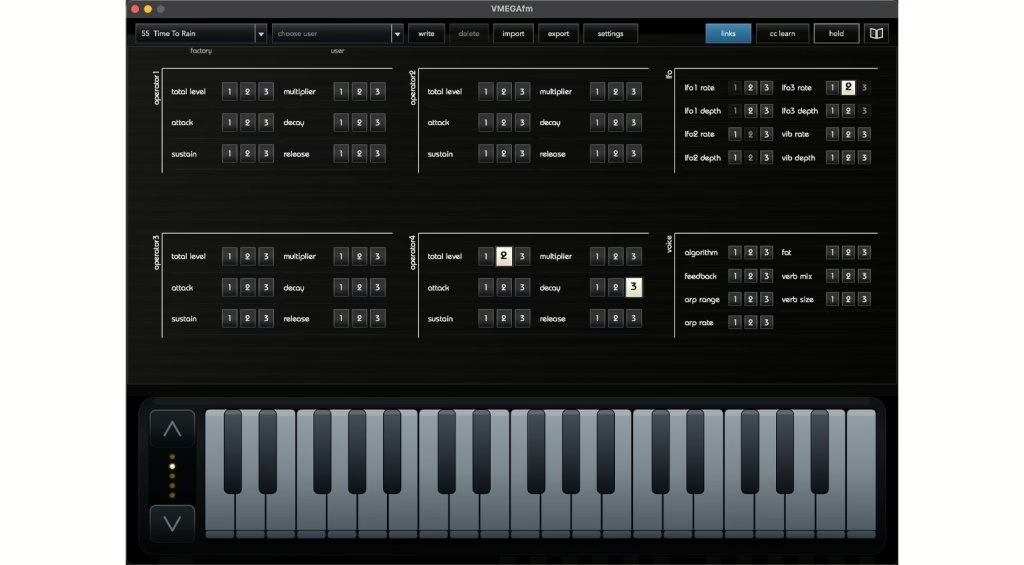
An algorithm in FM has nothing to do with computing: it’s simply the wiring diagram of the operators. Which operators are carriers? Which ones modulate which? An algorithm where all operators are carriers sent in parallel gives an additive, organ-like tone, soft and full. A cascaded algorithm, where one modulator drives another that drives a third, produces biting, harmonically rich, sometimes downright aggressive timbres. FM synths usually offer a list of preset algorithms: scrolling through them is the first thing to do to understand the instrument.
The frequency ratio, the key to timbre
Here’s the most important concept, the one that separates harmonious FM from metallic FM. What matters isn’t a modulator’s absolute frequency, but its ratio to the carrier it modulates. When that ratio is a whole number (1:1, 2:1, 3:1…), the new frequencies land on harmonics of the played note: the sound stays tonal, musical, usable for basses or pads. When the ratio isn’t a whole number (say 1:1.41), the generated frequencies no longer align with a harmonic series: the result becomes inharmonic, and that’s exactly what produces the bells, chimes, metallic percussion and glassy textures characteristic of FM.
Remember this simple rule: whole-number ratio = harmonic and singing, non-whole ratio = inharmonic and metallic. On its own, it explains 80% of what you hear in an FM patch.
Modulation depth and its envelope
The second decisive parameter is modulation depth, often called the modulation index. The stronger the modulator, the more harmonics it generates, so the brighter and more complex the sound. At zero depth, only the carrier’s pure sine remains. As you raise the depth, you progressively add harmonics, up to very rich timbres.
The real secret of living FM sounds is to apply an envelope to the modulation depth, not just to the volume. Take the famous DX7 electric piano: its bright, percussive attack that then softens comes from an envelope that opens the modulation wide at the start of the note and closes it afterwards. It’s the modulation moving over time, not just the volume. Once you master that gesture, you hold the key to FM textures that breathe.
Feedback and small gestures
One last ingredient: feedback, when an operator modulates itself. In small doses it enriches the timbre; pushed hard, it heads toward a sawtooth sound, even toward noise. It’s an excellent way to add grit. Finally, keep in mind that in FM very small changes sometimes produce enormous shifts: a slightly detuned frequency ratio, a depth nudged up one notch, and the timbre flips. Disorienting at first, thrilling later.
FM today
FM has never been more accessible. Software engines finally display operators, envelopes and routings visually, sweeping away the DX7’s mystique. You’ll find it in plugins faithful to the old chips, in modern hardware machines, and often hybridised with subtractive synthesis to marry FM brightness with the roundness of a filter. To place FM against the other families, our article on the East Coast and West Coast schools is a good companion: FM is, in a sense, a third path, born of the digital era. If you want to experiment without spending, our roundup of free virtual synths includes several FM engines, and to see other approaches to sound generation, look at the granular sonicLAB Creation v2 or the semi-modular Pittsburgh Modular Lifeforms SV-2.
Where to start
My hands-on advice: start small. Take two operators, a carrier and a modulator, set a simple whole-number ratio (2:1), slowly raise the depth while listening to the harmonics appear, then assign an envelope to that depth to animate the attack. You’ve just recreated the logic of an FM bass or electric piano. From there, everything is variation: change the ratio to go metallic, add a third operator, dial in a little feedback. FM rewards methodical curiosity far more than chance.