Swiss maker HLabs keeps mining Studer’s legacy. After a preamp inspired by the 169 console, it now revives a compression topology that has become rare: the pulse-width modulation (PWM) gain reduction of the 089 console, brought to the 500 Series. The CL089 is a boutique object, built in small batches, priced around €949, and it targets engineers after a compression colour off the beaten path.
The PWM compression of a 1968 console
A little history helps. Introduced in 1968, the 089 was Studer’s first fully transistorised console, and its compressor/limiter module used an uncommon principle: PWM gain reduction, designed with Swiss broadcasting and classical recording in mind. The house philosophy was high-fidelity, capturing the truth, with controlled, unobtrusive compression, excellent transient handling and preserved highs. Where many compressors of the era could pump or harden, the Studer approach stayed solid and composed. HLabs reproduces that analog PWM circuit as close to the original as possible, with all the character six decades have given it.
Simple controls, real grain
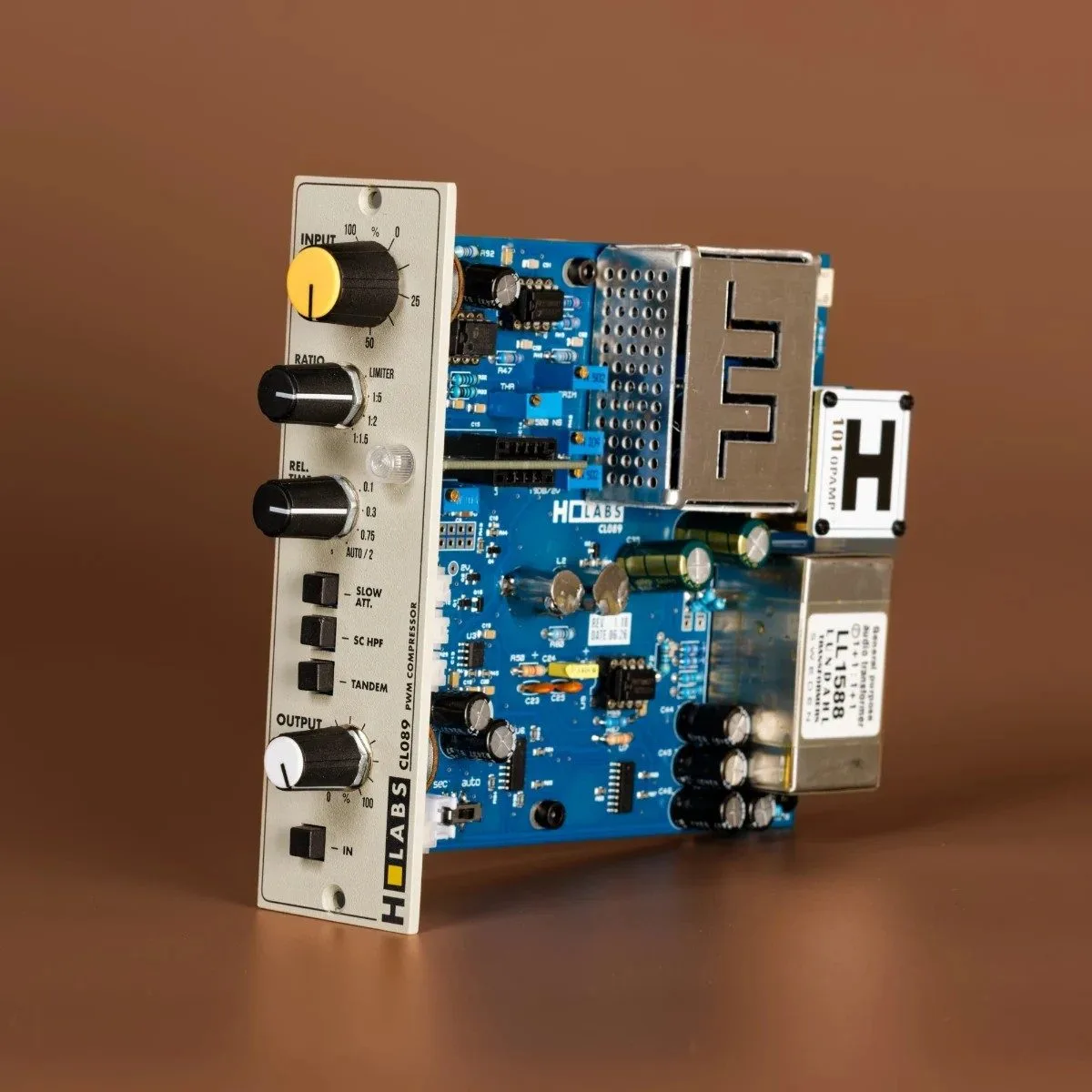
The front panel sticks to the essentials, in the spirit of the original module. You set input gain, a four-position ratio (1:1.5, 1:2, 1:5 and a limiter mode beyond 1:20), and a release time chosen from 0.1, 0.3, 0.75 second or an auto mode. Two modern additions round it out: a slow-attack mode (Slow Att.) and a sidechain high-pass filter, so the lows do not drive all the compression. An old-fashioned bulb indicator shows gain reduction, a detail as charming as it is useful.
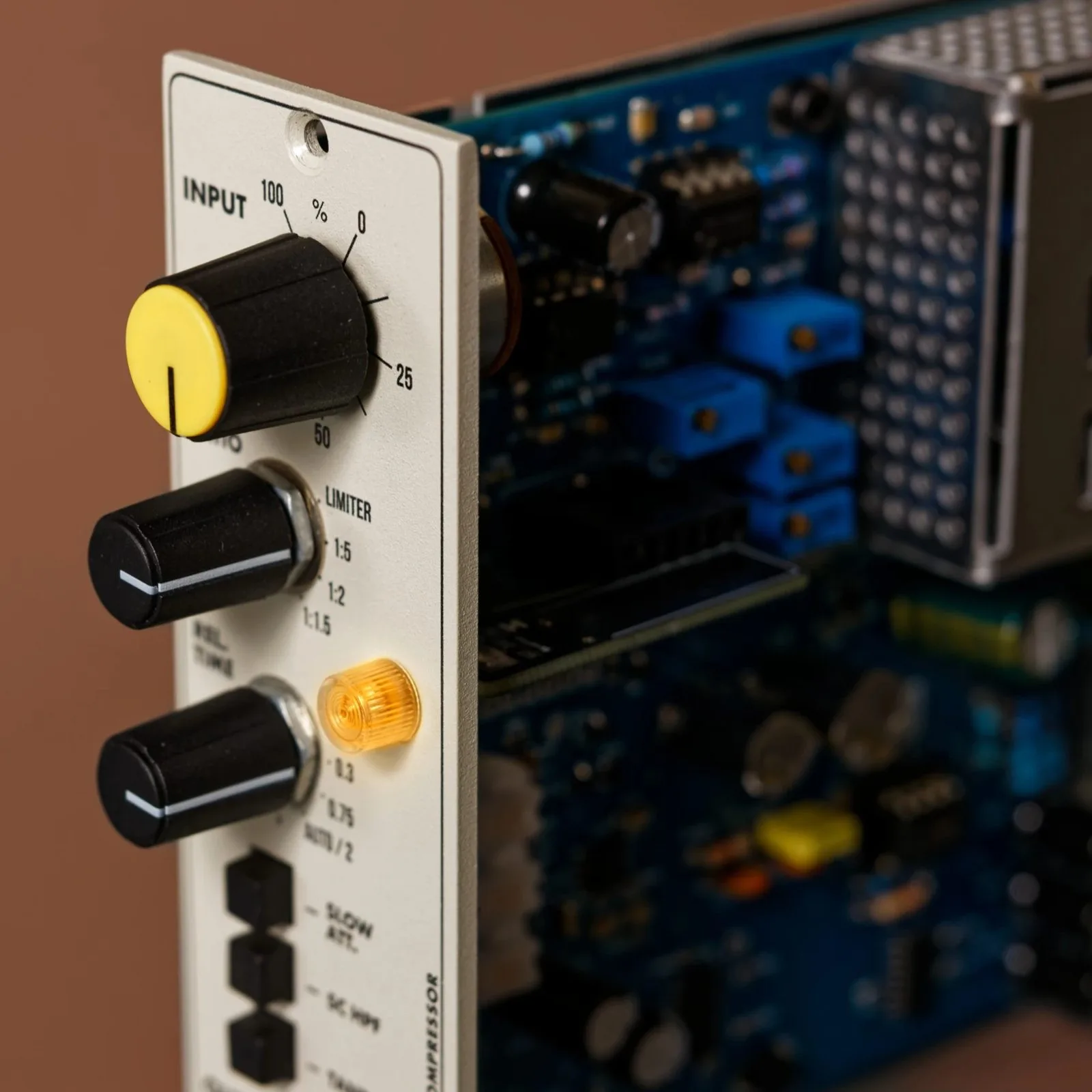
For stereo work, a Tandem link couples two modules for stereo or dual-mono operation. Nothing superfluous: this is a compressor to put on a voice, a bus or a strip, asked for personality rather than a feature list.
A build you can see
Build quality is central to the pitch. The signal path is 99% through-hole, a Lundahl LL1588 output transformer is driven by the in-house H101 op-amp, which is 2520-compatible and socketed, so it can be swapped. That level of detail, like the PWM topology itself, places the CL089 among character tools rather than all-purpose Swiss Army knives. For a studio already full of transparent compressors, that is exactly the point: a colour you do not already have on hand.
My take
PWM compression is still a curiosity, and that is its charm: neither opto, FET nor VCA, a behaviour of its own that respects transients and the top end. HLabs has the good sense not to sand it down, and the build, Lundahl transformer, through-hole parts, socketed op-amp, breathes serious work. At close to €949 a module, this is no impulse buy, and the small run forces a quick decision. The listening test has to confirm what the spec sheet promises, but for anyone who collects compression flavours, this is an address well off the beaten track.
Frequently asked questions
What is PWM compression?
It is a gain-reduction method based on pulse-width modulation, different from the more common opto, FET or VCA topologies. Studer chose it for its 089 console for its transparency and transient handling. HLabs reproduces the original analog circuit.
What controls does the CL089 offer?
Input gain, a four-position ratio (1:1.5, 1:2, 1:5 and a limiter mode beyond 1:20), release times from 0.1 to 0.75 second plus an auto mode, a slow-attack mode, a sidechain high-pass filter, output gain and a bypass.
Can you use it in stereo?
Yes. A Tandem link couples two CL089 units for coherent stereo or dual-mono processing. You therefore need two modules and two 500 Series slots to work in linked stereo.
What is inside?
A signal path that is 99% through-hole, a Lundahl LL1588 output transformer and an in-house H101 op-amp, which is 2520-compatible and socketed, so it can be replaced with another compatible model.
To stay with HLabs and the world of compression, revisit our piece on the HLabs PRE169S preamp inspired by the Studer 169, our look at the SSL Bus Comp Classic, and our explainer on the 1176 compressor.